Key takeaways
- Dispensing rate: how quickly cold water comes out while the system is operating.
- Recovery rate: how quickly the chiller can cool fresh incoming water.
- Storage or ice-bank capacity: how much previously cooled water is available during a demand spike.
Best Under Counter Water Chillers: Top Choices by Kitchen and Office Need
The best under counter water chiller for most kitchens is a compact, fan-cooled unit delivering about 1.5–2.5 litres of cold water per minute, while busy offices usually need a 3–5 litre-per-minute commercial model with a larger ice bank or storage reservoir.
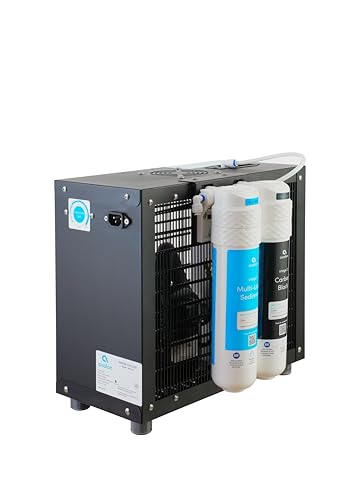
These systems sit inside a cabinet and connect to a dedicated drinking-water tap, often alongside a filtration cartridge. Unlike a countertop dispenser, they keep the worktop clear, but they require careful planning for ventilation, drainage, filter replacement and cabinet space.
Our top picks



As an Amazon Associate we earn from qualifying purchases at no extra cost to you. Ratings are shown as listed on Amazon.
Quick comparison of under counter water chiller types
| Chiller type | Typical cold-water output | Approx. dimensions (W × D × H) | Approx. weight | Typical cold temperature | Best suited to |
|---|---|---|---|---|---|
| Compact compressor chiller | 1.0–2.0 L/min | 150–220 × 400–500 × 350–450 mm | 12–20 kg | 5–12°C | Homes, small kitchens and light office use |
| Standard residential under-sink chiller | 1.5–2.5 L/min | 200–280 × 450–550 × 350–500 mm | 15–25 kg | 4–10°C | Families and offices with up to 20 regular users |
| High-capacity ice-bank chiller | 3.0–5.0 L/min | 250–350 × 500–650 × 400–550 mm | 25–45 kg | 4–10°C | Busy offices, hospitality and frequent consecutive fills |
| Thermoelectric chiller | 0.5–1.5 L/min | 150–250 × 350–500 × 250–400 mm | 5–12 kg | 10–18°C | Low-demand locations where quiet operation matters most |
Actual performance depends on inlet-water temperature, room temperature, mains pressure and the length of the dispensing run. A unit advertised as capable of producing cold water continuously may still deliver warm water temporarily if several large bottles are filled back to back.
Best choices by situation
Best for a normal household: compact compressor chiller with carbon filtration
For a kitchen serving two to six people, a compressor-based unit is usually the best balance of cooling performance, price and cabinet space. Look for roughly 1.5–2.5 L/min dispensing capacity, a cold-water reservoir or ice bank, and a replaceable carbon block filter.
Activated carbon can reduce chlorine taste and odour and may reduce some sediment when the cartridge is appropriately certified. It does not make every water supply safe, remove every contaminant or replace a water-quality assessment. Choose filtration based on the certification and contaminant claims for the specific cartridge, not simply the word “filtered.”
Best for a small office: higher recovery capacity and an easy-to-service filter
A small office needs more than a low purchase price. Ten people filling 750 ml bottles during a morning break can draw 7.5 litres within a short period. A small reservoir may run warm before the compressor has recovered. Choose a unit with at least a 3 L/min delivery rate, a larger ice bank or storage capacity, and a filter that can be changed without removing the whole appliance.
A commercial under counter chiller from a specialist water-dispenser manufacturer such as Zip, Billi, Elkay or Waterlogic may be appropriate, but model specifications vary by market and configuration. Confirm the exact recovery rate, electrical requirements and included filter before buying.
Best for a very quiet kitchen: thermoelectric cooling
Thermoelectric units generally avoid the vibration and compressor noise associated with refrigeration systems. They can suit a study, bedroom-adjacent kitchen or quiet reception area, but their cooling capacity is usually lower. They may deliver cool rather than refrigerator-cold water, particularly in a warm cabinet or after repeated use.
Do not select thermoelectric cooling solely from its decibel figure. Ask whether the quoted noise is measured at one metre, whether the fan operates continuously and how the unit performs at the stated ambient temperature.
Best for heavy demand: commercial ice-bank system
An ice-bank chiller stores cooling capacity in a refrigerated mass of water or ice, allowing it to handle short bursts of high demand better than a small direct-chill unit. This is useful for a workplace, studio, gym reception or hospitality setting.
The trade-off is a larger cabinet, greater weight, higher purchase cost and more demanding installation. These systems may need a dedicated electrical circuit, ventilation clearance and professional commissioning. They are unnecessary for a household that fills only a few glasses at a time.
What to compare before buying
Cooling capacity and temperature performance
Separate three figures that manufacturers sometimes combine:
- Dispensing rate: how quickly cold water comes out while the system is operating.
- Recovery rate: how quickly the chiller can cool fresh incoming water.
- Storage or ice-bank capacity: how much previously cooled water is available during a demand spike.
For a kitchen, water around 5–12°C is normally cold enough for drinking. If you want near-refrigerator temperatures, choose a compressor system and place it away from heat-producing appliances. A cabinet with poor airflow can raise the water temperature and shorten compressor life.
Installation requirements
Most under counter chillers need a cold-water feed, a shut-off valve, flexible tubing, an electrical outlet and enough space around the ventilation grilles. Some models also need a drain connection, particularly if they include chilled, sparkling or ambient-water functions.
Measure the usable cabinet opening rather than the external cabinet size. Allow room for:
- At least 50–100 mm of ventilation clearance where the manual specifies it.
- Filter access and tubing bends behind or beside the appliance.
- A reachable isolation valve for maintenance.
- A drip tray or leak sensor where the cabinet contains flooring or stored goods.
Never trap a compressor chiller tightly against a cabinet wall. Restricted airflow increases energy use and can prevent the unit from reaching its rated temperature.
Noise
Compressor chillers commonly produce an intermittent hum in the approximate 35–50 dB range, while fans may add a noticeable airflow sound. A thermoelectric model can be quieter overall, but its fan may run for longer. For an open-plan office, look for a published operating noise level below about 45 dB and check whether the figure applies to the complete system or only the compressor.
Filtration and replacement cost
Filter cartridges commonly last around six to twelve months in ordinary use, though a high-sediment supply or heavy office traffic may shorten that period. Capacity ratings vary widely; a cartridge rated for 2,000 litres will not necessarily last two years if the manufacturer also specifies a six-month time limit.
Budget for replacement cartridges, sanitising supplies and occasional service. A cheaper chiller with proprietary filters can cost more to own than a better-built unit using readily available cartridges. Check whether the filter incorporates a shut-off valve and whether changing it requires tools.
Decision matrix
| Your situation | Recommended specification | What to avoid |
|---|---|---|
| Limited budget and occasional use | Thermoelectric or compact compressor unit, 1 L/min or more | Paying for sparkling-water hardware you will not use |
| Small cabinet with limited plumbing experience | Compact unit, front-access filter, standard push-fit connections | Models requiring a drain, pump or separate pressure regulator |
| Family kitchen used throughout the day | Compressor cooling, 1.5–2.5 L/min and at least 1.5 litres of cold storage | Small thermoelectric units with low recovery capacity |
| Office with 20 or more regular users | Commercial ice-bank system, 3–5 L/min, serviceable filter housing | Residential units rated only for intermittent dispensing |
| Noise-sensitive room | Quiet thermoelectric unit or compressor below approximately 45 dB | Installing the chiller against a thin cabinet panel or bedroom wall |
Worked sizing example
Suppose an office has 12 users and each fills a 600 ml bottle twice during the workday. That is 14.4 litres daily, but demand is not evenly spread. If half of that volume is drawn during a 30-minute break, the system must supply about 7.2 litres during that period.
A unit dispensing at 2 L/min could theoretically deliver the water in under four minutes, but its reservoir and recovery rate still matter. A commercial model with a 3 L/min delivery rate and a larger ice bank gives more margin, especially if the incoming water is warm. For a two-person home drawing 6 litres over an entire day, the smaller residential class is usually sufficient.
Ownership realities and common mistakes
The filter is normally the first consumable to wear out, but tubing, push-fit seals, ventilation fans and dispensing valves can also develop problems. Hard-water scale may restrict flow or affect temperature sensors. If the chiller has a reservoir, stagnant water can acquire an unpleasant taste when the unit is left unused for long periods.
- Flush a new filter according to its instructions before drinking the water.
- Replace cartridges by time as well as volume when the manufacturer specifies both limits.
- Clean the tap outlet and drip area regularly; these are exposed to hands and splashes.
- Inspect tubing and connections for moisture after installation and after changing a filter.
- Leave the appliance powered long enough to reach operating temperature before judging performance.
- Do not use hot-water connections, unapproved tubing or an extension lead unless the installation instructions explicitly permit them.
For a permanent kitchen or office installation, use a qualified plumber or appliance installer where local regulations require it. The best under counter water chiller is not the one with the lowest advertised temperature; it is the model whose cooling capacity, ventilation, filter cost and service access match the way your space actually uses water.