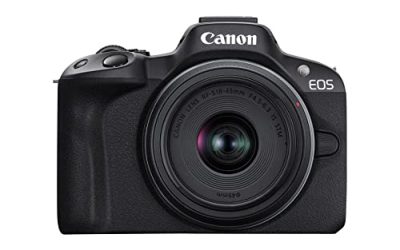
Our Short List of 3

- Best for: Creators who mix stills and 4K video and want manual exposure over both.
- 20.1 Megapixel 1.0-inch stacked CMOS sensor and DIGIC 8 processor
- 4.2x optical zoom lens, 24-100mm f/1.8-2.8, with optical image stabilizer
- Shooting modes: Aperture Priority, Manual, Program, Shutter Priority
- 4K 30p and Full HD 120p video recording

- Best for: Solo video creators who still want genuine PASM control for photographs.
- 20.1 MP 1-inch Exmor RS CMOS sensor with DRAM
- ZEISS Vario-Sonnar T lens, 24-70mm F1.8-2.8
- Shooting modes include Program Auto, Aperture Priority, Shutter Speed Priority and Manual Exposure
- 4K HDR video with HLG and S-Log3/2 picture profiles

- Best for: Street and everyday photographers who want APS-C quality and full manual modes in a true pocket camera.
- 24.24 MP APS-C CMOS sensor, anti-aliasing filter-less design, GR ENGINE 6
- Fixed 26.1mm GR lens (40mm in 35mm format), F2.8
- Shooting modes: Program, Aperture Priority, Shutter Priority, Manual, plus Bulb and Time modes
- 14-bit RAW and JPEG recording
All 3 Picks at a Glance
| Product | Specs | Action |
|---|---|---|
| Canon PowerShot G7 X Mark III |
| Check price on Amazon |
| Sony ZV-1 |
| Check price on Amazon |
| Ricoh GR IIIx |
| Check price on Amazon |
Key takeaways
- Four point-and-shoot cameras whose Amazon listings confirm full PASM manual modes, from Sony's 24-200mm RX100 VII to Ricoh's fixed-lens GR IIIx.
The decision that actually matters here is not megapixels or zoom. It is whether the camera hands you the exposure itself: a Program mode for when you want help, Aperture and Shutter priority for when you want one variable, and a full Manual mode for when you want both. Plenty of compacts advertise a manual mode that turns out to mean manual focus only, so every camera below earned its place because its Amazon listing prints all four PASM modes in the shooting modes field.
This shortlist is written for three kinds of buyers: travelers who want one pocketable camera they can still boss around, creators who split their shooting between stills and 4K video, and street photographers who would rather have a fixed lens and honest dials than a zoom. Each pick was chosen from the shooting modes, sensor and lens details published on its Amazon product page, and the four separate cleanly along sensor size, zoom range and how seriously they take video.
Quick Picks
As an Amazon Associate we earn from qualifying purchases
Four cameras, four different answers to the same question: how much control can you carry in a pocket?
| Product | Best for | Key spec from title |
|---|---|---|
| Sony RX100 VII | Pocketable telephoto reach with full manual exposure | 1.0-type stacked CMOS sensor, 24-200mm zoom lens |
| Canon PowerShot G7 X Mark III | Stills and 4K video from one bright-lens compact | 24-100mm f/1.8-2.8 lens, 4K 30p video |
| Sony ZV-1 | Video-first shooting with PASM stills control | 24-70mm F1.8-2.8 ZEISS lens, flip screen |
| Ricoh GR IIIx | Street photography with an APS-C sensor | 24MP APS-C sensor, 40mm F2.8 fixed lens |
How to Choose
Confirm the listing really promises all four PASM modes
Start with the shooting modes field on the product page, not the headline. A camera earns the manual label here only when that field names Program, Aperture priority, Shutter priority and Manual exposure side by side. Some well-known compacts fail this test on their own listings: the Sony ZV-1 II page, for example, summarises its modes as “Easy” with automatic exposure control, even though the camera is capable of more. If the listing will not say PASM out loud, treat the camera as an automatic with extras and keep looking.
Let sensor size set your low-light ceiling
Manual control pays off most after dark, and sensor size decides how far you can push it. The three 1-inch cameras here gather far more light than a phone or a small-sensor superzoom, so raising ISO in Manual mode stays usable instead of turning gritty. The Ricoh GR IIIx goes a step further with an APS-C sensor, the same format as many interchangeable-lens cameras, which is why it can offer sensitivity up to ISO 102400. If your manual shooting happens at concerts, restaurants or night markets, sensor size matters more than any mode dial.
Weigh zoom range against lens speed honestly
Every zoom here trades something. The RX100 VII reaches 200mm, which is genuine telephoto from a jacket pocket, but its widest aperture is f/2.8 and it narrows as you zoom. The Canon and the ZV-1 stop at 100mm and 70mm yet hold f/1.8 at the wide end, gathering more light for indoor work. The GR IIIx refuses the trade entirely with a fixed 40mm f/2.8 lens. Decide which scenes you actually shoot: distant subjects reward reach, while dim interiors reward aperture, and no compact on this list gives you the maximum of both.
Check how the controls feel before the specs seduce you
Manual modes are only useful if changing settings is quick. Look for a lens control ring you can assign to aperture, a rear dial for shutter speed, and a screen that tilts or flips for low and high angles. The RX100 VII adds a pop-up electronic viewfinder for bright sun, while the Canon and ZV-1 rely on their rear screens alone. Touch focus helps on all four, but physical controls decide whether Manual mode becomes a habit or a menu you visit twice and abandon.
The 4 Best Options
Sony RX100 VII
If your idea of a travel camera is one that disappears into a coat pocket yet still frames a lighthouse, a stage or a shy bird, this is the pick. The 24-200mm zoom is the longest reach in this group, and the listing confirms the full spread of Program auto, Aperture priority, Shutter speed priority and Manual exposure to go with it. A stacked sensor, blackout-free shooting at up to 20 frames per second and a pop-up viewfinder make it the most complete all-rounder here, equally happy in Shutter priority at a school sports day or full Manual on a tripod at dusk.
Specs
- 20.1 MP 1.0-type stacked CMOS sensor
- ZEISS zoom lens, 24-200mm in 35mm equivalent terms
- Shooting modes include Program auto, Aperture priority, Shutter speed priority and Manual exposure
- Continuous shooting up to 20 fps, single burst up to 90 fps
- 4K UHD 2160p video, microphone jack for external audio
- Pop-up electronic viewfinder and 3-inch tilting touchscreen
- JPEG and RAW file formats
- Wi-Fi and Bluetooth connectivity
Best for: Travelers who want real telephoto reach and full manual control in one pocketable body.
Watch out for: Confirm you are buying the camera-only configuration (model DSCRX100M7/B); the Shooting Grip Kit is a separate listing with a different ASIN.
ASIN: B07VPQV7BY
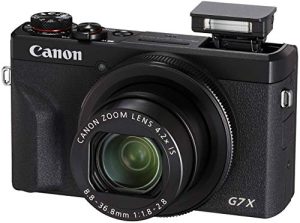
Canon PowerShot G7 X Mark III
- Best for: Creators who mix stills and 4K video and want manual exposure over both.
- 20.1 Megapixel 1.0-inch stacked CMOS sensor and DIGIC 8 processor
- 4.2x optical zoom lens, 24-100mm f/1.8-2.8, with optical image stabilizer
- Shooting modes: Aperture Priority, Manual, Program, Shutter Priority
- 4K 30p and Full HD 120p video recording
Creators who mix stills and 4K video and want manual exposure over both.
There is no electronic viewfinder, so composing in harsh sunlight means relying on the rear screen alone.
Canon built this one for people who shoot photographs and video in the same outing and want manual say over both. Its listing states the shooting modes plainly: Aperture Priority, Manual, Program and Shutter Priority. The f/1.8-2.8 lens is the brightest zoom here at the wide end, which suits indoor stills and evening street scenes, while 4K 30p recording, an external microphone terminal and clean HDMI output cover the video side. Bursts run up to 20 frames per second, and the tilting touchscreen flips up for self-framing. Choose it when one camera has to serve a photo walk and a filmed update on the same day.
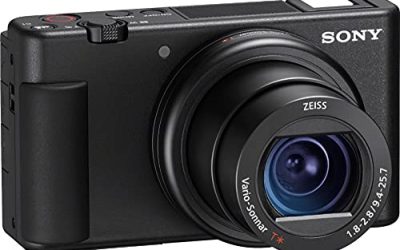
Sony ZV-1
- Best for: Solo video creators who still want genuine PASM control for photographs.
- 20.1 MP 1-inch Exmor RS CMOS sensor with DRAM
- ZEISS Vario-Sonnar T lens, 24-70mm F1.8-2.8
- Shooting modes include Program Auto, Aperture Priority, Shutter Speed Priority and Manual Exposure
- 4K HDR video with HLG and S-Log3/2 picture profiles
Solo video creators who still want genuine PASM control for photographs.
There is no viewfinder and no built-in flash, and the 24-70mm range is the shortest zoom here, so distant subjects stay distant.
The ZV-1 starts from video and works backwards to stills, which makes it the natural choice when filming yourself is the main job. Its flip-out screen faces the front, the built-in directional microphone ships with a wind screen, and features like Product Showcase focus exist purely for people who present objects to a camera. None of that costs you manual control: the listing’s shooting modes run through Program Auto, Aperture Priority, Shutter Speed Priority and Manual Exposure, backed by a bright 24-70mm F1.8-2.8 ZEISS lens and picture profiles including S-Log3 for anyone who grades footage afterwards.
Ricoh GR IIIx
- Best for: Street and everyday photographers who want APS-C quality and full manual modes in a true pocket camera.
- 24.24 MP APS-C CMOS sensor, anti-aliasing filter-less design, GR ENGINE 6
- Fixed 26.1mm GR lens (40mm in 35mm format), F2.8
- Shooting modes: Program, Aperture Priority, Shutter Priority, Manual, plus Bulb and Time modes
- 14-bit RAW and JPEG recording
Street and everyday photographers who want APS-C quality and full manual modes in a true pocket camera.
The lens does not zoom at all, and video tops out at Full HD, so frame with your feet and look elsewhere for 4K.
Street photographers who find zooms distracting will feel at home here. The GR IIIx fixes its lens at 40mm in 35mm terms and puts the saved space into an APS-C sensor, the largest in this group by a wide margin. Its listing spells out Bulb Mode, Time Mode, Aperture Priority, Manual, Program and Shutter Priority, so long-exposure and fully manual work are both covered. A built-in neutral density filter, sensor-shift shake reduction and a snap-friendly startup of about 0.8 seconds suit a camera that lives in a pocket and wakes up ready. Video stops at Full HD, which tells you exactly where Ricoh spent the budget: on stills.
Which One Fits Your Situation
Your one camera for a three-week trip
Take the Sony RX100 VII. The 24-200mm lens covers wide street scenes and distant details without a second body, the pop-up viewfinder rescues composition on glare-heavy days, and Shutter priority keeps moving subjects honest while you learn the camera. It is the only model here that never forces a compromise between reach, control and size, which is exactly what a long trip demands from a single pocket.
You publish photos and videos every week
The Canon PowerShot G7 X Mark III fits a mixed workflow best. Manual and priority modes cover your stills, the bright f/1.8 wide end handles indoor shots, and 4K recording with a microphone terminal and clean HDMI output handles filming and streaming from the same body. If your output is mostly video with photographs as a sideline, swap to the ZV-1 and its front-facing screen instead.
You film yourself talking, products in hand
Choose the Sony ZV-1. The side flip-out screen lets you check framing while you present, Product Showcase shifts focus from your face to whatever you hold up, and the bundled wind screen keeps outdoor audio usable. When you want the exposure locked instead of drifting, Manual Exposure mode is right there in the listing’s mode list, and Aperture Priority keeps backgrounds soft for stills between takes.
You shoot streets daily and hate carrying a bag
The Ricoh GR IIIx was designed for your pocket and your habits. Its fixed 40mm lens removes zoom dithering, the APS-C sensor keeps high-ISO frames clean in Manual mode, and the built-in ND filter lets you drag the shutter on bright days without accessories. It starts in about 0.8 seconds, so the photograph you spotted across the street is still there when the camera wakes.
Common Mistakes
- Trusting a headline that says “manual mode” without opening the spec table; on some compacts that phrase means manual focus only, with exposure still fully automatic.
- Choosing a small-sensor superzoom for evening shooting, then discovering that Manual mode cannot fix a noisy 1/2.3-inch sensor once the light drops.
- Forgetting that a zoom’s aperture narrows toward the telephoto end, so the f/1.8 or f/2.8 figure that sold the camera only applies at its widest setting.
- Buying a bundle or Renewed listing by accident; grip kits, international models and refurbished units carry different ASINs from the standard camera-only listing.
- Leaving RAW switched off, which throws away the editing headroom that makes deliberate manual exposure worth learning in the first place.
Frequently Asked Questions
What does PASM actually give me that automatic mode does not?
PASM stands for Program, Aperture priority, Shutter priority and Manual. Together they let you decide how much of the exposure you control: aperture for depth of field, shutter speed for motion, or both at once in Manual. Automatic mode makes every one of those calls for you, which is fast but unpredictable when light gets tricky.
Can these cameras shoot RAW while in manual mode?
Yes. All four listings include RAW alongside JPEG in their supported formats, and RAW stays available in the priority and Manual modes. Shooting RAW in Manual is the combination most enthusiasts settle on, because the exposure decisions are yours and the file keeps maximum room for brightening shadows or recovering highlights later.
Is a fixed-lens camera like the Ricoh GR IIIx too limiting?
It is limiting in one specific way: you cannot zoom, so framing means moving closer or cropping afterwards. In exchange you get the largest sensor in this group, a small and discreet body, and a lens designed for one job. Photographers who mostly shoot at one focal length rarely miss the zoom; those who photograph wildlife or stage events will.
Which of these cameras has a viewfinder for sunny days?
Only the Sony RX100 VII. Its electronic viewfinder pops up from the body when screen glare makes the LCD hard to read, then sinks back down for pocketing. The Canon, the ZV-1 and the Ricoh all compose on their rear screens, which are bright and touch-sensitive but still worth checking against the kind of midday light you shoot in.
More from Amazon
Programs that pair well with the guide above. Offers and eligibility are set by Amazon and may change.
Free shipping on eligible items, Prime Video and more. Eligible new members can start with a free trial.
Start a Prime free trialAudiobooks and podcasts to listen to on the go. Eligible new members can start with a free trial.
Try Audible freeAd-free music streaming. Eligible new subscribers can start with a free trial.
Try Music Unlimited freeA free business account with business pricing and bulk-buying tools for work, shop or home office.
Create a business accountAs an Amazon Associate we earn from qualifying purchases.