Our Top Picks
As an Amazon Associate we earn from qualifying purchases.
A bike safety camera has a different job from a camera bought to make ride videos look beautiful. Its job is evidence and deterrence: it should switch on with the ride, record continuously without you managing files, survive rain and road vibration, and capture enough detail — a number plate, a close pass, a door opening — that the footage still means something after the moment has passed. A camera that needs charging every hour, fills its card and stops, or blurs every plate at dusk fails that job no matter how cinematic its highlights look.

This guide covers bicycle cameras only: dedicated loop-recording safety cameras that mount at the seatpost or handlebar, and mainstream action cameras configured specifically for street cycling on a bicycle mount. There are no car dashcams here and no car mounts, because a windscreen camera solves a different problem in a different vehicle. Every pick below was judged on the same locked criteria: loop recording that overwrites old footage, number-plate readability, battery life, weather resistance, and a secure handlebar or seatpost mount.
Disclosure: This article contains affiliate links. If you buy through a link on this page, we may earn a commission at no extra cost to you.
Quick Picks
Our Short List of 3
- Best for: Commuters and road riders who want one device, mounted once, that watches their back on every ride without any file management.
- Best for: Riders who want the sharpest possible front footage, already own GoPro mounts, or want one camera that covers both the commute and weekend riding.

- Best for: Year-round commuters, riders with long routes, and anyone whose safety footage is most likely to be needed at dawn, dusk or in the rain.
All 3 Picks at a Glance
| Product | Specs | Action |
|---|---|---|
| 1. Cycliq Fly6 CE — Best Dedicated Rear Safety Camera |
| Check price on Amazon |
| 2. GoPro HERO13 Black — Best Front Camera for Sharp Evidence Footage |
| Check price on Amazon |
| 3. DJI Osmo Action 5 Pro — Best for Long Rides and Dark Commutes |
| Check price on Amazon |
The short version: most close passes, tailgating and harassment come from behind, so a dedicated rear camera such as the Fly6 CE is the single most useful safety purchase. Add a front action camera when junctions, oncoming traffic and your own forward view also need a record.
What Makes a Camera a Safety Camera?
Loop recording is non-negotiable
A safety camera must never stop recording because its card filled up on a previous ride. Loop recording solves this by writing footage in short segments and overwriting the oldest unlocked segment once the card is full. Dedicated bike cameras such as the Cycliq do this automatically and cannot really be used any other way. General action cameras need more discipline: choose sensible segment and resolution settings, format the card on a routine, and check before a ride that the camera is actually recording rather than sitting on a full card or a menu screen.
Incident protection matters alongside the loop. The footage that counts is exactly the footage most at risk of being overwritten on the ride home, so learn how your camera locks a clip — a button press, an app command, or automatic detection — and use it after anything serious, then copy that file off the card the same day.
Plate readability beats headline resolution
A number plate is a small, fast-moving, often dirty target, usually read at an angle and frequently at dusk. Resolution helps, but so do frame rate, stabilisation, lens angle and exposure. A very wide lens spreads its pixels across more of the scene, which makes a plate smaller in the frame; a narrower view concentrates detail but misses action at the edges. In practice, the winning combination for evidence is a moderately wide lens, strong electronic stabilisation to keep frames sharp rather than smeared, and a resolution high enough that a paused frame still shows characters. Judge sample footage by pausing it on a passing car, not by how good a sunny landscape looks in motion.
Battery life must cover the whole ride, twice over
Manufacturers quote battery life under friendly conditions, and a safety camera that dies on the last hill home has failed at the worst possible time. Look for a claim that comfortably exceeds your longest regular ride, assume cold weather and a bright light mode will eat into it, and prefer cameras with removable batteries if you ride all day — a spare in a pocket restores a front action camera instantly, while a sealed rear unit needs a charging routine at home.
Weather resistance and the mount are safety parts, not accessories
A bicycle camera lives in spray from the road, direct rain and constant vibration. A stated waterproof or weather-resistant rating matters more here than in almost any other camera category, and so does the mount. Use the manufacturer’s seatpost or handlebar mount, add a safety tether where one is supplied, and check the clamp after the first few rides. A camera that rotates downward on cobbles records tarmac; a camera that leaves its mount in a crash records nothing at all.
1. Cycliq Fly6 CE — Best Dedicated Rear Safety Camera
- Best for: Commuters and road riders who want one device, mounted once, that watches their back on every ride without any file management.
Commuters and road riders who want one device, mounted once, that watches their back on every ride without any file management.
View the Cycliq Fly6 CE on Amazon
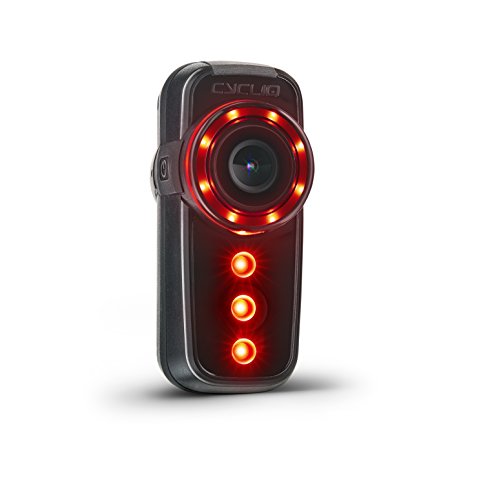
The Fly6 CE is the clearest expression of what a bicycle safety camera should be: a rear-facing camera built into a tail light, mounted at the seatpost, that records the traffic approaching from behind — which is where most of the danger a commuter actually faces comes from. The Amazon listing describes the Fly6 CE at just 110 grams, and the camera records in 1080p HD through a 135-degree wide-angle lens, a field of view wide enough to cover the lane behind you and the shoulder beside it without stretching plates at the edges beyond recognition.
Its defining feature is the recording behaviour. The Fly6 CE records on a continuous loop, overwriting old footage as the card fills, so the camera is designed to be switched on and forgotten rather than managed like a content camera. Battery life is quoted at up to seven hours, which covers a week of ordinary commuting for many riders or a full day ride, and because the unit is also your rear light, it earns its place on the bike twice: drivers see the light, and the camera sees the drivers.
The honest limitations follow from the format. Rear footage tells the story of a close pass brilliantly but says nothing about a junction conflict ahead of you, so serious commuters often pair a unit like this with a front camera later. A 1080p sensor also has less cropping headroom than the 4K and 5.3K action cameras below, so plate reads depend more on distance and light. And as a sealed light-and-camera unit, when the battery is done, the ride’s recording is done — there is no pocket spare to swap in.
Key specs: Rear-facing 1080p HD camera; 135-degree wide-angle lens; integrated tail light; continuous loop recording; up to 7 hours of battery life; 110 g; seatpost mounting.
2. GoPro HERO13 Black — Best Front Camera for Sharp Evidence Footage
- Best for: Riders who want the sharpest possible front footage, already own GoPro mounts, or want one camera that covers both the commute and weekend riding.
Riders who want the sharpest possible front footage, already own GoPro mounts, or want one camera that covers both the commute and weekend riding.
View the GoPro HERO13 Black on Amazon
Mounted on a handlebar bicycle mount and aimed slightly downward at the road ahead, the HERO13 Black is the strongest front-facing evidence camera in this guide. It records up to 5.3K at 60 frames per second, and that resolution is not vanity in this role: a paused 5.3K frame holds far more plate and signage detail than a 1080p frame, and the high frame rate keeps individual frames cleaner when a car passes quickly in the opposite lane. GoPro’s HyperSmooth stabilisation deals with the buzz and judder that handlebar mounting feeds into any camera, which matters because a stabilised frame is a readable frame.
Endurance is the trade-off to plan around. The 1,900 mAh Enduro battery is rated by GoPro for more than two and a half hours at 1080p30 and over an hour and a half at 5.3K30 and 4K30, so the sensible safety configuration is a moderate resolution for ordinary commuting — where the battery lasts and plates at city distances still read — with the highest modes reserved for shorter, higher-risk rides. The battery is removable, so a spare extends coverage on long days. The camera is waterproof to 10 metres without a housing, comfortably beyond anything road spray and rain will do to it.
Two disciplines separate a GoPro used as a safety camera from a GoPro used as a toy. First, card management is on you: set the camera up so it keeps recording through a whole ride, and clear or format the card on a routine before it can fill at a bad moment. Second, buy the mount properly. GoPro’s accessory ecosystem is the deepest here, including bicycle handlebar mounts from GoPro and many third parties, and that depth is a genuine safety advantage — a rigid, correctly sized clamp with a tether beats an improvised bracket every time.
Key specs: Up to 5.3K at 60 fps; HyperSmooth stabilisation; 1,900 mAh removable Enduro battery; rated over 2.5 hours at 1080p30; waterproof to 10 metres; extensive handlebar mount ecosystem.
3. DJI Osmo Action 5 Pro — Best for Long Rides and Dark Commutes
- Best for: Year-round commuters, riders with long routes, and anyone whose safety footage is most likely to be needed at dawn, dusk or in the rain.
Year-round commuters, riders with long routes, and anyone whose safety footage is most likely to be needed at dawn, dusk or in the rain.
View the DJI Osmo Action 5 Pro on Amazon
The Osmo Action 5 Pro makes its safety case on endurance and low light, the two things winter commuting punishes most. DJI rates its 1,950 mAh battery for up to four hours of recording in laboratory conditions at modest settings; real 4K riding will return less, but even discounted, it is the strongest endurance claim among the front cameras here, and the battery is removable for swaps. The camera records up to 4K at 120 frames per second from a 1/1.3-inch sensor — a large sensor by action camera standards, and sensor size is what keeps dusk footage clean enough for a plate to survive the noise.
Stabilisation is DJI’s RockSteady 3.0+, with HorizonSteady available in supported modes, and the magnetic quick-release mounting system makes moving the camera between a handlebar mount, a chest mount and a tripod quick — useful if the same camera commutes on weekdays and films at weekends. Weather sealing is the best in this guide: the camera is waterproof to 20 metres without a case, so rain, spray and slush are simply not a consideration. Dual OLED touchscreens front and rear also help at setup time, letting you confirm framing and that recording has started while the camera is already on the bars.
As with the GoPro, this is an action camera doing safety duty, so the loop discipline is yours to maintain: pick a resolution your card and battery can sustain for the full ride, verify recording before you roll, and lock and save any clip that matters as soon as you get home. Configured that way, its combination of run time, low-light sensor and sealing makes it the most forgiving front camera here for riders whose commute happens in the dark at both ends.
Key specs: Up to 4K at 120 fps; 1/1.3-inch sensor; RockSteady 3.0+ stabilisation; 1,950 mAh removable battery rated up to 4 hours in laboratory conditions; waterproof to 20 metres without a case; dual OLED touchscreens; magnetic quick-release mounting.
Front, Rear, or Both?
Think about where your risk actually comes from. On most urban and rural roads, the incidents riders most want on record — close passes, tailgating, punishment passes, a vehicle pulling out behind a queue — happen behind or beside the rider, which is why a rear unit like the Fly6 CE is the recommended first purchase. Front footage earns its keep at junctions, roundabouts and anywhere oncoming or crossing traffic is the threat, and a front camera also records your own line and speed, which can matter when a story is disputed.
Budget for one camera first, mounted in the direction of your worst regular risk, and add the second direction later if the riding justifies it. Two cameras double the charging and card routine, so a setup you actually maintain beats a complete setup that sits in a drawer with flat batteries.
Setting Up a Bike Camera So the Footage Counts
Aim the camera at the horizon line of the road, not at the sky or your front wheel, and check the framing on a short test ride before trusting it. Clean the lens more often than feels reasonable — road film builds up fast in wet weather and quietly destroys plate readability. Use the largest good-quality microSD card the camera supports, because a bigger card means the loop keeps more of your recent riding before overwriting. After any incident, stop the loop from eating the evidence: lock the clip if the camera supports it, and copy the file to a phone or computer the same day, keeping the original file untouched. Finally, know your local rules: recording on public roads is broadly accepted in many places, but audio recording and sharing footage publicly can be treated differently, so check before you publish rather than after.
Frequently Asked Questions
Is a rear bike camera more important than a front one?
For most riders, yes. The majority of frightening and disputed incidents involve vehicles approaching from behind, and a rear camera with an integrated light, such as the Fly6 CE, also makes you more visible while it records. Riders whose main risk is junction traffic should weight the front more heavily.
Can an action camera replace a dedicated bike safety camera?
Partly. Action cameras such as the HERO13 Black and Osmo Action 5 Pro record sharper footage and handle weather well, but they demand more from you: shorter battery life per charge, manual card management, and a deliberate start-recording habit. A dedicated loop-recording camera wins on set-and-forget behaviour; an action camera wins on image quality and versatility.
What resolution do I need to read a number plate?
1080p can read plates at close range in good light, which covers many rear close passes. Higher resolutions such as 4K and 5.3K extend the distance and the poor-light conditions at which a paused frame stays legible, which is why the front cameras here record well beyond 1080p. Stabilisation and a clean lens matter as much as the headline number.
How long should a bike safety camera record for?
Longer than your longest regular ride, with margin. The Fly6 CE quotes up to seven hours, which suits all-day riding. Front action cameras quote between roughly an hour and a half and four hours depending on settings and conditions, so commuters should favour moderate resolutions and carry a spare battery on long routes.
Where is the best place to mount a bike camera?
Rear cameras belong at the seatpost, centred and level, clear of saddlebags. Front cameras belong on a rigid handlebar mount, centred where possible, with a tether as backup. Helmet mounting is legal in some places and not others, changes how footage moves, and is best treated as a supplement rather than the main evidence position.
Verdict
The best bike camera for safety is the one that is charged, mounted and looping on the ride where something happens. Start with the Cycliq Fly6 CE if you can only buy one camera: its automatic loop recording, integrated tail light and seven-hour battery claim make rear coverage genuinely effortless. Choose the GoPro HERO13 Black when front footage quality is the priority and you will manage cards and batteries actively, or the DJI Osmo Action 5 Pro when your riding is long, dark and wet and endurance matters most. Mount it properly, keep the lens clean, and save the clip the same day — the routine is the safety feature as much as the camera is.
More from Amazon
Programs that pair well with the guide above. Offers and eligibility are set by Amazon and may change.
Free shipping on eligible items, Prime Video and more. Eligible new members can start with a free trial.
Start a Prime free trialAudiobooks and podcasts to listen to on the go. Eligible new members can start with a free trial.
Try Audible freeAd-free music streaming. Eligible new subscribers can start with a free trial.
Try Music Unlimited freeA free business account with business pricing and bulk-buying tools for work, shop or home office.
Create a business accountAs an Amazon Associate we earn from qualifying purchases.