Key takeaways
- Our guide to the best fusion backup camera for rv drivers: two wireless camera kits compared by range, monitor, night vision and install for RVs and trailers.
Reversing an RV blind is the most stressful part of any trip: the rear window shows nothing, the mirrors miss the low corners, and a campsite post can cost a fortune. A wireless backup camera fixes that by putting a live rear view on the dashboard, with no video cable to run through a 30-foot vehicle. The keyword for this guide reads “fusion”, and this guide treats it as a wireless backup camera system for RVs, covering the two kits below.

This guide is for RV owners, trailer towers and motorhome drivers who want a camera that installs without drilling and a monitor they can read at a glance. Both kits below were chosen from the names and specifications on their Amazon pages, with attention to wireless range, monitor size, night vision and how the camera gets its power. The comparison below covers range, monitor size, night vision and power, so you can pick the kit that suits your rig.
Quick Picks
As an Amazon Associate we earn from qualifying purchases
| Product | Best for | Key spec from title |
|---|---|---|
| LeeKooLuu LK2 Wireless Backup Camera | Quick install on cars, RVs and trailers in minutes with no wiring at all | 1080P HD picture |
| AUTO-VOX Solar 5-Inch Wireless Backup Camera | Low-maintenance daily driving with solar charging built in for you every day | Solar-assisted battery |
How to Choose
Match the wireless range to your vehicle length
The first number to check on an RV camera is how far the wireless signal reaches, since an RV is far longer than a car. A kit rated for a 26-foot vehicle range covers most motorhomes and trailers, while a kit rated for 52 feet holds a steady picture on longer rigs. Check the range figure on the listing, and remember that walls, metal and other electronics can shorten the real range. A camera that drops the picture halfway down the RV is worse than no camera at all. Walls, metal and other electronics can shorten the real range, so allow a margin above your vehicle length.
Choose a monitor you can read quickly
The monitor sits on the dashboard, and you must read it without taking your eyes off the road for long. A 5-inch monitor suits most RV dashboards, showing a clear picture without blocking the windscreen, while a larger screen helps older drivers but takes more dash space. Check whether the monitor plugs into a cigarette lighter or a USB port, and whether it mounts on the dash or the windscreen. A monitor that wobbles on rough roads is a distraction, not a help. A screen that stays clear from an angle helps when the monitor sits low on the dashboard.
Check night vision and the viewing angle
Most reversing accidents happen at dusk or in a dark campsite, so night vision matters as much as daylight picture quality. Look for starlight night vision or infrared LEDs on the listing, and check the viewing angle: a 150-degree lens shows the corners of the RV and the ground behind it, while a narrow lens misses the low obstacles that cause the most damage. A wide lens with good night vision is worth more than extra resolution. Check the lens angle on the listing, and favour a camera that shows the ground directly behind the RV as well as the horizon.
Decide how the camera gets power and mounts
An RV camera should install without drilling holes in the vehicle, so the power and mount decide the job. A camera that draws power from the reversing light circuit switches on automatically when you reverse, while a solar-assisted battery camera charges itself and needs no wiring at all. Check whether the mount is magnetic, screwed or strapped, and confirm it fits the rear of your RV. A magnetic mount moves between vehicles, which suits owners with a truck and a trailer. A screwed mount suits one vehicle kept for years, while a magnetic mount suits an owner who moves the camera between rigs.
The 2 Best Options
LeeKooLuu LK2 Wireless Backup Camera
The LeeKooLuu LK2 suits an RV or SUV driver who wants a simple plug-and-play wireless kit. It uses a 2.4GHz digital wireless signal to send a 1080P HD picture to a 5-inch monitor, with a 150-degree wide-angle lens and night vision for a clear view in daylight and after dark. The camera draws power from the reversing light circuit and the monitor plugs into a cigarette lighter or USB port, so the install takes about 15 minutes with no video cable to run through the cabin. The signal reaches up to 100 metres in open space and covers a 26-foot vehicle range.
Specs
- Resolution: 1080P HD
- Monitor: 5-inch monitor
- Viewing angle: 150 degrees
- Wireless: 2.4GHz digital signal
- Range: up to 100 metres open space, 26-foot vehicle range
- Night vision: starlight night vision
- Install time: about 15 minutes
- Power: camera from reversing light, monitor from cigarette lighter or USB
- 150-degree lens shows the corners of the RV
- 5-inch monitor easy to read at a glance
- Starlight night vision shows the ground after dark
- Camera powers from the reversing light automatically
- Monitor plugs into a lighter socket or USB
- 15-minute install with no video cable
Best for: RV and SUV drivers who want a quick plug-and-play wireless install and a wide night view.
Watch out for: The camera needs a connection to the reversing light for power, so check your light wiring is accessible on the RV.
AUTO-VOX Solar 5-Inch Wireless Backup Camera
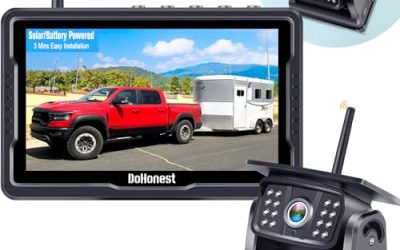
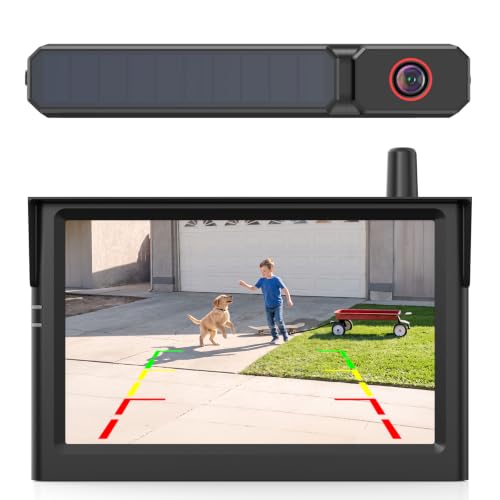
The AUTO-VOX solar 5-inch kit suits a driver who wants a balanced everyday system with solar-assisted charging. Its 5-inch monitor shows a 1080P rear view, and the 52-foot wireless range holds a steady picture on cars, SUVs, vans and shorter RVs. Six adjustable parking lines help you judge distance while reversing, and split-screen support lets you add a second camera for a wider view later. The solar-assisted battery reduces how often you need to charge the camera, which makes it a low-maintenance choice for daily driving, and the compact monitor fits neatly on most dashboards.
Specs
- Resolution: 1080P HD
- Monitor: 5-inch screen
- Wireless range: 52 feet
- Parking lines: 6 adjustable parking lines
- Battery: solar-assisted battery
- Display: split-screen support for a second camera
- Use: cars, SUVs and vans
- Low-maintenance choice for daily driving
- Six parking lines help judge distance while reversing
- Solar battery tops up in daylight while you drive
- Add a second camera later for a wider view
Best for: Drivers who want a balanced 5-inch wireless system with solar charging and room to add a second camera.
Watch out for: Solar charging depends on daylight, so top the battery up by USB if the RV sits in a garage or under cover for days.
Which One Fits Your Situation
You want the fastest install on an RV or SUV
Pick the LeeKooLuu LK2. It installs in about 15 minutes with no video cable to run, the camera powers from the reversing light, and the monitor plugs into a lighter socket or USB port. The 150-degree lens and starlight night vision cover the corners and the dark campsite alike. The reversing-light power also means the camera switches on automatically whenever you reverse.
You want a low-maintenance camera for daily driving
Pick the AUTO-VOX Solar kit. Its solar-assisted battery means fewer charges, the 52-foot range holds a steady picture, and the six adjustable parking lines help you judge distance. Split-screen support lets you add a second camera later for a wider rear view. The solar-assisted battery also means fewer charges, which suits a driver who uses the camera every day.
You reverse a longer RV or a trailer
Pick the AUTO-VOX Solar kit for its 52-foot wireless range, which covers longer rigs than the LeeKooLuu’s 26-foot vehicle range. Check your RV’s length against the range figure before ordering, and remember that metal walls can shorten the real range on the road. The 52-foot range also covers a trailer hitched behind the RV, which shorter kits cannot do.
You park in dark campsites most nights
Pick the LeeKooLuu LK2. Its 150-degree wide-angle lens shows the low corners and the ground behind the RV, and its starlight night vision gives a clear picture after dark. The 1080P resolution also keeps the image sharp enough to spot a low post or a kerb. The 1080P resolution keeps the image sharp enough to spot a post or a low wall.
Common Mistakes
- Buying a camera whose wireless range is shorter than the RV, which drops the picture halfway down the vehicle and leaves you reversing blind into trouble on a dark campsite at night
- Choosing a monitor too large for the dashboard, which blocks the windscreen and forces you to look around it while driving on a busy road in heavy traffic
- Ignoring night vision and discovering the camera is blind at dusk, when most reversing accidents happen and the light is already poor and fading fast into night
- Fitting a camera that needs reversing-light power without checking the wiring and finding the light circuit buried behind trim you cannot reach without tools or help
- Forgetting that solar charging stops when the RV sits under cover for days, which leaves a dead camera on the morning you need it most of all on the road
Frequently Asked Questions
Do wireless backup cameras work on long RVs?
They can, if the wireless range covers the vehicle length. The LeeKooLuu LK2 covers a 26-foot vehicle range, while the AUTO-VOX Solar kit reaches 52 feet, which suits longer rigs. Measure your RV from the camera mount to the dashboard before ordering, and allow for signal loss through metal walls.
How do I power a wireless backup camera on an RV?
The LeeKooLuu LK2 draws power from the reversing light circuit, so it switches on when you reverse, and its monitor plugs into a lighter socket or USB port. The AUTO-VOX kit uses a solar-assisted battery, which charges itself in daylight and needs a USB top-up after days under cover.
Can I install a backup camera on an RV myself?
Yes, both kits here are built for self-installation without drilling or running a video cable. The LeeKooLuu LK2 installs in about 15 minutes, with the camera wired to the reversing light and the monitor plugged into the cab. Check your reversing-light wiring is accessible before you start.
Will a wireless backup camera survive rain?
Both kits here are built for outdoor use on vehicles, with sealed bodies that handle rain and road spray. Check the waterproof rating on the listing before ordering, and mount the camera where the lens stays clear of direct spray from the wheels on wet roads. Wipe the lens before reversing in rain.
More from Amazon
Programs that pair well with the guide above. Offers and eligibility are set by Amazon and may change.
Free shipping on eligible items, Prime Video and more. Eligible new members can start with a free trial.
Start a Prime free trialAudiobooks and podcasts to listen to on the go. Eligible new members can start with a free trial.
Try Audible freeAd-free music streaming. Eligible new subscribers can start with a free trial.
Try Music Unlimited freeA free business account with business pricing and bulk-buying tools for work, shop or home office.
Create a business accountAs an Amazon Associate we earn from qualifying purchases.