Key takeaways
- Simple trail cameras with no app, no WiFi, and no subscription: the GardePro A3S and Vikeri 4K record to an SD card with basic controls anyone can set up in minutes.
“Simple” is a specific brief for a trail camera, and this guide treats it that way. A simple trail camera records to an SD card, has no app to pair, no WiFi or cellular radio to configure, and no subscription attached to it. You strap it to a tree, set a few basic options, walk away, and later pull the card to see what passed by. That is a different product from the cellular cameras that send photos to a phone, and from connected models that trade simplicity for remote access. Both picks below are non-cellular, non-WiFi models chosen for basic operation and a short learning curve.

Trail camera listings advertise enormous megapixel numbers, but for a simple camera the numbers that matter are trigger speed, night range, and how the camera behaves on a set of AA batteries over weeks in the woods. Those are the criteria used here.
Quick Picks
As an Amazon Associate we earn from qualifying purchases.
| Product | Best for | Key spec from title |
|---|---|---|
| GardePro A3S Trail Camera | The simplest setup with fast triggering | Non-cellular, non-WiFi, 0.1s trigger, 100ft no-glow night vision |
| Vikeri 4K Trail Camera (32MP) | Higher-resolution video on a basic camera | 4K video, 0.1s trigger, 2.4-inch LCD screen |
How to Choose
Decide What “Simple” Excludes Before You Shop
Simplicity is mostly about what a camera leaves out. No cellular radio means no signal hunting, no data plan, and no subscription. No WiFi or Bluetooth means no app pairing, which is where most trail camera frustration lives. What remains is the classic workflow: physical buttons, a small setup screen or simple switches, and an SD card you review on a computer or card reader. If a listing leads with app control or cloud storage, it is not a simple camera, however easy the marketing claims it is to use.
Trigger Speed Beats Megapixel Counts
The advertised megapixel figures on trail cameras are heavily interpolated, so a 64MP badge does not mean images twice as detailed as a 32MP one. Trigger speed is the honest spec: it measures how quickly the camera wakes and captures after sensing motion, and the difference between 0.1 and 0.7 seconds is the difference between a deer centered in frame and a tail leaving it. For a simple camera watching a feeder, trail, or garden gate, a fast trigger and a decent sensor matter far more than headline resolution.
Night Vision Type Changes What You See
Trail cameras light the night with infrared LEDs. Low-glow LEDs emit a faint red shimmer that some animals notice, while no-glow LEDs are effectively invisible and are the better choice for wary game and for discreet placement near property. The listing states the flash type and its range in feet; range decides how much of a clearing or trail the camera can cover after dark. For a simple camera, no-glow flash with a stated range around 100 feet covers most backyard and woodland uses without extra settings to manage. Placement matters as much as flash type: a camera mounted too high wastes its night range on open ground far beyond the spot animals actually cross.
Power and Storage Decide Maintenance Intervals
A simple camera should be forgettable once mounted. Most run on AA batteries, and lithium AAs last far longer in cold weather than alkaline. Storage is an SD card, and the listing states the maximum card size supported; a larger supported card means fewer trips to swap it. Video consumes card space and battery far faster than photos, so beginners often start in photo mode, learn what visits, and add short video clips later. Check both figures on the listing before buying so the camera’s service interval matches how often you can reach it. Mounting height and angle matter just as much as the power plan: chest height on a tree, angled slightly downward toward the trail or feeder, with the detection zone crossing the animal’s path rather than pointing straight down it, produces far more usable captures than any menu setting.
The 2 Best Options
1. GardePro A3S Trail Camera
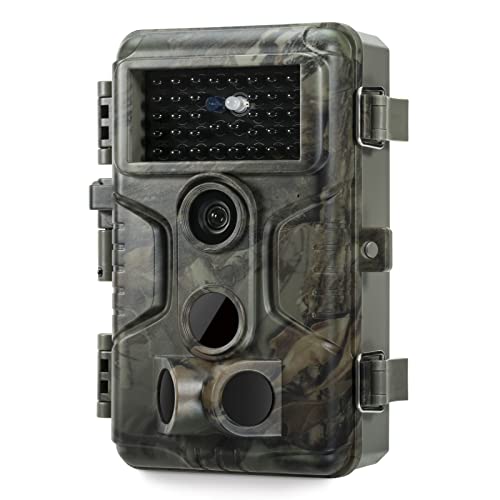
The A3S is built around the simple brief: its listing states non-cellular and non-WiFi operation up front, so there is nothing to pair and nothing to subscribe to. It records 64MP photos and 1296P HD video to an SD card, triggers in 0.1 seconds, and uses no-glow infrared for a stated 100-foot night range, which is the combination a beginner actually needs. Setup is the standard strap-and-buttons routine, and the camera’s job is to sit on a tree for weeks without attention. For a first trail camera, this is the most direct expression of the category. It also avoids the most common beginner regret, paying for connected features that never get used because the camera hangs somewhere with weak signal and the owner stops checking the app within a month.
Specs
- Connectivity: non-cellular, non-WiFi
- Photos: 64MP
- Video: 1296P HD
- Trigger speed: 0.1 seconds
- Night vision: no-glow infrared, 100ft range
- Operation: motion activated
- Model: A3S
Best for: Beginners and property owners who want a set-and-forget camera with fast triggering and invisible night flash.
Watch out for: With no connectivity, checking photos means physically retrieving the SD card, and the high photo resolution setting fills cards faster than the lower settings.
ASIN: B087G8W2PY
2. Vikeri 4K Trail Camera (32MP)
The Vikeri keeps the same simple, card-based workflow and adds two things the GardePro lacks: 4K video capture and a built-in 2.4-inch LCD screen, which lets you review photos and aim the camera in the field without removing the card. Its listing states a 0.1-second trigger time, a 120-degree wide lens, and 40 no-glow infrared LEDs behind an IP66 waterproof rating. The wide lens covers more of a clearing per placement, useful when you are guessing where animals cross. It remains a basic camera at heart: no app, no radio, just a screen, buttons, and a card.
Specs
- Video: 4K capture
- Photos: 32MP
- Trigger time: 0.1 seconds
- Lens: 120-degree wide angle
- Night vision: 40 no-glow infrared LEDs
- Screen: 2.4-inch LCD
- Waterproof rating: IP66
Best for: Users who want to review and aim the camera on its own screen, and who value 4K video of wildlife activity.
Watch out for: Recording 4K video drains batteries and fills cards much faster than photos, and the wide lens can make distant animals appear small in frame.
ASIN: B0B4J8VT67
Which One Fits Your Situation
You Want the Least to Learn
Take the GardePro A3S. There is no screen-based workflow to master and no connection features at all; you set the mode, close the case, and check the card when you return. Its fast trigger and no-glow flash handle the two things beginners most often get wrong with a first camera, which is missing the animal or scaring it at night. That simplicity is the feature; everything else on the listing is secondary.
You Watch a Garden, Feeder, or Gate
Either camera works, but the Vikeri’s built-in screen makes placement easier: you can stand where the camera sits, see its view, and adjust the angle on the spot. For a fixed spot you visit often, that convenience compounds, and 4K video of feeder activity is genuinely enjoyable to review at home. A garden camera also works shorter shifts than a deep-woods camera, so the card-swap workflow is barely an inconvenience when the camera is fifty steps from the back door, and you can experiment with placement weekly until the framing is right.
You Leave Cameras Out for Weeks
The GardePro A3S suits long, unattended sits better. Photo-focused settings, no screen sessions in the field, and no radios mean the batteries only feed the sensor and the flash. Use lithium AA batteries for cold weather, choose a card size the listing supports, and the camera can wait quietly between your visits. One brief mid-season card check is still worthwhile, since it confirms the camera is still aimed and working rather than silently full or flat.
You Are Buying a First Camera for Someone Else
Give the Vikeri. The LCD screen removes the most intimidating part of a first trail camera, not knowing whether it is aimed correctly or even recording. Being able to show the recipient their first photos on the camera itself, standing at the tree, makes the gift land better than a card they must take home to read.
Common Mistakes
- Buying a cellular or WiFi camera for a location with no signal or no desire to manage an app, then fighting the features you never wanted.
- Judging cameras by advertised megapixels, which are interpolated, instead of trigger speed and night range.
- Mounting the camera facing east or west into direct sun, which triggers false captures and washes out photos.
- Using alkaline batteries in winter, when lithium AAs last far longer in the cold.
- Setting video length too long on a first deployment, filling the card and draining the batteries before anything interesting visits.
Frequently Asked Questions
Do simple trail cameras need a subscription?
No. A simple, non-cellular trail camera records everything to its SD card and has no service attached to it, so there is nothing to subscribe to. Subscriptions only appear with cellular cameras that transmit photos over a mobile network. If avoiding ongoing costs is part of why you want a simple camera, confirm the listing says non-cellular, as both picks here do.
How do I view photos from a camera with no app?
You remove the SD card and read it with a computer, a card reader, or a phone adapter. The Vikeri in this guide also has a built-in LCD, so you can review images on the camera itself at the tree. The card-based workflow is slower than an app, but it is also the reason these cameras are simple and subscription-free. Keeping a spare card in your pocket lets you swap in seconds and review the full card at home at your leisure.
What trigger speed should I look for?
Around 0.1 to 0.3 seconds is a good target for a simple camera. At walking speed, an animal crosses a camera’s detection zone in a second or two, so a slow trigger photographs empty trail or the rear half of the subject. Both cameras here state a 0.1-second trigger, which is fast for this class and price style of camera. Recovery time between captures matters too when several animals pass in a group.
Can a simple trail camera work for home security?
Yes, within limits. A no-glow camera discreetly records motion-activated photos and video of a gate, driveway, or outbuilding, and the footage is stored on the card inside the camera. The limits are real: there are no instant alerts, and a stolen camera takes its card with it. For watch-over-time evidence rather than real-time alarms, a simple trail camera is a reasonable tool.
More from Amazon
Programs that pair well with the guide above. Offers and eligibility are set by Amazon and may change.
Free shipping on eligible items, Prime Video and more. Eligible new members can start with a free trial.
Start a Prime free trialAudiobooks and podcasts to listen to on the go. Eligible new members can start with a free trial.
Try Audible freeAd-free music streaming. Eligible new subscribers can start with a free trial.
Try Music Unlimited freeA free business account with business pricing and bulk-buying tools for work, shop or home office.
Create a business accountAs an Amazon Associate we earn from qualifying purchases.