If you are looking for stereo speakers that improve your desktop audio, anchor a home theater setup, or fill a room with balanced sound, the market is crowded with options that range from genuinely versatile to merely passable. The core problem is not finding speakers that play sound; it is finding a pair whose size, power requirements, and tonal character match the space and source you already have. A passive pair that needs an external amplifier becomes useless if you do not own one, while a powered pair that demands desk space may be overkill for a small bedroom or a guest room on a shelf.
What separates a good set from a mediocre one in this category comes down to three things: how well the drivers handle midrange vocals and dialogue without distortion, whether the enclosure is tuned tightly enough to avoid boomy or hollow bass, and whether the price reflects real build quality rather than brand markup. Owner feedback consistently reveals that cheap stereo speakers often sound muddy at moderate volumes, while slightly pricier pairs deliver noticeable gains in clarity and imaging. Below, we compared published specifications, listed prices, and aggregated owner impressions across eight models to identify which stereo speakers make the most sense for different budgets and use cases in 2026.
Our top picks




As an Amazon Associate we earn from qualifying purchases at no extra cost to you.
Quick Picks
| Product | Best for | Price |
|---|---|---|
| Polk Audio T15 | Home theater on a budget | $125 |
| Elimavi Passive Bookshelf | Tightest budget, existing amp | $49.99 |
| Edifier P12 | Wall-mounted stereo pair | $89.98 |
| Edifier R1280T | Desktop near-field listening | $129.99 |
| Anker soundcore 2 | Portable stereo sound | $29.98 |
| Sony SS-CS5M2 | Hi-Res audio on a shelf | $198 |
| Klipsch R-41M | Compact room-filling detail | $199 |
| Klipsch R-51M | Larger shelves, richer bass | $289.99 |
How We Picked
We narrowed this list using four criteria: price-to-performance ratio relative to listed wattage and driver configuration, whether the speaker is powered or passive (which determines what additional gear you need), enclosure and driver material quality as described by owners over time, and form-factor flexibility for the intended placement. A model that sounds good but requires a separate receiver costs more in total than a powered pair at a higher sticker price, so we weighed total setup cost alongside per-unit value.
The 8 Best Stereo Speakers in 2026
Polk Audio T15
The Polk Audio T15 is a long-standing value pick for people who want bookshelf stereo speakers as front channels in a home theater system. They handle 100 watts of input power, meaning they pair well with mid-range AV receivers without worrying about underpowering them. Owners praise the balanced midrange and the fact that vocals remain clear even during action-heavy scenes. The wood veneer cabinet gives them a more finished look than many budget alternatives. The main limitation is bass extension; they roll off sooner than larger or pricier models, so adding a subwoofer helps if you watch a lot of action films. Skip these if your desk or shelf cannot accommodate their depth, or if you need wireless input.
Elimavi Passive Bookshelf Speakers
At $49.99 for a pair, the Elimavi passive bookshelf speakers are the most affordable stereo speakers on this list. They require a receiver or amplifier, which adds to total cost if you lack one. Owners report a warm, non-fatiguing sound that is adequate for background music and casual listening in small rooms. The brown finish is understated and blends into wood furniture. The trade-off is that imaging and detail resolution are noticeably behind models priced at twice the cost. Skip these if you need precision for critical listening or if you do not already own a compatible amplifier. They are a sensible first pair for someone learning what they like before spending more.
Edifier P12
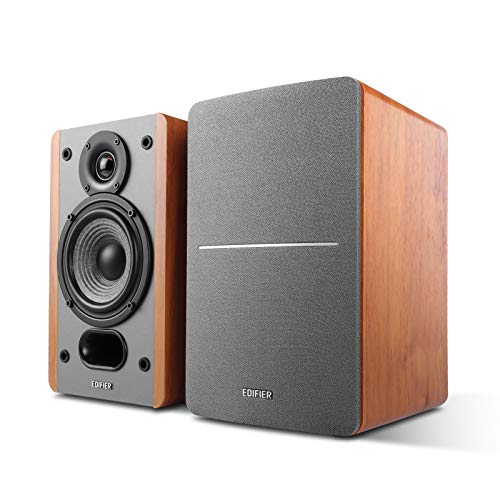
The Edifier P12 is a two-way passive bookshelf speaker that includes a built-in wall-mount bracket, making it one of the few pairs on this list that suits flush-wall placement out of the box. At $89.98, they sit between the ultra-budget and mid-range tiers. The wood-color finish is attractive for living spaces where you want speakers to look like furniture. Owners highlight the clean upper mids and reasonable dispersion for the price. They need an external amplifier, which is a consideration if your setup lacks one. The bass is modest, as expected from a compact two-way design. Skip these if you want a powered solution or need deep low-frequency extension without a sub.
Edifier R1280T
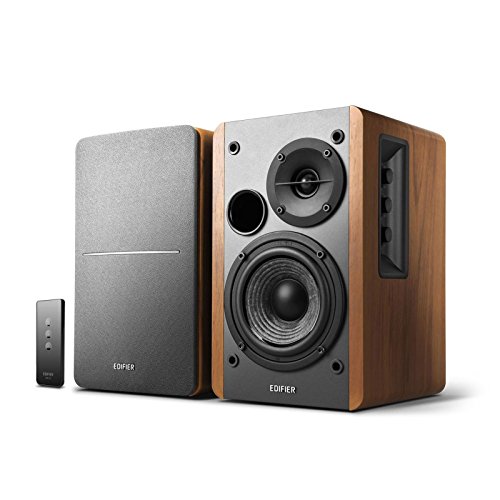
The Edifier R1280T is a powered 2.0 near-field studio monitor style stereo speaker, meaning it has a built-in amplifier and needs no external gear. At $129.99, it is a popular desktop upgrade for people who want better sound than a laptop or monitor built-in speakers provide. Owners consistently note the warm, slightly forward midrange that suits podcasts, gaming, and general media. The rear-firing port allows placement close to a wall without excessive boominess. The limitation is that they are not designed for large rooms or critical audiophile listening; at distance, imaging softens. Skip these if you need passive speakers to fit an existing receiver-based home theater, or if you want a wireless Bluetooth input without a dongle.
Anker soundcore 2
The Anker soundcore 2 is a portable Bluetooth speaker with stereo sound and an IPX7 waterproof rating. At $29.98, it is the least expensive option here and the only one that functions as a single wireless unit. It suits campers, travelers, and anyone who wants stereo separation without desk real estate. Owners appreciate the compact size and the fact that it handles splashes and brief submersion. The trade-off is obvious: a pocket-sized speaker cannot match the detail or low-end of a bookshelf pair on a shelf. Skip this if your goal is a stationary home listening setup. It is best thought of as a companion to a home pair rather than a replacement for one.
Sony SS-CS5M2
The Sony SS-CS5M2 is a three-way, three-driver compact bookshelf speaker rated for Hi-Res audio content. At $198 per pair, they target listeners who want a wider frequency spread and better instrument separation than a two-way design provides. The extra driver handles the upper range, reducing strain on the woofer and tweeter at higher volumes. Owners report improved detail in complex passages and a less colored midrange compared to single-tweeter designs. They are passive, so an amplifier or receiver is required. The size is compact for a three-way, but depth on a narrow shelf should be verified. Skip these if you cannot spare room for an external amp or if your listening is mostly spoken-word content where three-way design adds little benefit.
Klipsch R-41M
The Klipsch R-41M bookshelf speakers are compact and efficient, a hallmark of the brand’s horn-loaded tweeter design. At $199 per pair, they deliver noticeably more output per watt than many competitors, meaning they drive well from smaller amplifiers or receivers. Owners praise the detail and the slightly forward, energetic presentation that works well for rock, electronic, and film dialogue. The black finish and compact footprint suit most shelves. The trade-off is that the forward character can feel fatiguing with long sessions of acoustic or vocal-focused material at high volume. Skip these if you prefer a relaxed, laid-back tonal signature or if your existing amplifier has limited headroom and you plan to listen loudly.
Klipsch R-51M
The Klipsch R-51M steps up from the R-41M with a larger woofer in a similar cabinet philosophy. At $289.99 per pair, they occupy the premium end of this list. The bigger driver brings more low-end authority without needing a subwoofer, and owners note improved weight in the bass while retaining the brand’s signature detail and efficiency. The black finish matches the R-41M, so mixing sizes in a multi-room setup is visually consistent. They are passive, so plan for an amplifier. The size is noticeable on a small desk. Skip these if space is tight or if your listening level rarely demands the extra bass headroom that the larger driver provides.
Buying Guide
Powered vs. Passive: Total Setup Cost Matters
Powered stereo speakers have a built-in amplifier and work with just an audio source, while passive speakers require a separate receiver or amplifier. A passive pair listed at $50 may actually cost $150 or more once you factor in the required electronics. Decide whether your existing setup already has an amp, and compare total cost rather than sticker price alone.
Driver Count and Configuration
Two-way speakers use one woofer and one tweeter, which is efficient and compact but can show strain at higher volumes where both drivers cover overlapping frequencies. Three-way designs add a dedicated midrange or super-tweeter, improving separation and reducing distortion at moderate listening levels. For small rooms and desktop use, two-way is often sufficient. For larger spaces or critical listening, a three-way pair like the Sony SS-CS5M2 justifies the extra cost through cleaner instrument layering.
Placement and Room Size
Bookshelf stereo speakers perform best when placed at ear height, angled slightly inward, and set a few inches from the rear wall to allow port airflow. Rear-ported models should not be pushed flush against a wall. Front-ported or sealed designs tolerate closer placement. Match cabinet size to room size: a compact pair in a large open space will sound thin, while an oversized pair on a small desk crowds the room and causes boominess.
Our Verdict
Our top pick among these stereo speakers is the Klipsch R-41M, which combines compact size, high efficiency, and detailed sound at a fair $199 price. For the tightest budget that still delivers genuine stereo separation without any amplifier requirement, the Edifier R1280T is the best value at $129.99. If you need a powered pair but already own a receiver and prefer wall-mount flexibility, the Edifier P12 wins on that specific condition at $89.98.
FAQ
Do stereo speakers need a subwoofer?
Not always. Compact bookshelf stereo speakers roll off sooner in the bass, so a subwoofer helps if you listen for deep low-end or watch action-heavy content. If your primary listening is vocals, podcasts, or mid-range music, the speaker pair alone is usually sufficient.
Can I use passive speakers with a Bluetooth transmitter?
You can, but you still need an amplifier to drive passive speakers. A Bluetooth transmitter only converts your wireless signal to analog; it does not add power. A powered pair like the Edifier R1280T handles wireless sources more simply.
Is a 100-watt speaker the same as a 100-watt amplifier requirement?
No. A rating of 100 watts on a speaker typically indicates the maximum safe input it can handle, not the power it needs to produce reasonable volume. Most passive bookshelf speakers sound fine at well below their rated maximum.
Are portable Bluetooth speakers considered stereo speakers?
Only if they have two drivers placed apart to produce actual left and right channel separation. Many single-unit portables claim stereo sound through processing rather than true spatial separation. The Anker soundcore 2 is a compact example that aims for stereo imaging in a small footprint.