Our Short List of 3
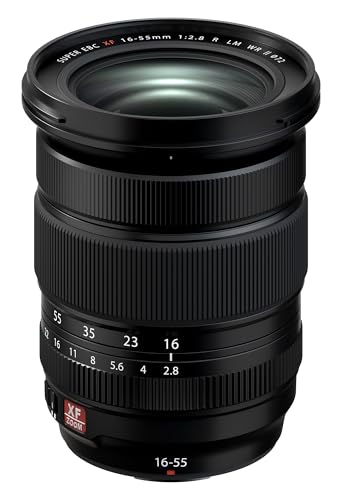
- Mount: Fujifilm X; Focal length: 16-55mm (24-83mm equivalent); Aperture: f/2.8 to f/16; Autofocus: linear motor; Stabilization: none; Minimum focus: 0.30 m; Magnification: 0.21x; Filter thread: 72mm; Elements: 16 in 11 groups; Diaphragm blades: 11; Weather sealing: yes; Weight: 410 g; Dimensions: 77.8 x 95.1 mm.

- Mount: Fujifilm X; Focal length: 17-40mm (25.5-60mm equivalent); Aperture: f/1.8 to f/16; Autofocus: HLA linear motor; Stabilization: none; Minimum focus: 0.28 m; Magnification: 0.21x; Filter thread: 67mm; Elements: 17 in 11 groups; Diaphragm blades: 11; Weather sealing: yes; Weight: 530 g; Dimensions: 72.9 x 118.2 mm.

- Mount: Fujifilm X; Focal length: 56mm (84mm equivalent); Aperture: f/1.4 to f/16; Autofocus: stepping motor; Stabilization: none; Minimum focus: 0.50 m; Magnification: 0.14x; Filter thread: 55mm; Elements: 10 in 6 groups; Diaphragm blades: 9; Weather sealing: dust and splash resistant at mount; Weight: 280 g; Dimensions: 66.5 x 59.8 mm.
All 4 Picks at a Glance
| Product | Specs | Action |
|---|---|---|
| 1. Fujifilm XF 16-55mm f/2.8 R LM WR II — Best Pro Standard Zoom |
| Check price on Amazon |
| 2. Sigma 17-40mm f/1.8 DC Art — Best Fast Zoom for Low Light |
| Check price on Amazon |
| 4. Sigma 56mm f/1.4 DC DN Contemporary X-Mount — Best Portrait Prime |
| Check price on Amazon |
 5. Fujifilm XF 50-140mm f/2.8 R LM OIS WR — Best Telephoto Zoom |
| Check price on Amazon |
Key takeaways
- Find the best lenses for Fujifilm X-T3, from a fast f/1.8 zoom and an ultra-wide to a 56mm portrait prime and two pro zooms for stills and video.
The Fujifilm X-T3 remains a serious camera years after its debut, and the reason is simple: a 26.1MP APS-C sensor, fast autofocus, and 4K video that still holds up for hybrid shooters. It is the kind of body that rewards good glass, because the sensor resolves fine detail and the film simulations give color that needs little work after the shot. The weak link for many owners is the kit zoom, which is handy in daylight but modest in dim rooms and limited when you want a blurred background behind a portrait.
A better lens changes the X-T3 more than almost any other upgrade. Native X-mount glass keeps autofocus fast and communication between lens and body complete, with no adapter in the way. The five lenses in this guide cover the focal lengths most X-T3 owners actually use: a fast wide zoom, an ultra-wide zoom, a portrait prime, and two constant-aperture pro zooms for events, travel, and wildlife. Each one is an X-mount model made for this sensor size, so confirm that mount code when you order.
As an Amazon Associate, we earn from qualifying purchases.
How the 1.5x Crop Factor Shapes Your Choice
Every lens on the X-T3 behaves longer than the number printed on its barrel. The APS-C sensor crops the image circle, so you multiply the focal length by 1.5 to get the full-frame equivalent field of view. A 35mm lens frames like a 53mm lens on a full-frame camera, and a 56mm lens frames like an 84mm lens. This matters when you plan a kit, because a lens that sounds wide on paper can feel normal on the X-T3, and a lens that sounds normal can feel like a portrait lens.
The X-T3 has no in-body stabilization, so stabilization in the lens matters for handheld video and for stills in dim light. The Fujifilm 50-140mm in this guide carries optical stabilization, while the fast primes and the Sigma zooms below rely on wide apertures instead. A lens at f/1.4 or f/1.8 gathers far more light than a kit zoom at f/5.6, which lets you keep shutter speeds high and ISO values low indoors.
Weight matters just as much on a camera of this size. The X-T3 body weighs about 539 grams with battery and card, so a heavy lens tips the balance forward on long days. The ultra-wide Sigma below weighs only 250 grams, while the two Fujifilm pro zooms are heavier tools built for work rather than for pocket carry.
1. Fujifilm XF 16-55mm f/2.8 R LM WR II — Best Pro Standard Zoom
- Mount: Fujifilm X; Focal length: 16-55mm (24-83mm equivalent); Aperture: f/2.8 to f/16; Autofocus: linear motor; Stabilization: none; Minimum focus: 0.30 m; Magnification: 0.21x; Filter thread: 72mm; Elements: 16 in 11 groups; Diaphragm blades: 11; Weather sealing: yes; Weight: 410 g; Dimensions: 77.8 x 95.1 mm.
The Fujifilm XF 16-55mm f/2.8 R LM WR II is the workhorse zoom for the X-T3, and the second generation of a lens that many Fujifilm shooters never take off the body. On the X-T3 it covers 24mm to 83mm in full-frame equivalent terms, from a genuinely wide view for streets and interiors to a short telephoto view for portraits. The constant f/2.8 aperture holds across the whole range, so exposure stays steady as you zoom and backgrounds stay soft at the long end.
Optically this is one of the finest standard zooms Fujifilm has made for the X system. It is crisp across the frame when stopped down a little, and it holds up well wide open in the center, where your subject usually sits. The Mark II is smaller and lighter than the original, which suits the X-T3 for long days of walking and shooting. Weather sealing guards against dust and drizzle, the aperture ring gives direct control without digging through menus, and the linear motor focuses quickly and quietly for stills and video alike.
For video, the 16-55mm II is a natural partner for the X-T3. The focal range covers wide establishing shots, medium interview framing, and tight detail shots without a lens change, and the quiet autofocus keeps focus pulls smooth. If you want one lens that handles weddings, events, travel, and daily work on the X-T3, this is the lens to buy first.
2. Sigma 17-40mm f/1.8 DC Art — Best Fast Zoom for Low Light
- Mount: Fujifilm X; Focal length: 17-40mm (25.5-60mm equivalent); Aperture: f/1.8 to f/16; Autofocus: HLA linear motor; Stabilization: none; Minimum focus: 0.28 m; Magnification: 0.21x; Filter thread: 67mm; Elements: 17 in 11 groups; Diaphragm blades: 11; Weather sealing: yes; Weight: 530 g; Dimensions: 72.9 x 118.2 mm.
The Sigma 17-40mm f/1.8 DC Art is the most unusual zoom in this guide, and the one that changes what a zoom can do on the X-T3. On the X-T3 it covers 25.5mm to 60mm in full-frame equivalent terms, from wide-angle scenes to a normal view for portraits and events. The constant f/1.8 aperture is the headline: it gathers far more light than any f/2.8 zoom, and it gives background blur that comes close to what a fast prime delivers.
Image quality is the reason this lens earns its Art badge. It is crisp across the frame when stopped down a little, with good contrast and pleasing color, and it holds up well wide open in the center. The 0.28-meter minimum focus distance lets you fill the frame with a small subject, and the internal zoom design means the barrel does not extend as you zoom, which keeps balance steady on a gimbal. For hybrid shooters who film and photograph with one lens, the Sigma 17-40mm is the most flexible pick in this guide.
3. Sigma 10-18mm f/2.8 DC DN Contemporary — Best Ultra-Wide Zoom
The Sigma 10-18mm f/2.8 DC DN Contemporary is the smallest and lightest ultra-wide zoom in this guide, and the lens that gives the X-T3 a view no other lens here can match. On the X-T3 it covers 15mm to 27mm in full-frame equivalent terms, wide enough for tight interiors, architecture, group photos in small rooms, and landscapes with real depth. The constant f/2.8 aperture keeps exposure steady across the range and helps in dim interiors where a slower ultra-wide would struggle.
Optically this is a strong lens for its size. It is crisp across the frame when stopped down a little, with good contrast and pleasing color, and it controls distortion well for such a wide view. For vlogging, real estate, travel, and landscape work on the X-T3, the Sigma 10-18mm is the wide lens to add when the standard zoom is not wide enough.
Specs
- Mount: Fujifilm X; Focal length: 10-18mm (15-27mm equivalent); Aperture: f/2.8 to f/22; Autofocus: stepping motor; Stabilization: none; Minimum focus: 0.12 m; Magnification: 0.25x; Filter thread: 67mm; Elements: 13 in 10 groups; Diaphragm blades: 7; Weather sealing: no; Weight: 250 g; Dimensions: 72.2 x 64.3 mm.
4. Sigma 56mm f/1.4 DC DN Contemporary X-Mount — Best Portrait Prime
- Mount: Fujifilm X; Focal length: 56mm (84mm equivalent); Aperture: f/1.4 to f/16; Autofocus: stepping motor; Stabilization: none; Minimum focus: 0.50 m; Magnification: 0.14x; Filter thread: 55mm; Elements: 10 in 6 groups; Diaphragm blades: 9; Weather sealing: dust and splash resistant at mount; Weight: 280 g; Dimensions: 66.5 x 59.8 mm.
The Sigma 56mm f/1.4 DC DN Contemporary in X-mount is the classic portrait lens for the X-T3, and the most useful single prime for people photography. On the X-T3 it frames like an 84mm lens, the classic portrait focal length, close enough for head-and-shoulders shots without crowding your subject and long enough to flatten features gently. The f/1.4 aperture gives soft, creamy backgrounds that a kit zoom cannot approach, and it keeps shutter speeds high in living rooms, restaurants, and evening light.
At 280 grams, the Sigma 56mm is light enough to carry all day and small enough to balance well on the X-T3. Dust and splash sealing at the mount guards against light drizzle and dust, and the 55mm filter thread takes a single compact filter. For portraits, headshots, weddings, and any work where people are the subject, the Sigma 56mm f/1.4 is the lens that delivers the most flattering look for the least bulk in this guide.
5. Fujifilm XF 50-140mm f/2.8 R LM OIS WR — Best Telephoto Zoom
- Mount: Fujifilm X; Focal length: 50-140mm (75-210mm equivalent); Aperture: f/2.8 to f/22; Autofocus: linear motor; Stabilization: OIS optical, about 5 stops; Minimum focus: 1.0 m; Magnification: 0.12x; Filter thread: 72mm; Elements: 23 in 16 groups; Diaphragm blades: 7; Weather sealing: yes; Weight: 995 g; Dimensions: 82.9 x 175.9 mm.
The Fujifilm XF 50-140mm f/2.8 R LM OIS WR is the telephoto workhorse for the X-T3, and the lens to add when your subjects stay far away. On the X-T3 it covers 75mm to 210mm in full-frame equivalent terms, from a short telephoto view for portraits to a real telephoto reach for sports, wildlife at a distance, and compressed landscapes. The constant f/2.8 aperture holds across the whole range, so exposure stays steady as you zoom.
Optical stabilization is the key feature here, because the X-T3 has no in-body stabilization of its own. The stabilization in the 50-140mm steadies handheld video and lets you shoot stills at slower shutter speeds in shade and indoors, which matters most at 140mm, where every tremor shows. The linear motor focuses quickly and quietly, and the weather-sealed build suits outdoor work in drizzle and dust.
Image quality is strong across the range, with crisp detail and good contrast when stopped down a little, and solid center sharpness wide open. The 1.0-meter minimum focus distance lets you fill the frame with a subject at the short end, and the 72mm filter thread matches the 16-55mm II above, so one set of filters covers both Fujifilm zooms in this guide. At 995 grams it is the heaviest lens here, so pair it with a strap for long days, but for events, sports, and wildlife on the X-T3, no other lens in this guide reaches as far.
Which Lens Should You Buy First
Match the lens to the shooting you do most, not to the lens with the longest spec sheet. For everyday work, events, and travel with one lens, the Fujifilm 16-55mm f/2.8 II is the clear first buy: it covers wide streets and short telephoto portraits, holds f/2.8 across the range, and balances well on the X-T3. For dim rooms, indoor events, and video where light is limited, the Sigma 17-40mm f/1.8 is the better first buy, because its wider aperture keeps indoor shots clean and gives soft backgrounds that a f/2.8 zoom cannot match.
For portraits and people photography, the Sigma 56mm f/1.4 is the lens to add next, because its 84mm equivalent view and f/1.4 aperture flatter faces and melt backgrounds away. Add the Sigma 10-18mm when interiors, architecture, and wide landscapes fill your weekends, and add the Fujifilm 50-140mm when sports, wildlife, and distant subjects fill your calendar.
Frequently Asked Questions
Is the Fujifilm XF 16-55mm f/2.8 II good for video on the X-T3?
Yes, it is one of the best video zooms for the X-T3. The 24-83mm equivalent range covers wide establishing shots and medium interview framing, the quiet linear motor keeps focus pulls smooth, and the constant f/2.8 aperture keeps exposure steady as you zoom.
Do I need the Sigma 17-40mm f/1.8 or the Fujifilm 16-55mm f/2.8 II for the X-T3?
Choose the Sigma 17-40mm for dim rooms, indoor events, and video in low light, where its f/1.8 aperture matters most. Choose the Fujifilm 16-55mm II when range and weather sealing matter more, because it reaches 83mm equivalent and covers portraits and details that the Sigma cannot reach.
Is the Sigma 56mm f/1.4 sharp enough for the 26.1MP sensor?
Yes, for portraits and daily shooting. It is crisp in the center wide open, where your subject usually sits, and it sharpens across the frame when stopped down to f/2.8. The 84mm equivalent view flatters faces, and the f/1.4 aperture gives soft backgrounds that suit headshots and half-length portraits.
What is the best single lens for travel with the Fujifilm X-T3?
The Fujifilm XF 16-55mm f/2.8 R LM WR II is the best single travel lens for the X-T3. It covers 24mm to 83mm in equivalent terms, holds f/2.8 across the range, has weather sealing for outdoor days, and weighs 410 grams, so one lens handles streets, landscapes, portraits, and details on a trip.
Final Thoughts
The X-T3 rewards bright, well-built glass, and the five lenses above keep that promise. The Fujifilm 16-55mm II and the Sigma 17-40mm f/1.8 cover daily work and dim rooms with constant wide apertures. The Sigma 10-18mm adds a wide view for interiors and landscapes without adding bulk. The Sigma 56mm f/1.4 opens up portraits that the kit zoom cannot reach, and the Fujifilm 50-140mm brings distant subjects close with stabilization that the X-T3 body lacks on its own.
More from Amazon
Programs that pair well with the guide above. Offers and eligibility are set by Amazon and may change.
Free shipping on eligible items, Prime Video and more. Eligible new members can start with a free trial.
Start a Prime free trialAudiobooks and podcasts to listen to on the go. Eligible new members can start with a free trial.
Try Audible freeAd-free music streaming. Eligible new subscribers can start with a free trial.
Try Music Unlimited freeA free business account with business pricing and bulk-buying tools for work, shop or home office.
Create a business accountAs an Amazon Associate we earn from qualifying purchases.