Our Short List of 3
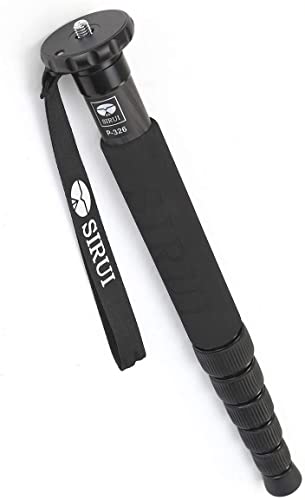
- Carbon fibre, 6 sections, about 400 g, folds to about 15 inches, extends to about 60.6 inches, 22 lb load guidance, reversible 1/4-inch and 3/8-inch mounting plate, wrist strap and hand grip.

- Carbon fibre, 4 sections, model MPMXPROC4US, about 1.3 lb, folds to about 20.5 inches, extends to about 64.8 inches, 20 kg load guidance, standard camera thread, quick locks.

- Anodized aluminium flexible stand, model JB01569-BWW, holds up to 3 kg, weighs about 9.6 ounces, about 9.25 inches tall, jointed legs that grip and wrap, accepts a ball head, 1/4-inch and 3/8-inch mounting.
All 5 Picks at a Glance
| Product | Specs | Action |
|---|---|---|
| 1. Sirui P-326 |
| Check price on Amazon |
| 2. Manfrotto XPRO Carbon Monopod |
| Check price on Amazon |
| 3. JOBY GorillaPod 3K PRO Stand |
| Check price on Amazon |
 4. Manfrotto 290 Carbon Monopod |
| Check price on Amazon |
 5. NEEWER T222 |
| Check price on Amazon |
Our Top Picks
Lesser centaury is a small plant that asks very little of a photographer and even less of a monopod. It grows low on damp sandy ground, often near paths and open patches where the soil stays moist into the summer. Its small pink five-petalled flowers sit close to the ground on slender stems, and the main challenge is getting low enough without stepping on the plants around it.
This guide looks at five monopods and asks a plain question about each one: does it help you photograph lesser centaury, or does it only add weight to your bag? The honest answer, given up front, is that a monopod is barely useful for this plant. If you already own a monopod, bring it and use it well. If you do not own one, do not buy one only for lesser centaury.
As an Amazon Associate, we earn from qualifying purchases.
Why a Monopod Is a Weak Tool Here
A monopod is at its best when it holds a heavy lens steady at eye level for a long time, while a photographer stands in one place and waits. Lesser centaury asks for the opposite. The flowers are small and low, the camera needs to be close to the ground, and the photographer needs to move in small steps along the edge of a patch rather than standing still in the middle of it. A monopod set to full height is the wrong shape for this work, and a monopod set very short is little more than a handle.
There are still a few moments when a monopod helps. On damp sandy ground, a monopod foot can rest on a firm patch of path while the camera leans in low over the plants, giving a little extra steadiness for a slow shutter in dull light. From a kneeling position, a short monopod can take some of the weight of a camera and a mid-range zoom, letting you hold a low angle for longer without your arms tiring. But the limits matter more than the uses. A monopod is not a tripod, and it cannot hold a camera on its own while you step away.
Meeting Lesser Centaury in the Field
Lesser centaury, Centaurium pulchellum, belongs to the gentian family, Gentianaceae. It is a small annual plant, which means it grows from seed, flowers, and sets seed all in a single season, and the plants you see in one year may not be in exactly the same spot the next. It favours damp sandy ground: the edges of sandy tracks, open hollows that hold moisture, dune slacks, and the margins of sandy fields where the soil stays damp. It is not a plant of dry banks or shady woods, and it does not tolerate trampling.
The flowers are the key to finding it and to photographing it well. They are small pink five-petalled flowers, opening on slender stems above narrow leaves, and they open in sunlight and close in dull weather. A single flower is only a few millimetres across, so a photograph needs to get close. Stay on paths wherever you can, and never pick the plant.
Lesser Centaury Is Not Common Centaury
This is the point that causes the most confusion, so it deserves a section of its own. Lesser centaury is not common centaury. The two plants share a genus, Centaurium, but they are different species: lesser centaury is Centaurium pulchellum, and common centaury is Centaurium erythraea.
The differences are plain once you know them. Lesser centaury is a small annual plant, usually low and slender, with small pink five-petalled flowers on short stalks. Common centaury is a taller plant, often standing well above the surrounding grass, with larger pink flowers carried on a more branched stem. Size is the quickest guide in the field: a plant that reaches your ankle with tiny flowers is likely lesser centaury, while a plant that reaches your knee with larger flowers is likely common centaury. Habitat gives a second clue. Lesser centaury favours damp sandy ground, while common centaury is more at home on drier grassland, chalk banks, and open woodland edges.
What Matters in a Monopod for This Plant
A monopod for lesser centaury needs to be judged on a short list of qualities, and the list is different from the one you would use for a tall bird or a fast-moving animal. Height matters, but in the other direction: the monopod must collapse short enough to work from a kneeling position, and it must adjust in small steps so you can fine-tune a low angle without fumbling. Weight matters, because the monopod will spend most of the day folded in your hand or in your bag, and a heavy pole that you never extend is dead weight. A comfortable grip matters, because your hands will be damp and sandy, and a smooth metal tube can slip when you need it most.
The foot matters more than most people expect. On damp sandy ground, a rubber foot grips better than a bare spike, and a spike should only be used on firm bare ground, never pushed into soil where plants are growing.
The Five Monopods
Each of the five below is judged on low-height handling, carry weight, and care for the ground. None is a tripod.
1. Sirui P-326
- Carbon fibre, 6 sections, about 400 g, folds to about 15 inches, extends to about 60.6 inches, 22 lb load guidance, reversible 1/4-inch and 3/8-inch mounting plate, wrist strap and hand grip.
The Sirui P-326 is the lightest monopod in this guide, and that is its main strength for a subject that barely needs a monopod at all. It is a carbon fibre pole with six sections, and it folds down to a short length that slips easily into the side of a day bag. The carbon fibre keeps the weight down to around 400 grams, and the wrist strap and hand grip give a secure hold when your hands are damp.
2. Manfrotto XPRO Carbon Monopod
- Carbon fibre, 4 sections, model MPMXPROC4US, about 1.3 lb, folds to about 20.5 inches, extends to about 64.8 inches, 20 kg load guidance, standard camera thread, quick locks.
The Manfrotto XPRO Carbon Monopod, model MPMXPROC4US, is a four-section carbon fibre pole built for photographers who want a stiff, simple support. For lesser centaury, the XPRO works best as a short, stiff prop. Set to knee height, it holds a camera steady while you frame a low group of flowers, and the quick locks let you adjust the height with one hand.
3. JOBY GorillaPod 3K PRO Stand
- Anodized aluminium flexible stand, model JB01569-BWW, holds up to 3 kg, weighs about 9.6 ounces, about 9.25 inches tall, jointed legs that grip and wrap, accepts a ball head, 1/4-inch and 3/8-inch mounting.
The JOBY GorillaPod 3K PRO Stand is the odd one out in this guide, and it is here because it solves a problem the straight poles do not. It is not a monopod in the usual sense at all. It is a short, flexible stand with jointed legs that can grip, wrap, and stand on uneven ground, and it holds up to 3 kg of camera gear. For lesser centaury, the GorillaPod earns its place at ground level. Set low on a path, with its legs splayed, it holds a camera a few inches above the ground and aimed at a patch of flowers. It is short, so it cannot lift a camera to eye level.
4. Manfrotto 290 Carbon Monopod
- Carbon fibre, 4 sections, model MM290C4US, about 1.1 lb, folds to about 19.3 inches, extends to about 59.4 inches, 5 kg safe working load from the datasheet, flip locks, rubber grip and wrist strap.
The Manfrotto 290 Carbon Monopod, model MM290C4US, is a four-section carbon fibre pole that sits between the Sirui and the XPRO in weight and feel. It weighs about 1.1 pounds, folds to about 19.3 inches, and extends to about 59.4 inches. For lesser centaury, the 290 is a steady, unshowy choice. Set short, it is rigid enough to hold a camera and a mid-range zoom without flex, and the rubber grip and wrist strap keep it secure when your hands are damp.
5. NEEWER T222
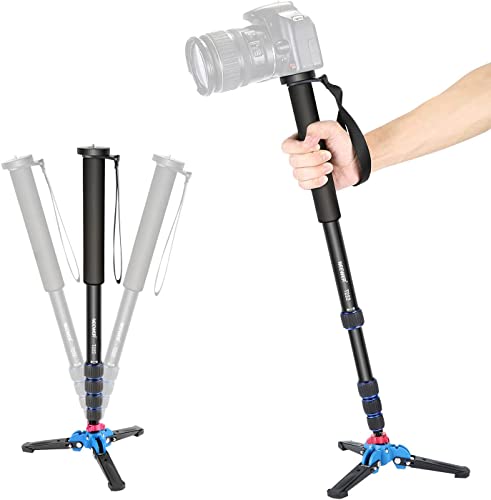
- Aluminium alloy, 5 sections, model T222, about 1.3 lb, folds to about 20.5 inches, extends to 66 inches, 5 kg maximum load, detachable folding base with 360-degree pan and 15-degree tilt, 1/4-inch mounting screw.
The NEEWER T222 is the tallest and most versatile monopod in this guide, and its detachable base is the reason to consider it. It is an aluminium alloy pole with five sections, extending to 66 inches and folding to about 20.5 inches, and it weighs about 1.3 pounds. For lesser centaury, the T222 is best used with the base fitted on firm bare ground at the edge of a patch, where it lets you frame a low shot and adjust the angle without lifting the pole. The drawbacks are weight and bulk: the base adds both, and the pole is the longest in this guide when folded.
How the Five Compare
Put side by side, the five monopods split into two groups. The Sirui P-326 and the Manfrotto 290 are the light, simple poles, and they are the easiest to carry all day and the easiest to set short for kneeling work. The JOBY GorillaPod 3K PRO Stand stands apart from all four, because it works at ground level rather than at standing height, and for a plant as low as lesser centaury, that may matter more than any number on a spec sheet. A light pole used from the edge of a patch will serve you better than a heavy pole pushed into the middle of one.
Working a Patch Without Harming It
A good session with lesser centaury begins before you lift the camera. Walk the area slowly, stay on the path, and look for a patch that can be photographed from bare ground. If other people are using the path, step aside and let them pass before you set down any gear. When you find your angle, set the monopod on firm ground at the edge of the patch, and keep your feet on the path. If the ground is soft, do not push a spike foot into it. Use a rubber foot, or rest the pole on a flat stone or a firm piece of path.
What Not to Buy for This Plant
Do not buy a heavy video monopod with a fluid base for lesser centaury. Do not buy a monopod with a spike foot as its only foot, and do not buy a support that cannot collapse short enough to use from your knees. More plainly still: if you do not already own a monopod, do not buy one only for lesser centaury. The plant will not know the difference, and your photographs will be just as good. A monopod is a tool for a photographer who already has one and already knows how to use it.
Frequently Asked Questions
Is a monopod useful for lesser centaury photography?
Only a little, and only in narrow situations. A monopod can steady a camera at a low angle from the edge of a patch, and it can take some weight off your arms during a long kneeling session. If you already own one, bring it. If you do not, do not buy one only for this plant.
How do I tell lesser centaury from common centaury?
Look at size first. Lesser centaury, Centaurium pulchellum, is a small annual plant with small pink five-petalled flowers on slender stems, usually growing low on damp sandy ground. Common centaury, Centaurium erythraea, is a taller plant with larger pink flowers on a more branched stem, usually growing on drier grassland.
Which monopod in this guide is best for low, close work?
The JOBY GorillaPod 3K PRO Stand is the best of the five for low, close work, because it holds a camera a few inches above the ground and can grip a low post at the edge of a patch. Among the straight poles, the Sirui P-326 is the best for kneeling work, because it is the lightest and folds the shortest.
Can I use a monopod instead of a tripod for lesser centaury?
No. A monopod cannot hold a camera on its own, and it cannot replace a tripod for long exposures or for any shot where you need to step away from the camera. A monopod is a single leg that steadies a camera while you hold it, and it needs your hands on it the whole time.
Lesser centaury rewards a slow, careful photographer more than it rewards new gear. The small pink five-petalled flowers will do the rest.
More from Amazon
Programs that pair well with the guide above. Offers and eligibility are set by Amazon and may change.
Free shipping on eligible items, Prime Video and more. Eligible new members can start with a free trial.
Start a Prime free trialAudiobooks and podcasts to listen to on the go. Eligible new members can start with a free trial.
Try Audible freeAd-free music streaming. Eligible new subscribers can start with a free trial.
Try Music Unlimited freeA free business account with business pricing and bulk-buying tools for work, shop or home office.
Create a business accountAs an Amazon Associate we earn from qualifying purchases.