Key takeaways
- Buy the ZWO ASI2600MC Pro if deep-sky imaging is your main goal and you already have, or plan to buy, a tracking mount. Choose the Sony a7S III for portable Milky Way photography and lens flexibility, the Nikon Z8 for high-resolution hybrid use, the QHY268C…
The best astrophotography cameras in 2026 are the ZWO ASI2600MC Pro for cooled deep-sky imaging, Sony a7S III for wide-field Milky Way work, and ZWO ASI585MC for an affordable camera that can also capture planets.
Our top picks



As an Amazon Associate we earn from qualifying purchases at no extra cost to you. Ratings are shown as listed on Amazon.
Best astrophotography cameras at a glance
| Camera | Best for | Sensor and resolution | Cooling / ISO or gain | Weight | Typical market range |
|---|---|---|---|---|---|
| ZWO ASI2600MC Pro | Deep-sky imaging and beginners moving beyond DSLR | APS-C, 26 MP, 23.5 × 15.7 mm | Two-stage TEC, up to about 35–40°C below ambient; gain 0–600 | About 700 g | About $1,400–$1,700 |
| QHY268C | Deep-sky detail and flexible gain control | APS-C, 26 MP, Sony IMX571 | Two-stage TEC; gain 0–600 | About 700–800 g | About $1,500–$1,900 |
| Sony a7S III | Handheld or tripod Milky Way photography | Full frame, 12.1 MP, 35.6 × 23.8 mm | Uncooled; ISO 80–102,400 native range | 699 g with battery and card | About $2,000–$2,500 |
| Nikon Z8 | High-resolution landscapes, stars, and daytime photography | Full frame, 45.7 MP, 35.9 × 23.9 mm | Uncooled; ISO 64–25,600 native range | 910 g with battery and card | About $3,000–$3,500 |
| ZWO ASI585MC | Planetary imaging and low-cost deep-sky video | 1/1.2-inch, 8.3 MP, 11.1 × 6.3 mm | Uncooled; gain 0–600 | About 126 g | About $300–$400 |
Prices are broad 2026 market ranges and vary by region, bundled accessories, and temporary discounts. Dedicated cooled cameras usually need a separate telescope, mount, computer, filter drawer, and power supply, so their total system cost is considerably higher than the camera price.
1. ZWO ASI2600MC Pro: best overall for deep-sky imaging
The ASI2600MC Pro is the strongest all-round choice for nebulae, galaxies, and star clusters when you use a tracking mount. Its APS-C Sony IMX571 sensor combines low read noise, roughly 14 stops of dynamic range at low gain, no conventional amplifier glow, and 16-bit files. That gives astrophotographers useful shadow detail without sacrificing bright star cores as quickly as smaller sensors can.
Its two-stage thermoelectric cooler is the decisive advantage over a normal mirrorless camera. You can set a repeatable sensor temperature, such as -10°C or -15°C when ambient conditions allow, then reuse matching dark frames throughout a season. Cooling does not remove light pollution or poor focus, but it makes thermal noise and calibration far more predictable.
The camera uses a USB connection rather than a lens mount, so lens compatibility depends on your telescope, adapters, and backfocus spacing. An APS-C field of view is wide enough for many nebulae yet provides more image scale than full frame with the same telescope. Choose the monochrome version only if you are prepared for filters, filter-wheel expense, and longer acquisition sessions.
2. Sony a7S III: best for wide-field Milky Way photography
For a camera carried to dark-sky locations, the Sony a7S III remains one of the most practical choices. Its 12.1-megapixel full-frame sensor uses relatively large pixels, performs well at high ISO, and produces clean-looking single exposures for the Milky Way, aurora, and night landscapes. Sony’s E mount also gives you access to a large range of fast wide-angle lenses, including 14 mm, 20 mm, and 24 mm options.
The trade-off is resolution. A 12 MP file leaves less room for cropping and does not match a high-resolution camera for large prints or detailed lunar mosaics. The body is also uncooled, so long sequences show more temperature-dependent noise than a cooled astronomy camera. Battery operation, weather sealing, a bright screen, and fast autofocus for daytime use make it much more versatile away from the observatory.
For a fixed tripod, start with a fast lens around f/1.4 to f/2.8, manual focus on a bright star, and exposures short enough to prevent obvious trailing. On a tracker, the camera’s high-ISO capability becomes less important because longer, lower-ISO exposures can preserve more highlight detail.
3. QHY268C: best alternative for demanding cooled color imaging
The QHY268C uses the same broad sensor class as the ASI2600MC Pro and is therefore a head-to-head alternative rather than a completely different type of camera. It offers APS-C coverage, 26 MP resolution, 16-bit output, low read noise, and a two-stage cooler. Its adjustable gain modes and onboard design options appeal to users who want more control over camera settings and integration with a permanent imaging setup.
Choose between the QHY268C and ASI2600MC Pro based on the control software, driver support, power arrangement, and accessories you already use. Both are excellent for faint deep-sky targets. Neither is a sensible first purchase for casual Milky Way photography because each requires a computer, regulated power, and a tracking telescope to show its advantage.
4. Nikon Z8: best high-resolution hybrid camera
The Nikon Z8 is a compelling choice when astrophotography is one part of a broader photography system. Its 45.7 MP full-frame sensor captures detailed foregrounds, star fields, and crop-friendly compositions, while the Nikon Z mount accepts fast modern lenses and many adapted manual-focus lenses.
Its high pixel count is valuable for landscapes and lunar work, but it also makes focus, tracking accuracy, and lens quality more demanding. At high ISO it is not as specialized for low-light video or very short exposures as the a7S III. The body is uncooled, and long deep-sky sessions require dark-frame management or stacking to control thermal variation.
The Z8 is most appropriate for an experienced photographer who wants one premium camera for daylight, landscapes, time-lapse, and occasional stars. A dedicated cooled camera gives better repeatability for weekly nebula imaging at a lower body price.
5. ZWO ASI585MC: best budget planetary and entry deep-sky camera
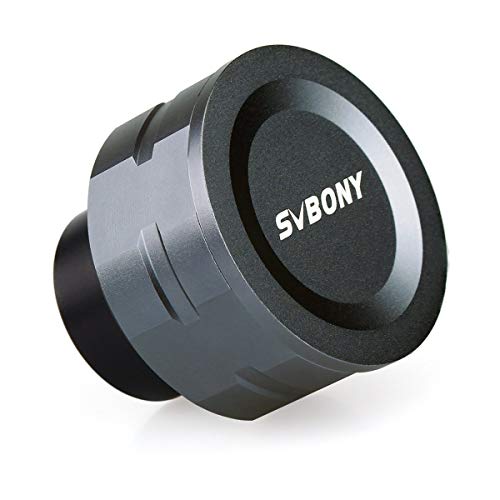
The ASI585MC is a small, lightweight USB camera built around a modern back-illuminated color sensor. Its small pixels and high frame rates make it particularly effective for the Moon, Jupiter, Saturn, and the Sun when used with a properly filtered telescope. Recording thousands of frames lets planetary software select and stack the sharpest moments through atmospheric turbulence.
It can also photograph brighter deep-sky targets, especially with short-exposure stacking, but its small sensor produces a narrow field of view. That makes large nebulae and extended galaxies difficult to frame. It has no active cooling, so it is less consistent than the ASI2600MC Pro for multi-hour exposures.
Which camera fits your situation?
| Your situation | Best choice | Why |
|---|---|---|
| First dedicated camera, tracking mount, regular deep-sky sessions | ASI2600MC Pro | Low noise, large APS-C field, cooling, and straightforward one-shot color workflow |
| Dark-sky trips with no telescope or computer | Sony a7S III | Battery-powered, excellent lens compatibility, and strong high-ISO performance |
| Planetary imaging on a limited budget | ASI585MC | Small pixels, high frame rate, low weight, and a modest purchase cost |
| One camera for high-resolution daylight and stars | Nikon Z8 | High-resolution full-frame files and a broad Z-mount lens system |
| Permanent observatory or advanced color workflow | QHY268C | Cooled APS-C performance with extensive gain and integration controls |
Sensor noise, dynamic range, and ISO: what matters in practice
Cooling is most valuable when exposures are long and repeated. A cooled sensor can hold a target temperature, making dark-frame calibration reliable. An uncooled camera can still produce excellent results, especially for exposures of 10–30 seconds, but its noise changes as the night warms or cools.
High ISO does not make a camera collect more photons. It amplifies the signal and can reduce the visibility of read noise, but it also reduces highlight headroom. For tracked deep-sky work, use the camera’s low-noise gain range and let stacking increase the final signal. For a fixed tripod, higher ISO can be useful because exposure time is limited by star trailing.
Dynamic range matters when a bright star sits beside faint nebulosity. A camera with low read noise and a high full-well capacity preserves more of both. Pixel size is not an automatic quality score: larger pixels help per-pixel sensitivity, while smaller pixels can provide better sampling with short focal lengths or planetary telescopes.
A practical ownership and setup checklist
- Balance the telescope and camera on the mount before connecting cables. A front- or rear-heavy setup increases tracking errors and can cause cable snags.
- Set a repeatable temperature on a cooled camera, then build a library of dark frames at the same temperature, gain, and exposure length.
- Use a proper UV/IR-cut or light-pollution filter only when its spectral effect suits the target. Filters can change star color and require new calibration frames.
- Take flat frames after changing the camera rotation, filter, reducer, or dust configuration. Flats correct vignetting and dust shadows that stacking cannot remove by itself.
- Keep the sensor chamber sealed. Dust cleaning, desiccant replacement, USB cable strain, and dew control are more common ownership concerns than sensor wear.
A useful budget calculation is to separate the camera from the imaging system. A $1,500 cooled camera may need a $1,000–$2,000 mount, telescope or lens, computer, filters, and power equipment. If you image twice a month for three years, that is 72 sessions; a $4,000 complete setup works out to about $56 per session before travel and consumables. For occasional trips, a mirrorless camera and lens can therefore be the better value even when its raw deep-sky performance is lower.
Final verdict
Buy the ZWO ASI2600MC Pro if deep-sky imaging is your main goal and you already have, or plan to buy, a tracking mount. Choose the Sony a7S III for portable Milky Way photography and lens flexibility, the Nikon Z8 for high-resolution hybrid use, the QHY268C for an advanced cooled color system, and the ZWO ASI585MC when planetary imaging and low cost matter most.