Key takeaways
- Increment printing: Look for blades that mark every 1/8-inch with a printed fraction and every 1/16-inch with a clear tick. Tapes that only print 1/8-inch fractions are faster to read at a glance; tapes that print both 1/8 and 1/16 are more precise but can look busier.
- Blade clarity: High-contrast colors (black fractions on white/yellow blade, red for 16-inch stud centers) and large font size reduce eye strain. Matte coating reduces glare under work lights.
- Blade width and standout: A 1-1/4-inch wide blade typically gives 9 to 11 feet of standout, which helps when measuring solo. Wider blades are more readable but heavier.
- Hook and lock: A riveted, slightly loose end hook is supposed to slide to compensate for inside vs. outside measurements. If it gets bent or caked with debris, all your reads will be off by 1/16-inch.
The best fractional tape measure for most users is a 25-foot x 1-1/4-inch wide-blade model that prints the actual fractions (like 1/8, 1/4, 3/16) directly on the blade in contrasting colors, because it eliminates mental math, reduces misreads, and still has enough standout and durability for jobsite and home use.
Our top picks



As an Amazon Associate we earn from qualifying purchases at no extra cost to you. Ratings are shown as listed on Amazon.
Why a Fractional Tape Measure Saves Time and Mistakes
A standard tape measure forces you to count tiny hash marks and convert them to fractions in your head. A fractional tape measure prints the fraction at each mark, so you read “3-1/2” or “7-5/8” instead of counting “seven ticks past the half.” That difference matters when you are cutting trim, building cabinets, or doing repetitive measuring where a 1/16-inch error ruins a joint.
Key features that actually affect accuracy and speed:
- Increment printing: Look for blades that mark every 1/8-inch with a printed fraction and every 1/16-inch with a clear tick. Tapes that only print 1/8-inch fractions are faster to read at a glance; tapes that print both 1/8 and 1/16 are more precise but can look busier.
- Blade clarity: High-contrast colors (black fractions on white/yellow blade, red for 16-inch stud centers) and large font size reduce eye strain. Matte coating reduces glare under work lights.
- Blade width and standout: A 1-1/4-inch wide blade typically gives 9 to 11 feet of standout, which helps when measuring solo. Wider blades are more readable but heavier.
- Hook and lock: A riveted, slightly loose end hook is supposed to slide to compensate for inside vs. outside measurements. If it gets bent or caked with debris, all your reads will be off by 1/16-inch.
Best Fractional Tape Measures Compared: Specs That Matter
Not all fractional tapes are equally legible or durable. These widely available models from established 2026 brands represent the main design approaches, from budget to pro-grade wide blade.
| Model / Type | Length x Blade Width | Smallest Printed Fraction | Standout (Approx.) | Blade Coating | Weight |
|---|---|---|---|---|---|
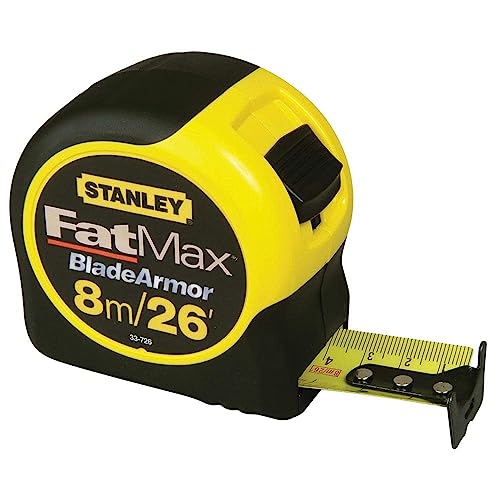
| Stanley FatMax Fractional (33-725 type) | 25 ft x 1-1/4 in. | 1/16 in. printed | 11 ft | Mylar polyester + BladeArmor | ~13.2 oz |
| Milwaukee Wide Blade Fractional (48-22-8625 type) | 25 ft x 1-1/4 in. | 1/8 in. printed, 1/16 ticks | 10 ft | Nylon bonded, matte | ~14.5 oz |
| DeWalt Tough Series Fractional (DWHT36107 type) | 25 ft x 1-1/4 in. | 1/8 in. printed, 1/16 ticks | 13 ft | Thermo-plastic coating | ~15.0 oz |
| Lufkin Crescent Self-Centering Fractional | 25 ft x 1 in. | 1/8 in. printed | 7 ft | Clear lacquer | ~10.8 oz |
| Komelon Speed Mark Fractional (SM5425 type) | 25 ft x 1-1/4 in. | 1/8 in. printed with vertical fractions | 8 ft | Acrylic coated | ~12.4 oz |
Takeaway: If you want maximum readability for finish work, the Stanley-style approach that prints every 1/16-inch fraction leaves zero guessing. If you want a cleaner blade for fast framing, the Milwaukee and DeWalt approach that prints only 1/8-inch fractions and uses ticks for 1/16-inch reduces visual clutter. The Lufkin 1-inch blade is lighter and fits better in an apron or pocket but sacrifices standout and large print.
Decision Matrix: Which Fractional Tape Fits Your Situation?
Choose based on how you will actually use it, not just length.
| Your Situation | Best Fit | Why |
|---|---|---|
| Beginner DIYer, occasional home repairs, budget under $20 | 1-inch wide, 16 ft or 25 ft fractional tape (Lufkin or Komelon style) | Lighter, cheaper to replace, fractions are large enough for learning, less fatigue for overhead measures |
| Trim carpenter, cabinet installer, or furniture maker | 25 ft x 1-1/4 in. with 1/16 printed fractions (Stanley FatMax type) | Every 1/16 is labeled, so you can call out and cut without converting ticks under poor lighting |
| Framer, general contractor, solo measuring long spans | 25 ft x 1-1/4 in. wide-blade with high standout (DeWalt Tough or Milwaukee Wide Blade) | Blade stays rigid over studs and headers, housing is impact-resistant for drops |
| Teacher, maker space, or anyone teaching fractions | Tape with vertical fraction printing (Komelon Speed Mark type) | Vertical orientation lets you read the fraction without tilting your head when the blade is extended |
| Tool-belt everyday carry, wants compact size | 16 ft compact fractional | Shorter blade retracts faster, less weight on belt, still covers 90% of interior measurements |
How to Read Fractions Correctly: A 30-Second Worked Example
Most tape reading errors are not about the tape, but about mixing up 8ths and 16ths. Here is how to avoid it:
Step-by-step read
Say your hook is at the end of a board and the blade shows the mark just past the 7-inch line:
- Find the nearest printed inch number: 7
- See if there is a printed fraction right at the mark. If it says 5/8, you are at 7-5/8 inches. Done.
- If there is no printed fraction but a tick, count the ticks to the next printed fraction. Example: the mark is one tick past 1/2 (which is 8/16). One tick is 1/16, so 8/16 + 1/16 = 9/16. Your measurement is 7-9/16 inches.
Quick check for cuts
If you need to cut two pieces at 7-9/16 inches from a 96-inch board, do the math before you cut: 7-9/16 = 7.5625 inches. Two pieces = 15.125 inches, leaving 80.875 inches (80-7/8 inches) of usable stock. Adding the fractions on paper first prevents the common mistake of cutting 7-5/8 by misreading one tick.
Durability and Ownership Realities: What Actually Wears Out
Fractional tapes fail in predictable ways. Knowing what to expect extends life far beyond the general market range of $12 to $35 for these models.
- First to wear: The first 6 inches of blade. This section is pulled, bent over edges, and used to mark with pencils and knives. The printed fractions and coating wear off here first. Wipe the blade clean instead of letting it snap back through sawdust and drywall dust, which acts like sandpaper inside the housing.
- Hook rivets loosen. A drop onto concrete can bend the hook 1/32-inch and throw off every inside measurement. Check accuracy monthly by hooking on a known straight edge and comparing inside vs. outside reads against a steel ruler.
- Blade kink at standout limit. Exceeding standout repeatedly creases the blade. Once kinked, it will never retract smoothly and will crack at the kink within weeks. Retract slowly and use a second hand for spans over 8 feet even if the tape claims 11 feet.
- Lock and spring fatigue. Nylon and Mylar coatings add life, but the retraction spring loses tension after 2-3 years of daily pro use. If retraction becomes sluggish, open the housing and blow out debris with compressed air; do not oil the spring, which attracts more grit.
- Cleaning: Wipe with a dry microfiber cloth. For sticky residue, use isopropyl alcohol on the cloth, never directly on the blade. Avoid leaving the tape in a hot truck or wet toolbox, which delaminates the coating and rusts the hook spring.
Common mistake: using the tape as a straight edge for a utility knife. The blade edge is not hardened for cutting and the hook will be nicked, making future reads inaccurate. Use a dedicated square or ruler for cutting guides.
What to Check Before You Buy
Since specifications do not tell the whole story, check these in person when possible:
- Can you read the 1/16 fractions without glasses at arm’s length under fluorescent light? Font size varies significantly even at the same blade width.
- Does the lock hold firmly without requiring two hands? A thumb lock that slips under tension is a safety issue.
- Is the housing comfortable for your hand size? Wide-blade 1-1/4-inch housings are bulky in smaller hands and snag in pockets.
- Do you need both SAE and metric? Some fractional tapes print metric on the bottom edge, which halves the font size for the fractions.
For most homeowners who want to eliminate guesswork, a mid-range 25-foot fractional tape with printed 1/8 and 1/16 marks and a matte, nylon-coated blade offers the best balance of clarity, standout, and long-term durability without paying a premium for extreme standout you will rarely use.
FAQ
Are fractional tape measures less accurate than standard tapes?
No. The underlying blade graduations are the same. Accuracy depends on blade printing tolerances and hook calibration, not on whether the fraction is printed. Both types are typically accurate to within 1/32-inch over 12 feet when new.
Should I get a 16-foot or 25-foot fractional tape?
Get 25-foot if you ever measure wall-to-wall, ceiling height, or lumber. The weight penalty is only about 2 to 4 ounces, and the price difference is usually a few dollars. Get 16-foot only if you work exclusively on small crafts, HVAC, or electrical boxes and want a lighter carry.
Why do some fractional tapes only print to 1/8-inch?
Printing every 1/16 makes the blade crowded, especially on 1-inch wide blades. Many pros prefer 1/8 printed fractions with smaller ticks for 1/16 because it is faster to scan. If you do fine finish work, choose a model that prints every 1/16.