Key takeaways
- Thread size: the filter thread printed on the lens front (for example 58 mm, 67 mm or 77 mm) sets which screw-in hood fits. Check the number on the lens or in the manual before buying a set.
- Bayonet lenses: if the lens has a bayonet mount for its hood and no usable filter thread in front, a screw-in kit will not attach. Use the matched hood.
- Wide zooms: an extended generic hood on a 16 mm or 24 mm equivalent lens can darken the corners. Test by shooting a plain wall at the widest setting and check the edges.
- Filters: a screw-in hood sits in front of any screw-on filter. Slim filters usually allow it; stacked filters may not.
- Lens caps: some rubber hoods accept the normal front cap, others require a pinch cap or a removal step first.
- Reverse mounting: petal and rubber hoods generally reverse onto the lens for storage. Confirm in the lens manual that the hood is meant to be stored that way.
For most photographers, a multi-size collapsible rubber hood set is the practical pick, because one kit covers several filter threads and folds flat in a bag, while a lens-specific petal hood is the better choice for a single prized lens and for wide-angle zooms where vignetting is a real risk. The right set depends on what you shoot, how many lenses you own and how much bulk you will tolerate.
Our top picks

As an Amazon Associate we earn from qualifying purchases at no extra cost to you.
What a lens hood set actually does
A hood blocks stray light that falls outside the frame but still reaches the front element. That light lowers contrast, adds haze and produces flare or ghosting when a bright source sits just outside the picture. A hood also gives the front element a measure of physical protection from bumps, rain splashes and fingers. It does not replace a filter against dust or salt spray, and it does not remove flare caused by a light source inside the frame.
Sets are sold because many photographers own several lenses with different front threads. Rather than buy an individual hood for each, a set bundles hoods or a hood with step rings so that one purchase can cover a range of lenses. The trade-off is that a generic hood is not shaped to a specific field of view, so it either shades less than a matched hood or, if it is too deep, cuts into the corners of the image.
Types of hood found in sets
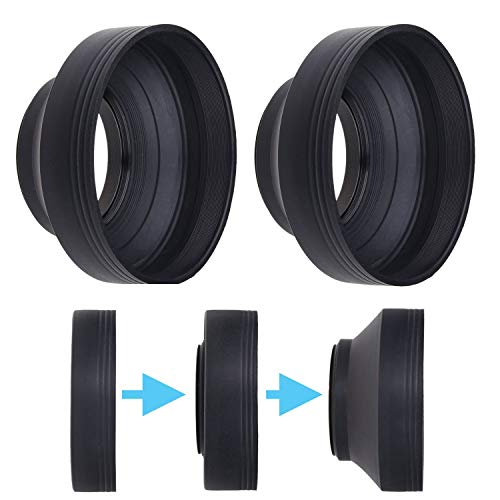
Collapsible rubber hoods
These screw onto the filter thread and fold back over the lens barrel. Makers such as JJC, K&F Concept, Neewer and Vello sell multi-size rubber hoods and kits that include several thread sizes. They suit travel, street and general use, and the rubber tolerates knocks. Their weakness is shape: most are round or only mildly scalloped, so they give moderate shading and can vignette on very wide lenses when extended.
Tulip or petal hoods
The cut-outs follow the rectangular frame, which allows a deeper hood without clipping the corners. Original-maker hoods are the standard answer and typically bayonet-mount to a specific lens. Third-party screw-in petal hoods exist but are less precisely matched. The petal design protects best and shades best, yet it only works properly when it is rotated into the correct orientation.
Tubular and cylindrical hoods
Plain tubes are common on telephotos, portrait primes and cine-style lenses. They provide strong shading at long focal lengths, where the field of view is narrow enough that the corners are not at risk. They are a poor match for wide zooms.
Hoods with step rings
Some kits pair one or two hoods with a set of step-up rings. This lets a single hood fit several lenses, and the quality of the result depends on the ring tolerances and on whether the hood is deeper than your widest lens can handle.
At a glance
| Set type | Best for | Key stated traits | Limits |
|---|---|---|---|
| Multi-size collapsible rubber kit | Travel and mixed lens kits | Screw-in, folds back for storage, several thread sizes in one box | Moderate shading, can clip corners on very wide lenses |
| Lens-specific petal hood (original maker) | One or two key lenses | Bayonet mount, shaped to the lens field of view | Fits only the named lens, bulkier in a bag |
| Third-party petal or tulip hood | Owners who want a spare or lighter option | Often sold per lens model | Fit tolerance varies by maker |
| Tubular hood | Telephoto and portrait lenses | Deep, simple shading | Unsuitable for wide angles |
| Hood plus step-ring set | Video shooters sharing one hood across lenses | One hood, multiple adapters | Extra rings add thickness and can vignette |
Fit, size and compatibility notes
- Thread size: the filter thread printed on the lens front (for example 58 mm, 67 mm or 77 mm) sets which screw-in hood fits. Check the number on the lens or in the manual before buying a set.
- Bayonet lenses: if the lens has a bayonet mount for its hood and no usable filter thread in front, a screw-in kit will not attach. Use the matched hood.
- Wide zooms: an extended generic hood on a 16 mm or 24 mm equivalent lens can darken the corners. Test by shooting a plain wall at the widest setting and check the edges.
- Filters: a screw-in hood sits in front of any screw-on filter. Slim filters usually allow it; stacked filters may not.
- Lens caps: some rubber hoods accept the normal front cap, others require a pinch cap or a removal step first.
- Reverse mounting: petal and rubber hoods generally reverse onto the lens for storage. Confirm in the lens manual that the hood is meant to be stored that way.
Budget, mid-range and premium tiers
Budget
Entry kits from third-party brands bundle several rubber hoods and often a few adapters. They work well on mid-length lenses and on travel setups. Expect some plastic threads, looser tolerances and mild vignetting at the widest setting of a wide zoom. For casual shooting this is a sensible way to cover a handful of lenses.
Mid-range
Mid-priced options include better-made rubber hoods with metal threads, slim-profile designs and sets that carry a case. Reviewers of accessory gear commonly point to thread quality, rubber flexibility and finish as the differences. This tier suits enthusiasts with three to five lenses.
Premium
The premium option is the original-maker hood for each lens. The maker designs the petal depth against the exact field of view, and the bayonet fit is positive. For a prized wide-angle or a fast zoom, the matched hood gives the best shading with no corner cut. The cost is that each lens needs its own hood.
Pick X if…
| If you… | Choose | Why |
|---|---|---|
| Own several lenses with different threads and travel often | Multi-size collapsible rubber kit | One kit covers many lenses and packs flat |
| Shoot a wide-angle zoom for landscapes or interiors | Original petal hood | Shaped to the frame, avoids corner vignetting |
| Use a telephoto or an 85 mm portrait prime | Tubular or original hood | Deep shading with no corner risk |
| Shoot video across several lenses | Hood with step rings | Keeps one hood in the kit bag |
| Want a spare hood for a lens you use outdoors | Third-party petal hood | Lower cost than a second original |
| Use stacked filters often | Slim bayonet or matte-box style hood | Avoids thread conflicts with filter stacks |
Care and handling
Rubber hoods collect dust and grit in the folds, so rinse them occasionally and let them dry fully before storing. Do not use solvent on rubber, which can stiffen or crack it. For plastic and metal hoods, a soft brush and a dry cloth are normally enough. Do not force a screw-in hood onto the filter thread: cross-threading can damage the lens front ring, and a damaged ring may be costly to repair. If a hood does not seat easily, back it off and restart. For bayonet hoods, align the index dots and turn until it clicks, and consult the lens manual for the exact procedure.
Take care when a hood is used as a carrying aid in the bag: a collapsed rubber hood can trap dirt against the front element. Keep the lens cap on during transport. If the front element is dusty, use a blower and a lens cloth rather than rubbing grit across the glass.
Common mistakes
- Buying a set by lens name rather than thread size, then finding the thread does not match.
- Extending a deep rubber hood on a wide lens and getting dark corners.
- Leaving a hood on while using a built-in flash, which can cast a shadow into the lower part of the frame at close range.
- Using a hood with a polarizer or filter that rotates, then forgetting that the hood can block the rotating ring.
- Assuming a hood will fix flare from a bright source inside the frame; reframing or changing angle is needed instead.
Alternatives to a hood set
- Lens-specific original hoods: the best fit for a single critical lens, at the cost of carrying a separate hood per lens.
- Matte box for video: a clamp-on or rod-mounted matte box shades several lenses and holds filters, but it is large and aimed at video work.
- Using a hand or card for shading: a quick field technique to cut flare, effective in emergencies but impractical for handheld work.
Frequently Asked Questions
Do I need a lens hood on every lens?
Most photographers benefit from one on lenses used outdoors, where side light and the sun can cause flare. On a bright indoor scene with no strong light sources, a hood has less effect, but the protection from bumps is still useful. Some compact lenses are designed without a hood, and in that case it is fine to skip one.
Will a generic hood fit my camera brand?
The hood attaches to the lens, not the camera body, so what matters is the filter thread diameter or bayonet type. A screw-in rubber hood in the right thread size works with any lens that has that thread. A bayonet hood only fits lenses made for it.
Why are the corners of my photos dark with a hood on?
The hood is probably too deep for the lens focal length, so it cuts into the picture area. Collapse or retract it partway, switch to a petal-shaped hood meant for that lens, or zoom in slightly. Corner darkening at the widest setting is a common sign of a mismatched hood.
Can a hood replace a UV or protective filter?
A hood protects against knocks and glare from the side, but it does not seal the front element against dust, moisture or fingerprints. Some photographers use both. A filter adds a layer of glass, so choose one with a good coating if you are concerned about flare.
Is a rubber hood or a plastic hood better?
Rubber tolerates impact and folds back for storage, while rigid plastic or metal holds its shape and usually gives a more exact fit. Rubber suits travel and rough use. Rigid hoods suit lens-specific shading and video work.
How do I know which size to buy?
Read the filter thread size marked on the front ring of the lens or listed in the maker’s specifications, then match it to the thread sizes included in the set. If the lens takes a bayonet hood, look up the matching part in the maker’s accessory list.
More from Amazon
Programs that pair well with the guide above. Offers and eligibility are set by Amazon and may change.
Free shipping on eligible items, Prime Video and more. Eligible new members can start with a free trial.
Start a Prime free trialAudiobooks and podcasts to listen to on the go. Eligible new members can start with a free trial.
Try Audible freeAd-free music streaming. Eligible new subscribers can start with a free trial.
Try Music Unlimited freeA free business account with business pricing and bulk-buying tools for work, shop or home office.
Create a business accountAs an Amazon Associate we earn from qualifying purchases.