Key takeaways
- We compare five bright LED panel lights for video, from pocket RGB panels to 200W Bowens monolights, to help you light YouTube and studio shoots.
Good lighting does more for your video than almost any camera upgrade. A soft, color-accurate key light flatters skin tones, separates your subject from the background, and lets your camera work at lower sensitivity, which keeps footage cleaner. The trouble is that the market is crowded with panels that look alike on a listing yet behave very differently on set. Some run hot, some shift color as you dim them, and some ship with batteries that last barely an hour.


This guide narrows the field to five LED panel lights that cover the full range of video work, from a pocket RGB panel you can clip to a camera to a 200W Bowens-mount monolight that can key a whole interview scene. Every pick below was chosen for color accuracy, usable brightness, flexible power, and a mount system that plays well with the modifiers you already own.
As an Amazon Associate, we earn from qualifying purchases.
How to Choose an LED Panel Light for Video
Before you compare models, it helps to know the four specs that matter most. First is color accuracy, measured by CRI and TLCI. A CRI of 95 or higher means the light renders skin tones and product colors faithfully, without the green or magenta cast that cheaper panels introduce. Anything below 90 will force you to correct color in editing, and some casts cannot be fixed cleanly.
Second is brightness, usually quoted in lux at one meter. A pocket light that delivers 1,250 lux at close range is plenty for a webcam or a phone vlog, while a key light for an interview should deliver tens of thousands of lux at one meter so you can place it several feet away and still shape it through a softbox. Always check the distance attached to a lux figure, because lux falls off fast as you move the light back.
Third is color temperature and power. Daylight-balanced panels sit near 5600K and match window light, while bi-color panels slide from warm tungsten near 3200K to daylight, and RGB panels reach a far wider range for creative color washes. On power, studio lights run on AC mains and never run flat, while battery-powered panels and lights that accept V-mount batteries free you from wall outlets on location. The most flexible lights accept both. Also check the mount: a Bowens mount opens up a huge world of softboxes, grids, and reflectors, while a cold shoe mount suits on-camera use.
1. Aputure Amaran 200d
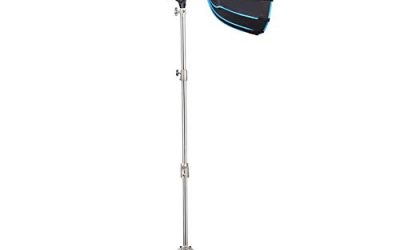
The Amaran 200d is the most powerful light in this roundup, and it is the pick for creators who want a true key light rather than a fill. Its 200W daylight-balanced COB LED pushes 65,000 lux at one meter with the included hyper-reflector, which is enough to light a two-person interview through a large softbox or to punch through a window on a bright afternoon. Despite that output, the lamp head stays compact and light enough to mount on a standard light stand.
Color accuracy is excellent, with a CRI of 95 or higher and a TLCI of 96 or higher, so skin tones stay natural even when the light is your only source. The fixed 5600K daylight temperature matches window light and pairs cleanly with daylight-balanced practicals. Dimming runs from 0 to 100 percent without a visible color shift, and eight built-in lighting effects let you simulate flicker, fire, or a passing storm for creative shots. Bluetooth app control means you can adjust brightness from behind the camera instead of walking over to the fixture.
The Bowens mount is a major advantage, because it accepts the softboxes, lanterns, and grids that most video creators already own. Power comes from an AC adapter for studio work, and the light also accepts DC input for battery setups on location. A quiet fan keeps the head cool during long takes. If you are building a serious home studio or lighting interviews regularly, this is the light to build around.
Specs
- 200W daylight COB LED; 5600K color temperature; CRI 95+ and TLCI 96+; 65,000 lux at 1m with hyper-reflector; 0-100% dimming; 8 lighting effects; Bowens mount; Bluetooth app control; AC and DC power.
2. Godox SL60W
The Godox SL60W has been a staple of budget home studios for years, and it remains one of the easiest ways to get a Bowens-mount key light without spending much. Its 60W daylight LED delivers a clean, even beam that works well as a key for talking-head videos, product demos, and small interviews. The output is modest next to the 200W lights in this guide, but for a desk setup or a small room it is more than enough, especially when paired with a softbox.
Color accuracy is strong for the class, with a CRI of 95 or higher, so faces look healthy and products keep their true hues. The fixed 5600K daylight temperature matches window light, and the 433MHz wireless grouping system lets you adjust brightness from a remote instead of reaching for the dial on the back of the unit. Dimming is smooth across the full range, and the Bowens mount accepts the same softboxes and modifiers as far more expensive lights.
The SL60W runs on AC mains power through its included adapter, which keeps the setup simple for a permanent studio corner. Its fan is audible in a silent room, so for whisper-quiet interview work you may want to place it a little farther back. For creators setting up their first dedicated video space, this light delivers the core of a professional look at an entry-level outlay.
Specs
- 60W daylight LED; 5600K color temperature; CRI 95+; Bowens mount; 0-100% dimming; 433MHz wireless remote grouping; AC mains power.
3. NEEWER 660 LED Video Light
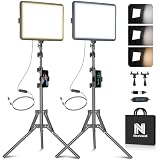
The NEEWER 660 is the classic flat panel of this roundup, and its shape is its strength. Instead of a single point source, 660 individual LEDs spread light across a wide surface, which produces a soft, even wash that flatters faces with little fuss. It works beautifully as a key for a desk setup, as a fill beside a window, or as a broad wash behind a product table. The included U-bracket tilts the panel to any angle, and the barn doors help you flag light off a background.
Bi-color control slides the temperature from 3200K warm tungsten to 5600K daylight, so you can match a cozy living room lamp or a bright window without gels. Color accuracy is rated at CRI 96 or higher, which keeps skin tones honest across the whole temperature range. Dimming is stepless, so you can fine-tune exposure without touching your camera settings.
Power is where this panel earns its keep for location work. It runs on AC mains power in the studio and also accepts two NP-F style batteries, so you can carry it to a client office or an outdoor shoot with no outlet in sight. The metal frame feels sturdy, and the panel is slim enough to pack flat in a gear bag.
Specs
- 660 LED beads; 40W; 3200-5600K bi-color; CRI 96+; stepless dimming; U-bracket and barn doors; AC mains or dual NP-F battery power.
4. ULANZI VL120 RGB

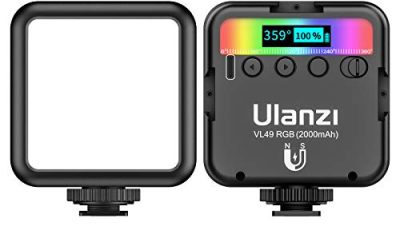
The ULANZI VL120 RGB is the smallest light here, about the size of a credit card, and it solves a different problem than the studio lights above. It clips onto a camera hot shoe, a phone rig, or a mini tripod, and it adds a kiss of light exactly where a built-in camera light cannot reach. It is ideal for vlogging, close-up product shots, video calls, and filling shadows when you film handheld.
Despite its size, the VL120 RGB is a full-color tool. It offers 360-degree RGB color control with adjustable saturation, a bi-color temperature range from 2500K to 9000K, and 20 built-in scene effects that simulate lightning, a passing police car, candlelight, and more. Color accuracy is rated at CRI 95 or higher, so even its colored output stays clean and usable rather than muddy.
The built-in 3100mAh battery runs for up to two hours at full brightness and far longer at low output, and it charges over USB-C, even while the light is in use. Maximum brightness reaches 1,250 lux at 0.3 meters, which is plenty at arm’s length. A silicone diffuser softens the output, and a cold shoe adapter is included in the box.
Specs
- 120 LED beads (84 bi-color, 36 RGB); 2500-9000K; CRI 95+; 360-degree RGB color; 20 scene effects; 1,250 lux at 0.3m; built-in 3100mAh battery; USB-C charging; 0-100% dimming.
5. Godox SL100D

The Godox SL100D sits in the sweet spot between the budget SL60W and the flagship 200W monolights. Its 100W daylight COB LED delivers 32,100 lux at one meter, which is enough to key a single-person interview through a medium softbox with room to spare, while the fixture itself stays compact and easy to rig on a standard stand. It is a natural upgrade for creators who have outgrown a 60W light but do not need the full output of a 200W unit.
Color accuracy is a step up as well, with a CRI of 96 or higher and a TLCI of 97 or higher, so skin tones and product colors hold up under close inspection. The fixed 5600K daylight temperature matches window light, and eight built-in lighting effects cover flicker, fire, and storm looks for creative scenes. Bluetooth app control lets you adjust brightness and effects from your phone, which is handy when the light is rigged high on a stand.
The Bowens mount accepts the same softboxes, grids, and reflectors as the rest of the SL series, so any modifiers you bought for a smaller Godox light carry straight over. The SL100D runs on AC mains power, which suits a fixed studio setup, and its fan is quiet enough for interview work at normal distances.
Specs
- 100W daylight COB LED; 5600K color temperature; CRI 96+ and TLCI 97+; 32,100 lux at 1m; 0-100% dimming; 8 lighting effects; Bowens mount; Bluetooth app control; AC mains power.
Which Light Fits Your Shoot?
If you film interviews or narrative work in a dedicated space, the Amaran 200d gives you the most headroom, and the Godox SL100D covers the same style of shooting at a more modest output. For a first home studio on a tight budget, the Godox SL60W delivers the essential Bowens-mount key light experience. The NEEWER 660 is the most flexible all-rounder, because its flat panel, bi-color range, and battery option adapt to desks, offices, and location work alike. And if you film handheld, travel light, or need a splash of color, the ULANZI VL120 RGB belongs in your pocket.
Think about your worst-case shoot, not your easiest one. If you ever need to overpower a sunny window, buy more output than you think you need. If you always film in one room, AC power and a Bowens mount matter more than batteries. Match the light to the room and the subject, and your footage will show it.
Frequently Asked Questions
What CRI should an LED panel light for video have?
Look for a CRI of 95 or higher for video work. At that level, skin tones and product colors render faithfully, and you will spend far less time correcting color in editing. Lights below 90 often add a green or magenta cast that is hard to remove cleanly.
How bright should a video key light be?
For a talking-head video at a desk, a panel delivering a few thousand lux at one meter is enough. For interviews lit through a softbox at a distance of several feet, aim for tens of thousands of lux at one meter, because a softbox absorbs a large share of the output before it reaches your subject.
Do I need a bi-color or RGB panel for video?
Not always. If you film in one room with consistent light, a daylight-balanced panel is fine. A bi-color panel earns its keep when you mix window light with warm room lamps, and an RGB panel adds creative color washes and effects that a plain white panel cannot produce.
Can I power an LED panel light with a battery on location?
Many panels accept NP-F or V-mount batteries, and pocket lights like the ULANZI VL120 RGB have a built-in battery. Check the battery type and the expected run time before you buy, because high-output monolights draw far more power than small panels and need larger batteries to run for a full shoot.
Final Thoughts
Good video lighting is less about owning the most expensive fixture and more about owning the right light for the way you shoot. A 200W monolight transforms an interview, a flat bi-color panel adapts to almost any room, and a pocket RGB light saves shots that would otherwise go unlit. Pick the light that matches your space, your subjects, and your power situation, and pair it with a softbox or diffuser to soften the output. Your camera will thank you, and so will everyone who watches your videos.
More from Amazon
Programs that pair well with the guide above. Offers and eligibility are set by Amazon and may change.
Free shipping on eligible items, Prime Video and more. Eligible new members can start with a free trial.
Start a Prime free trialAudiobooks and podcasts to listen to on the go. Eligible new members can start with a free trial.
Try Audible freeAd-free music streaming. Eligible new subscribers can start with a free trial.
Try Music Unlimited freeA free business account with business pricing and bulk-buying tools for work, shop or home office.
Create a business accountAs an Amazon Associate we earn from qualifying purchases.