Key takeaways
- Choose a 2-by-4 kit for the best balance of cost, space, and manageable plant numbers. Pick a 4-by-4 VIVOSUN-style kit when canopy area matters most and you are prepared for stronger ventilation. Choose AC Infinity when integrated control and a tidy system are priorities, Spider…
The best grow tent kits for most indoor gardeners are the AC Infinity CLOUDLAB 642 for a well-integrated 4-by-2-foot setup, the VIVOSUN 4-by-4 kit for lower-cost full-size coverage, and a Gorilla Grow Tent paired with a separate light and ventilation system when durability and upgradeability matter more than convenience.
The right choice depends less on the tent’s advertised wattage than on four practical questions: how many plants you want to grow, how much floor space you have, whether the included light covers the entire canopy, and how much noise and heat your room can tolerate. A small kit can be economical for two to four plants, while a 4-by-4 kit offers more usable area but usually needs stronger ventilation and a larger electrical budget.
Our top picks



As an Amazon Associate we earn from qualifying purchases at no extra cost to you. Ratings are shown as listed on Amazon.
Best grow tent kits compared
| Kit type or example | Typical tent size | Practical plant count | Light coverage | Ventilation commonly included | Typical setup time | Best for |
|---|---|---|---|---|---|---|
| AC Infinity CLOUDLAB 642 kit | 2 ft × 4 ft × 6 ft 7 in | 2–4 medium plants | About 8 sq. ft. | 4-inch inline fan, ducting, carbon filter, controller | 60–90 minutes | Quiet, organized growing in a narrow space |
| VIVOSUN 4 × 4 kit | 4 ft × 4 ft × 6.5–7 ft | 4–9 medium plants | About 16 sq. ft. | 6-inch inline fan and carbon filter on many configurations | 90–120 minutes | Budget-conscious gardeners needing more canopy area |
| Spider Farmer 2 × 4 kit | 2 ft × 4 ft × about 6.5 ft | 2–4 medium plants | About 8 sq. ft. | Usually 4-inch ventilation, depending on bundle | 60–90 minutes | Simple starter setup with a full-spectrum LED |
| Gorilla Grow Tent with separate components | Commonly 2 × 4 or 4 × 4 ft | 2–9 medium plants | Depends on selected LED | Depends on selected fan and filter | 90–150 minutes | Long-term ownership and component upgrades |
These figures are planning benchmarks rather than guarantees. A dense arrangement of small containers can hold more plants than a low-density layout with large pots, trellises, or tall varieties. Bundle contents also change between retailers and model generations, so confirm the fan size, LED wattage, controller, and filter before buying.
Best overall for a compact indoor garden: AC Infinity CLOUDLAB 642
A 2-by-4-foot AC Infinity CLOUDLAB kit is a strong all-in-one choice when floor space is limited but you want a more coordinated system. The long, narrow footprint fits against a wall, and its approximately 8-square-foot canopy is suitable for two large plants or four smaller ones. AC Infinity’s integrated controllers are particularly useful for coordinating light and fan schedules rather than relying on several independent timers.
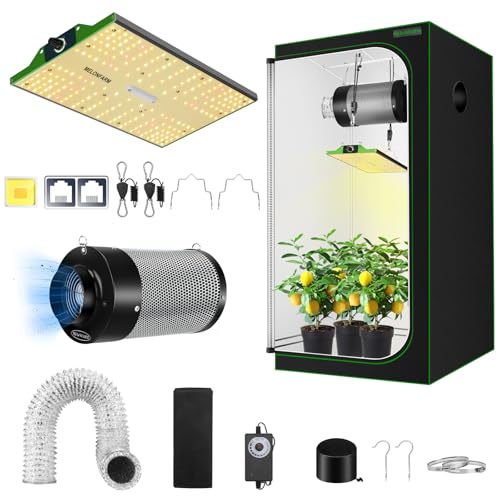
The main advantage is system compatibility. A typical kit includes a tent, full-spectrum LED, inline fan, carbon filter, ducting, hanging straps, and a controller. A 4-inch ventilation system is generally adequate for this volume if the room is not unusually hot. The limitation is headroom: after subtracting the light, hanging hardware, pot height, and a safe distance between the light and canopy, the usable vertical space is much less than the tent’s external height.
Choose this size if you want a manageable first garden, have a narrow alcove, or expect to check the plants frequently. It is less suitable if you want several large plants, a wide trellis, or enough room to work inside the tent without moving containers.
Best budget choice for more plants: a VIVOSUN 4 × 4 kit
A VIVOSUN 4-by-4 kit gives four times the floor area of a 2-by-2 tent and twice the area of a 2-by-4 tent. That makes it a better value when you already know you need room for four to nine medium plants, propagation trays, or a broad training layout. Many configurations include a 6-inch inline fan, carbon filter, LED light, ducting, and basic accessories.
The trade-off is that a larger tent magnifies every environmental problem. A 4-by-4 canopy needs a light that can illuminate all 16 square feet, not merely a bright spot in the center. It also produces more heat and humidity, so a 6-inch fan is usually more appropriate than a small 4-inch model. Check whether the listed LED power is its actual wall draw or a marketing-equivalent figure; the former is more useful for estimating heat and electricity.
VIVOSUN kits are attractive for buyers who want the lowest initial cost. Inspect the zipper alignment, duct ports, and frame joints during assembly, and avoid overloading the top bars with a heavy filter and light unless the manufacturer’s weight limits support that arrangement.
Best for a simple LED starter setup: Spider Farmer 2 × 4
Spider Farmer’s 2-by-4 kits are aimed at gardeners who want a straightforward LED-based package without selecting every component separately. The footprint works well for two to four plants, and a full-spectrum LED is normally included with a hanging kit, ducting, fan, filter, and basic monitoring or timer accessories depending on the package.
This format is easier to place than a 4-by-4 and generally costs less to operate. A useful selection target is an LED that can deliver even coverage across approximately 8 square feet at the intended growing height. If the light is substantially undersized, plants at the edges may stretch even when the center looks healthy.
Expect to add a small circulation fan, a reliable temperature-and-humidity meter, and spill protection for the floor. These items are inexpensive compared with replacing a damaged light or cleaning a room affected by excessive humidity.
Best for durability and future upgrades: Gorilla Grow Tent
Gorilla Grow Tent is better viewed as a premium tent platform than as a single fixed kit. The brand is known for thicker materials, reinforced construction, and height-extension options on some models. You then select the LED, inline fan, carbon filter, controller, and accessories separately.
This approach costs more initially, commonly several hundred dollars for the complete system and potentially more for a premium 4-by-4 configuration. Its benefit is flexibility: you can replace a fan without replacing the tent, choose a quieter controller, or upgrade the light as your growing method changes. It is a good fit for frequent use, rented spaces where leaks and noise matter, or anyone who expects to keep the setup for several growing cycles.
The disadvantage is decision complexity. A tent, light, fan, and filter from different manufacturers may use different controls and connectors. Before ordering, check the hanging weight, duct diameter, controller compatibility, and available electrical outlets.
Decision matrix: match the kit to your situation
| Your situation | Recommended direction | Why |
|---|---|---|
| First indoor garden, limited budget, 2–4 plants | 2 × 4 starter kit | Enough canopy for a useful harvest without the heat and equipment demands of a 4 × 4 |
| Narrow floor space, frequent plant monitoring | AC Infinity CLOUDLAB 642 or similar 2 × 4 kit | Efficient footprint and convenient integrated controls |
| Four or more medium plants, permanent growing area | 4 × 4 kit with a 6-inch fan | More usable canopy, but adequate ventilation is essential |
| Several growing cycles per year | Premium tent with separately selected components | Better opportunity to replace individual wear items and upgrade gradually |
| Noise-sensitive bedroom or living area | Smaller tent with a variable-speed inline fan and controller | Lower air volume and controllable fan speed make quiet operation easier |
| Large plants or a wide trellis | 4 × 4 tent with extra vertical clearance | More room for training, containers, and access around the canopy |
How to calculate the right light and tent size
Start with canopy area, not the number printed on the light box. A 2-by-4 tent has approximately 8 square feet of floor area; a 4-by-4 tent has approximately 16 square feet. If a light is rated for 8 square feet in the flowering or fruiting stage, placing it in a 4-by-4 tent will leave the perimeter underlit unless you add another fixture.
For example, suppose a kit includes a 240-watt LED and you operate it for 16 hours per day. Its maximum light energy use is:
240 watts × 16 hours = 3.84 kilowatt-hours per day.
Over 30 days, that is about 115 kWh before accounting for dimming. Add the fan, circulation fan, and any humidifier or heater when estimating running costs. The actual bill depends on your electricity rate, but this calculation exposes why a 4-by-4 system with two lights can cost noticeably more to operate than a single 2-by-4 setup.
Setup details that prevent common problems
- Assemble the frame on a clear floor and confirm that every corner is fully seated before adding the fabric.
- Install the light first, leaving enough adjustment range to raise it as plants grow. Do not let the fixture rest against the tent fabric.
- Place the carbon filter inside the tent when possible, connect it to the inline fan, and route the exhaust to a suitable room or duct outlet.
- Use a circulation fan to move air across the canopy without blasting one plant continuously.
- Run the fan and light for several hours before adding plants. Check temperature, humidity, zipper seals, unusual vibration, and whether the exhaust creates negative pressure.
- Keep electrical connections off the floor and use a surge-protected power strip that is rated for the combined load.
Negative pressure means the tent walls pull slightly inward while the exhaust fan runs. This helps keep odors and humid air from escaping through every seam, but it does not replace proper room ventilation.
Ownership costs and parts that wear first
Expect to replace carbon filters periodically as their odor-adsorbing material becomes saturated. The interval varies with humidity, odor load, and operating hours; a filter used continuously in a heavily scented garden may require replacement sooner than one used intermittently. Inline fan bearings, duct clamps, light-driver fans, zippers, and fabric seams are the other components most likely to need attention.
Clean the floor tray and nearby surfaces between plantings, wipe dust from the light and fan guards, and inspect ducting for kinks. Do not wash electrical equipment in place. One common mistake is hanging the carbon filter at the exhaust outlet outside the tent, which can allow unfiltered air to circulate inside before it reaches the filter. Another is buying a tent first and discovering that its height leaves insufficient room for containers and light clearance.
Bottom line
Choose a 2-by-4 kit for the best balance of cost, space, and manageable plant numbers. Pick a 4-by-4 VIVOSUN-style kit when canopy area matters most and you are prepared for stronger ventilation. Choose AC Infinity when integrated control and a tidy system are priorities, Spider Farmer when you want a simple starter bundle, and Gorilla Grow Tent when thicker construction and component-by-component upgrades justify the higher cost.