Our Short List of 3

- Best for: street photographers who want a fixed-lens camera with film looks and physical dials.
- 40.2MP X-Trans CMOS 5 HR sensor
- X-Processor 5
- Up to 6.0 stops in-body image stabilization
- 4-stop internal ND filter

- Best for: photographers who want film simulations with the freedom to change lenses.
- 40.2-megapixel X-Trans CMOS 5 HR sensor
- X-Processor 5
- In-body image stabilization
- 6.2K video in 4:2:2 10-bit internally
- Best for: shooters who want to switch film looks with a single dial turn.
- Dedicated Film Simulation dial on the top plate
- 20 unique Film Simulation modes including REALA ACE
- 40.2-megapixel X-Trans CMOS 5 HR sensor
- APS-C sensor, 23.5mm x 15.7mm
All 5 Picks at a Glance
| Product | Specs | Action |
|---|---|---|
| Fujifilm X100VI Digital Camera — Black |
| Check price on Amazon |
| Fujifilm X-T5 Mirrorless Digital Camera Body — Black |
| Check price on Amazon |
| Fujifilm X-T50 Mirrorless Digital Camera Body — Silver |
| Check price on Amazon |
 Ricoh GR IIIx Digital Compact Camera — Black |
| Check price on Amazon |
 OM SYSTEM OM-5 Mark II with M.Zuiko Digital 14-150mm f/4.0-5.6 II — Silver |
| Check price on Amazon |
Key takeaways
- Creative cameras reward experimenting with looks, dials, and light. Compare five cameras built for film simulations, manual controls, and street-ready shooting.
A creative photography camera is one that invites you to play with the look of an image before you ever open an editor. The cameras in this guide earn their place through film simulations, dedicated dials, in-camera looks, and compact bodies that make it easy to carry one everywhere and shoot often. They are not ranked on raw resolution or hybrid video specs; they are ranked on how much creative control they put in your hands and how naturally they fit a day of wandering, framing, and experimenting.
Each of the five picks below brings a different creative strength. One is built around a fixed lens and a dial-driven design that feels like a film camera, another puts a dedicated film simulation dial on the top plate, and the smallest is a pocket camera with a 40mm street focal length. Choose the one whose way of working matches yours, because the camera you enjoy holding is the one you will actually use.
Quick Picks
As an Amazon Associate we earn from qualifying purchases
| Product | Best for | Key spec from title |
|---|---|---|
| Fujifilm X100VI | Fixed-lens street shooting with film looks | 40.2MP X-Trans CMOS 5 HR sensor |
| Fujifilm X-T5 | Interchangeable-lens creative work | 40.2MP X-Trans CMOS 5 HR sensor |
| Fujifilm X-T50 | One-dial film simulation experiments | Dedicated Film Simulation dial |
| Ricoh GR IIIx | Pocketable 40mm street photography | 26.1mm f/2.8 GR lens, 40mm equivalent |
| OM SYSTEM OM-5 Mark II | Lightweight travel with a zoom kit | 14-150mm f/4-5.6 II kit lens |
How to Choose
Film Simulations and In-Camera Looks
The heart of a creative camera is the set of looks it can produce in the camera itself. Film simulations and in-camera looks change color, contrast, and grain at the moment of capture, so the image that comes out of the camera already carries a mood you chose. When comparing cameras, look for a wide menu of looks and a way to adjust them — a dedicated dial on the top plate is the most direct control, because it lets you switch styles without opening a menu. A camera that makes experimenting effortless will teach you more about your own taste than one that hides its looks three menus deep.
Dials, Controls, and the Shooting Experience
Creative shooting is a physical habit, and the camera’s controls shape it. Dedicated dials for shutter speed, ISO, and exposure compensation let you change settings by feel, while a camera that buries everything in touch menus slows you down and breaks concentration. A tilting screen helps when you shoot from low angles or over a crowd, and a bright viewfinder matters when you work in strong light. Hold the idea of the camera in mind as a tool you will carry for hours: a body that feels right in the hand and puts the important controls under your fingers will get used far more than a clever camera that fights you.
Size, Weight, and How Often You Carry It
The most creative camera is the one that is with you when the light turns interesting, so size and weight deserve as much attention as the sensor. A fixed-lens compact slips into a jacket pocket and goes everywhere, which is why so many street photographers choose one, while an interchangeable-lens body asks you to carry at least one lens and often a small bag. Think honestly about your habits: if you mostly shoot on walks and trips, a light body wins; if you plan deliberate sessions with different lenses, the extra weight is a fair trade for flexibility.
Lenses and Focal Lengths for Creative Work
Focal length shapes the story a photograph tells, and creative cameras differ widely here. A fixed 40mm lens forces you to move your feet and see the world at a natural, slightly tight angle, which suits street scenes and environmental portraits. An interchangeable body lets you swap between wide and telephoto looks, and a kit zoom that covers a broad range is the most flexible starting point for travel. Choose the focal length you reach for most often, not the one that sounds most impressive, because the lens you love using is the one that will shape your style.
The 5 Best Options
Fujifilm X100VI Digital Camera — Black
- Best for: street photographers who want a fixed-lens camera with film looks and physical dials.
- 40.2MP X-Trans CMOS 5 HR sensor
- X-Processor 5
- Up to 6.0 stops in-body image stabilization
- 4-stop internal ND filter
street photographers who want a fixed-lens camera with film looks and physical dials.
the fixed lens means no zooming, so you frame with your feet.
The X100VI is the purest creative camera in this guide because everything about it is built around the act of shooting. Its dial-based design puts shutter speed, ISO, and exposure compensation on the top plate, so changing a setting feels like turning a knob on a film camera rather than navigating a menu. The 40.2MP X-Trans CMOS 5 HR sensor and X-Processor 5 give the files plenty of room to work with, and the 4-stop internal ND filter lets you shoot wide open in bright light. Up to 6.0 stops of in-body image stabilization steadies handheld work, and 6.2K video is there when a scene asks for motion.
Watch out for: the fixed lens means no zooming, so you frame with your feet.
Fujifilm X-T5 Mirrorless Digital Camera Body — Black
- Best for: photographers who want film simulations with the freedom to change lenses.
- 40.2-megapixel X-Trans CMOS 5 HR sensor
- X-Processor 5
- In-body image stabilization
- 6.2K video in 4:2:2 10-bit internally
photographers who want film simulations with the freedom to change lenses.
it is a body-only listing, so budget for a lens separately.
The X-T5 takes the creative heart of the X100VI and opens it up to a full system of lenses, which makes it the pick for photographers who want film looks and interchangeable glass. The 40.2-megapixel X-Trans CMOS 5 HR sensor and X-Processor 5 sit behind a 3-way tilting LCD with 1.84 million dots, and the body weighs 557 g with battery and card, so it stays comfortable on walks. Film Simulations including Nostalgic Negativ give the images a distinct character straight out of the camera, and the mechanical shutter reaches 15fps when scenes move fast. The body-only listing means you choose the lens that fits your way of seeing.
Watch out for: it is a body-only listing, so budget for a lens separately.
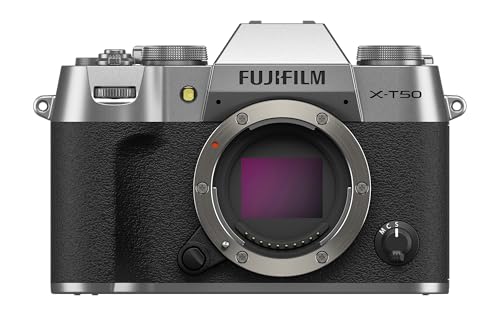
Fujifilm X-T50 Mirrorless Digital Camera Body — Silver
- Best for: shooters who want to switch film looks with a single dial turn.
- Dedicated Film Simulation dial on the top plate
- 20 unique Film Simulation modes including REALA ACE
- 40.2-megapixel X-Trans CMOS 5 HR sensor
- APS-C sensor, 23.5mm x 15.7mm
shooters who want to switch film looks with a single dial turn.
the compact body can feel small if you have large hands or mount heavy lenses.
The X-T50 is the camera for anyone who wants to experiment with film looks without thinking about it, as the first X Series camera with a dedicated Film Simulation dial on the top plate. Turning the dial steps through 20 Film Simulation modes including REALA ACE, so trying a new look takes a second rather than a menu dive. The same 40.2-megapixel sensor and X-Processor 5 as its bigger siblings sit inside a compact body with a redesigned handgrip, and up to 7.0 stops of in-body image stabilization steadies handheld shots. A 1.4x and 2x Digital Teleconverter extends the reach of a single lens when you need it.
Watch out for: the compact body can feel small if you have large hands or mount heavy lenses.
Ricoh GR IIIx Digital Compact Camera — Black
- Best for: street photographers who want a pocket camera with a 40mm view.
- 24MP (24.24 effective) APS-C-size CMOS sensor, AA filter-less design
- GR ENGINE 6
- 26.1mm f/2.8 GR lens (40mm in 35mm format)
- 3-axis, 4-step Shake Reduction (SR)
street photographers who want a pocket camera with a 40mm view.
the fixed 40mm lens offers no zoom, and there is no viewfinder.
The GR IIIx is the smallest camera here and the most single-minded, a pocket camera built around a 40mm street focal length that rewards moving closer and composing deliberately. Its newly developed 26.1mm f/2.8 GR lens gives a 40mm equivalent view, a natural angle for street scenes and environmental portraits, and the 24MP APS-C-size CMOS sensor with an AA filter-less design keeps detail crisp. The 3-axis, 4-step Shake Reduction steadies handheld shots, hybrid autofocus combines contrast and phase detection, and the 3.0-inch touch LCD makes it easy to change settings on the move. It is the camera you forget you are carrying until the moment arrives.
Watch out for: the fixed 40mm lens offers no zoom, and there is no viewfinder.
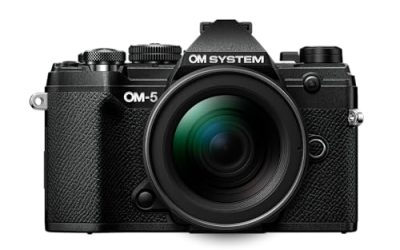
OM SYSTEM OM-5 Mark II with M.Zuiko Digital 14-150mm f/4.0-5.6 II — Silver
- Best for: travelers who want one light kit that covers wide to telephoto.
- 20.4 MP
- M.Zuiko Digital ED 14-150mm f/4-5.6 II lens, 10.7x optical zoom
- 370 g (body only)
- Weather sealed
travelers who want one light kit that covers wide to telephoto.
the variable-aperture zoom gathers less light at the long end than a fast prime.
The OM-5 Mark II kit is the travel pick in this guide, pairing a compact, weather-sealed body with a single zoom that covers an enormous range. The M.Zuiko Digital ED 14-150mm f/4-5.6 II lens gives 10.7x optical zoom, so one lens handles wide street scenes and distant details alike, and the body weighs only 370 g, which keeps the whole kit light in a day bag. The 20.4 MP sensor and 4K video cover stills and motion, and the weather sealing means a sudden shower does not end the shoot. This is the kit listing, so the lens is included and ready to use.
Watch out for: the variable-aperture zoom gathers less light at the long end than a fast prime.
Which One Fits Your Situation
You Shoot Street Scenes Every Day
The X100VI or the GR IIIx fits a daily street habit best, because both are ready the moment you pick them up. The X100VI gives you dials and film looks in a camera that feels deliberate, while the GR IIIx disappears into a pocket and asks for nothing but attention. Choose the X100VI if you enjoy the ritual of turning dials, and the GR IIIx if you want the smallest camera that still delivers a large-sensor image.
You Want One Camera for Many Kinds of Shoots
The X-T5 is the flexible choice when your creative work jumps between portraits, landscapes, and street scenes. Its interchangeable mount lets you add a wide lens for architecture one day and a portrait lens the next, while the film simulations keep every image carrying the same character. It is the largest commitment in this guide, but also the one that grows with your interests.
You Are Learning What Look You Like
The X-T50 is built for discovery, and its film simulation dial is the reason. Being able to turn a dial and see a different mood instantly teaches you faster than any tutorial which styles feel like yours. It is the best teacher in this group, and the compact body means you will carry it often enough to actually learn.
You Travel Light and Shoot Everything
The OM-5 Mark II kit suits a traveler who wants one bag, one lens, and no decisions about gear in the morning. The 10.7x zoom covers the range most trips demand, the weather sealing handles bad weather, and the light body keeps the kit comfortable across a full day of walking. It trades some of the character of the fixed-lens cameras for the freedom to shoot whatever appears.
Common Mistakes
- Buying for resolution instead of for the way you shoot. A bigger sensor number does not make a camera more creative, and every camera in this guide has more resolution than most creative work needs. What matters is whether the controls invite you to experiment and whether the body is one you will carry. A camera that stays home because it is heavy or awkward produces nothing, while a smaller camera you love using will teach you more in a month than a flagship you leave on a shelf.
- Ignoring the lens when you buy a body-only camera. The X-T5 and X-T50 listings are body-only, which means the total cost and the shooting experience depend entirely on the lens you add. A cheap, slow kit lens can hide what the body is capable of, while a lens that matches your favorite focal length makes the camera feel complete. Budget for the lens as part of the purchase and choose it for the subjects you shoot most, not for the widest zoom range on paper.
- Treating film simulations as a filter you apply later. The creative strength of these cameras is that the look is chosen at the moment of capture, shaping how you expose and compose. Shooting everything flat and planning to fix it in editing misses the point and adds hours of work. Try committing to one simulation for a whole day of shooting and see how it changes what you notice; the discipline of choosing a look in advance is where the creative growth happens.
- Forgetting that the OM-5 Mark II pick is a kit, not a body. The listing includes the 14-150mm lens, which is part of its value and its character — a single zoom that covers a huge range. If you compare its price or weight with body-only listings, you are not comparing like with like. Judge it as a complete travel kit, and if you already own lenses in the system, think about whether the zoom duplicates what you have before deciding it is the right pick.
- Choosing the smallest camera and then missing a viewfinder. The GR IIIx is pocketable and discreet, but it has no viewfinder, so all composing happens on the rear screen. In bright sunlight that can be frustrating, and some photographers never get comfortable shooting at arm’s length. If you know you rely on a viewfinder to connect with a scene, the X100VI or X-T5 will suit you better, even though they are larger. Try to be honest about how you actually shoot before choosing on size alone.
Frequently Asked Questions
What makes a camera creative rather than just good?
A creative camera gives you control over the look of your images and invites experimentation. Film simulations, in-camera looks, manual dials, and compact bodies all push you to make choices while shooting instead of fixing things later. An excellent camera with buried menus and no character can produce sharp files and still feel uninspiring, while a camera that makes trying a new look effortless will change how you see.
Do I need interchangeable lenses for creative photography?
No. Some of the most distinctive creative cameras have fixed lenses. A fixed lens makes you move, reframe, and see at one focal length, building a consistent style faster than swapping lenses. Interchangeable lenses help when subjects vary widely, but they are not required for creative work. Many photographers do their best work with a single focal length they know deeply.
Are film simulations better than editing in software?
They are different tools for different moments. A film simulation bakes a look into the image at capture, which speeds up your workflow and helps you learn what styles you like, because you see the result immediately. Editing software offers finer control and can rescue a file, but it also adds time after every shoot. Use simulations for the look and editing only for corrections, keeping screen time short.
Which creative camera is best for travel?
The OM-5 Mark II kit is the strongest travel pick here, pairing a light, weather-sealed body with a zoom that covers wide to telephoto, so one bag holds everything. If your travel style is street photography in cities, the X100VI or GR IIIx may suit you better, since they are smaller and more discreet. The travel camera covers the focal lengths you need without making you dread carrying it.
More from Amazon
Programs that pair well with the guide above. Offers and eligibility are set by Amazon and may change.
Free shipping on eligible items, Prime Video and more. Eligible new members can start with a free trial.
Start a Prime free trialAudiobooks and podcasts to listen to on the go. Eligible new members can start with a free trial.
Try Audible freeAd-free music streaming. Eligible new subscribers can start with a free trial.
Try Music Unlimited freeA free business account with business pricing and bulk-buying tools for work, shop or home office.
Create a business accountAs an Amazon Associate we earn from qualifying purchases.