Key takeaways
- Compare the 4 best 105mm camera lenses for mirrorless cameras, with native Nikon Z, Sony E, and L-mount macro primes plus one adapted F-mount option in detail.
A 105mm prime occupies a narrow but useful place in a mirrorless kit, pairing a short telephoto reach with true 1:1 macro. The focal length flatters portraits, isolates product details, and keeps a comfortable working distance from skittish insects, while the macro capability turns the same lens into a close-up tool for flowers, jewelry, and small products. Only a small number of true 105mm primes exist for mirrorless mounts, so the choice is short, the differences are clear, and the wrong mount is the most common buying error.

This guide covers the four verifiable 105mm primes sold on Amazon US, spanning Nikon Z, Sony E, and L-mount, plus one adapted F-mount lens for Nikon Z shooters. The pool is thin by nature: no Canon RF-mount 105mm exists and Sigma makes no RF version of this lens, so Canon RF owners will not find a pick here. Every lens below is a true 105mm prime, not a zoom that happens to cover the focal length.
Quick Picks
As an Amazon Associate we earn from qualifying purchases
| Product | Best for | Key spec from title |
|---|---|---|
| Nikon Z MC 105mm f/2.8 VR S | Native Nikon Z macro | 105mm f/2.8 with 1:1 macro |
| Sigma 105mm DG DN Art E-mount | Sony E-mount macro | 105mm f/2.8 with 1:1 macro |
| Sigma 105mm DG DN Art L-mount | L-mount macro | 105mm f/2.8 with 1:1 macro |
| Nikon AF-S Micro-NIKKOR 105mm | Adapted Nikon Z macro | 105mm f/2.8 F-mount macro |
How to Choose
Native Mount or Adapted
A native lens talks to the body without an adapter, so autofocus, stabilization, and metadata all work as designed, and the combination stays compact in the bag. The Nikon Z and Sony E picks here are native, while the L-mount Sigma serves Panasonic, Leica, and Sigma fp bodies directly with the same benefit. The fourth pick is an F-mount DSLR lens that works on Nikon Z bodies only with the FTZ adapter, which adds bulk, length, and a step in the workflow. Choose native whenever a mount option exists, and treat the adapted lens as a budget route rather than a first choice for a new system.
Macro Magnification and Working Distance
True macro means 1:1 magnification, so the subject appears life-size on the sensor, and all four picks here reach it without extension tubes or close-up filters. Working distance matters as much as magnification: a 105mm lens lets the photographer stand further from the subject than a 60mm macro, which keeps shadows off the subject and leaves room for a light or a reflector. Check the minimum focus distance on the listing, since a longer working distance also makes insect and flower work far easier in the field, where the subject moves and the light changes fast.
Aperture and Depth of Field
Every pick here opens to f/2.8, which gives a shallow depth of field for portraits and a bright viewfinder image in dim light, two qualities that make the focal length so popular. At macro distances the depth of field shrinks to millimetres, so stopping down becomes part of the craft rather than an option, and focus stacking enters the picture for deep subjects. A lens with a smooth aperture ring, like the Sigma Art pair, helps video shooters change exposure quietly, while a nine-blade diaphragm keeps out-of-focus highlights round and pleasing in portraits.
Stabilization and Focus Motor
Stabilization helps handheld macro work, where the smallest shake ruins a frame and a tripod is not always practical, and the Nikon Z pick carries VR while the F-mount pick carries it too. The Sigma lenses rely on the body’s stabilization instead, which works well on stabilized Sony and L-mount bodies and keeps the lens design simpler. A stepping motor or Hyper-Sonic Motor keeps autofocus quiet and smooth, which matters for video and for skittish subjects that bolt at the sound of a focusing lens. Check the motor type on the listing before assuming silent operation.
The 4 Best Options
Nikon NIKKOR Z MC 105mm f/2.8 VR S
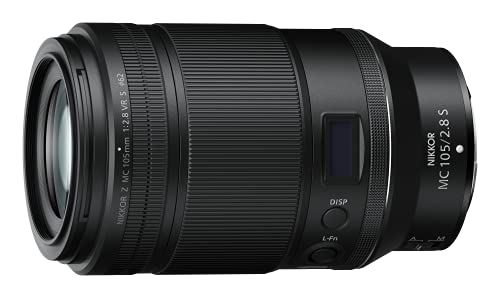
The Nikon Z MC 105mm is the anchor pick of this pool and the only native Nikon Z 105mm macro available, which makes it the default choice for Z shooters. Its f/2.8 aperture, 1:1 magnification, and VR stabilization cover portraits, product shots, and close-up work in one lens, while the STM stepping motor keeps autofocus quiet enough for video. A 62mm filter size and nine diaphragm blades round out a well-judged design, and the fluorine coat helps the front element shed dust and moisture during field work. For a Z owner who wants one lens to do two jobs, this is the pick.
Specs
- 105mm focal length
- f/2.8 maximum aperture
- Z mount
- 1:1 macro magnification
- VR stabilization
- 62mm filter size
- 9 diaphragm blades
- STM stepping-motor autofocus
- Fluorine coat
- Model 20100
Best for: Nikon Z shooters who want one lens for macro and portraits.
Watch out for: The only native Z option here, so there is no cheaper Z alternative in this pool.
ASIN: B096DHS1BF
Sigma 105mm f/2.8 DG DN Macro Art (Sony E-mount)
Sigma’s E-mount 105mm Art brings the same 1:1 macro capability to Sony bodies, with a Hyper-Sonic Motor, a focus limiter, and an aperture ring that video shooters will appreciate. The 62mm filter size matches the Nikon pick, which simplifies a shared filter kit for photographers who own both systems, and the AFL button gives quick focus control without diving into menus. The ASIN was pinned through mirror listings, so confirm the US listing on the product page before ordering, and check that the mount in the listing matches the Sony body in hand.
Specs
- 105mm focal length
- f/2.8 to f/22 aperture range
- 1:1 magnification
- 62mm filter size
- Hyper-Sonic Motor autofocus
- Focus limiter
- AFL button
- Aperture ring
- Sony E mount
- Model 260965
Best for: Sony E-mount photographers who want a macro prime with video-friendly controls.
Watch out for: The ASIN was pinned via mirror listings, so confirm the US listing before buying.
ASIN: B08KGQR14B
Sigma 105mm f/2.8 DG DN Macro Art (L-mount)
The L-mount version of Sigma’s 105mm Art shares the optics of its E-mount sibling, so the image quality and macro behavior are the same, while the mount fits Panasonic, Leica, and Sigma fp bodies. It carries the same f/2.8 aperture, 1:1 magnification, and 62mm filter thread, and the same focus limiter and aperture ring for video work. Do not confuse it with the E-mount version: the two are distinct ASINs for different mounts, and buying the wrong one leaves the photographer with a lens that will not fit the body at all.
Specs
- 105mm focal length
- f/2.8 maximum aperture
- 1:1 macro magnification
- 62mm filter size
- Leica L mount
- Model 260969
Best for: Panasonic, Leica, and Sigma fp shooters who need a native 105mm macro.
Watch out for: A distinct ASIN from the E-mount version, so check the mount before ordering.
ASIN: B08KGT1G2B
Nikon AF-S VR Micro-NIKKOR 105mm f/2.8G IF-ED
This F-mount Micro-NIKKOR is the veteran of the group, a DSLR-era 105mm macro with VR stabilization and 1:1 magnification that still performs well optically. On a Nikon Z body it works only with the FTZ adapter, so it is not a native Z lens and this article does not present it as one. The adapter adds length and a step to the workflow, but the lens itself is a proven performer and often costs less than the native Z version, which makes it a sensible route for patient buyers who already own the adapter or plan to use other F-mount glass.
Specs
- 105mm focal length
- f/2.8 maximum aperture
- VR stabilization
- 1:1 macro magnification
- F mount
- Model 2160
Best for: Nikon Z owners who already own the FTZ adapter and want a lower-cost 105mm macro.
Watch out for: F-mount only, so it needs the FTZ adapter on mirrorless bodies and is not a native Z lens.
ASIN: B000EOSHGQ
Which One Fits Your Situation
A Native Nikon Z Macro Lens
Choose the NIKKOR Z MC 105mm f/2.8 VR S for full autofocus, stabilization, and metadata support with no adapter in the chain. It is the cleanest option for a Z shooter who wants macro and portraits from one lens, and the fluorine coat helps in the field when dust and moisture are part of the day. The STM motor keeps video quiet, and the 62mm filter thread matches common filter sizes.
A Sony E-mount Macro Lens
Pick the Sigma 105mm DG DN Art in E-mount for its aperture ring, focus limiter, and quiet Hyper-Sonic Motor. It suits Sony shooters who split time between stills macro and video, and the 62mm filter thread keeps filter costs down. Confirm the US listing before ordering, since the ASIN was pinned through mirror listings rather than a fresh domestic crawl.
An L-mount Macro Lens
Take the Sigma 105mm DG DN Art in L-mount for Panasonic, Leica, or Sigma fp bodies. The optics match the E-mount version, so the choice is purely about the mount, and the aperture ring serves video work on those bodies too. Double-check the ASIN before ordering, since the E-mount and L-mount versions look identical in photos and differ only by mount.
A Lower-Cost Nikon Macro Route
Use the AF-S Micro-NIKKOR 105mm with the FTZ adapter when the native Z lens stretches the budget. Accept the extra bulk and the adapter step, and remember it is an adapted DSLR lens rather than a native mirrorless design. The optics still deliver, and the VR stabilization helps handheld macro work while the savings fund a second lens.
Common Mistakes
- Buying a 100mm macro and expecting it to behave like a 105mm lens with the same working distance and the same compression in portraits.
- Choosing a zoom that covers 105mm instead of a true 105mm prime with 1:1 magnification, and settling for a close-up mode that never reaches true macro.
- Ordering the wrong Sigma mount version and finding it does not fit the body at all, when a quick check of the mount would have caught the error before the return.
- Presenting the F-mount Micro-NIKKOR as a native Z lens when it needs the FTZ adapter.
- Forgetting that Canon RF has no 105mm prime, so no RF pick exists in this pool.
Frequently Asked Questions
Is a 105mm lens good for portraits as well as macro?
Yes, the focal length flatters faces with gentle compression and a comfortable working distance, while the f/2.8 aperture gives a shallow depth of field. The same lens that shoots a 1:1 close-up of a flower also makes a strong short telephoto for headshots, which is why 105mm is a popular dual-purpose choice for photographers who want one lens for two jobs.
What does 1:1 macro magnification mean?
It means the subject appears life-size on the sensor, so a 24mm flower fills a 24mm-wide sensor exactly. All four picks here reach 1:1, which is the standard for a true macro lens, and the 105mm focal length keeps a useful distance between the lens and the subject, which helps with lighting and with skittish insects.
Can I use the F-mount Micro-NIKKOR on a Nikon Z camera?
Yes, but only with the FTZ adapter, since the lens is an F-mount DSLR design rather than a native mirrorless lens. Autofocus and VR continue to work through the adapter, but the combination is longer and heavier than the native Z lens, so treat it as a budget route rather than a direct equivalent.
Why is there no Canon RF 105mm lens here?
No Canon RF-mount 105mm prime exists, and Sigma makes no RF version of its 105mm Art lens. Canon RF owners looking for a macro prime should consider the RF 100mm macro instead, which is a different focal length and falls outside this pool, or adapt an EF 100mm macro with the RF adapter.
More from Amazon
Programs that pair well with the guide above. Offers and eligibility are set by Amazon and may change.
Free shipping on eligible items, Prime Video and more. Eligible new members can start with a free trial.
Start a Prime free trialAudiobooks and podcasts to listen to on the go. Eligible new members can start with a free trial.
Try Audible freeAd-free music streaming. Eligible new subscribers can start with a free trial.
Try Music Unlimited freeA free business account with business pricing and bulk-buying tools for work, shop or home office.
Create a business accountAs an Amazon Associate we earn from qualifying purchases.