Key takeaways
- Find the best digital camera telephoto lens and battery life picks: three stabilized zooms that sip power, with tips to make every charge last longer.
A telephoto lens brings distant subjects close, but it also asks more of your camera battery than a standard zoom. The autofocus motor works harder to move heavier glass, and the image stabilization system runs constantly while you track a bird, a player or a plane. That is why the right telephoto lens is not just the sharpest one, but the one whose motor and stabilization are efficient enough to keep you shooting through a long session without swapping batteries every hour.

This guide is for wildlife and sports photographers, travel shooters who carry one body and one lens, and anyone who has watched a battery meter drop during a long afternoon with a telephoto zoom. The three lenses below were chosen from the names and specifications on their Amazon pages, and each one pairs a long zoom range with an efficient autofocus motor and stabilization, so you can compare them on reach, weight and power use rather than on sharpness alone.
Quick Picks
As an Amazon Associate we earn from qualifying purchases
| Product | Best for | Key spec from title |
|---|---|---|
| Sony E 70-350mm f/4.5-6.3 G OSS | Lightest long zoom for Sony APS-C | 70-350mm 5x zoom 1.38 lbs |
| Canon RF 100-400mm f/5.6-8 IS USM | Lightest 400mm for Canon RF | 100-400mm 635 g Nano USM |
| Sigma 100-400mm f/5-6.3 DG DN OS | Brightest aperture at 400mm | 100-400mm f/5-6.3 67mm filter |
How to Choose
Match the lens to your camera mount first
A telephoto lens only works on the mount it was built for, so check your camera body first. The Sony lens here fits Sony E-mount APS-C cameras, the Canon lens fits Canon RF-mount cameras, and the Sigma lens fits Sony E-mount full-frame cameras, and none of them can be adapted to another brand without an adapter that usually costs you autofocus speed. If you shoot with a different brand, look for the same focal length and aperture from a maker that supports your mount. Buying the wrong mount is the most expensive mistake in this category, because a lens you cannot mount is a lens you cannot use.
Think about battery life as part of the lens
Telephoto lenses drain batteries through their autofocus motors and stabilization systems, so a lens with an efficient motor and a stabilization system you can switch off will last longer on a charge. The Sony lens uses an XD linear motor that moves the glass quickly with little power, and the Canon lens uses a Nano USM motor that is fast and quiet without drawing much current. Turn stabilization off on a tripod, since the system keeps working even when the camera is steady, and carry a spare battery on long shoots, because even the most efficient lens will drain a small mirrorless battery over a full day.
Choose reach and weight together, not separately
A longer lens brings subjects closer, but it also weighs more and is harder to hold steady, so the right choice balances reach against what you can carry all day. The Sony lens reaches 350mm, which is 525mm in full-frame terms on an APS-C body, while weighing only 1.38 pounds, which makes it the easiest lens here to carry. The Canon and Sigma lenses both reach 400mm, which is further, but they are heavier and longer, so they suit photographers who work from a hide or a sideline rather than walking all day. If you hike with your camera, pick the lightest lens that still reaches far enough for your subjects.
Check stabilization and focus speed for moving subjects
Image stabilization keeps a long lens steady at slow shutter speeds, and fast autofocus keeps a moving subject sharp, so both matter for wildlife and sports. The Sony lens has Optical SteadyShot stabilization and a linear motor that focuses quickly and quietly, the Canon lens offers up to 5.5 stops of shake correction with a Nano USM motor, and the Sigma lens has Optical Stabilizer with a stepping motor. All three focus fast enough for birds in flight and players on a field, but the Canon and Sony motors are the quietest, which matters when you are close to wildlife. If you shoot mostly still subjects, stabilization matters more than focus speed.
The 3 Best Options
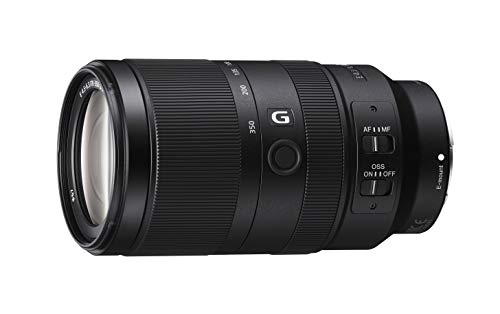
Sony E 70-350mm f/4.5-6.3 G OSS
The Sony 70-350mm is the lightest long zoom in this guide, a 5x super-telephoto that reaches 350mm, or 525mm in full-frame terms, on a Sony APS-C body while weighing only 1.38 pounds. Its XD linear motor focuses fast and quietly with little power draw, which helps battery life on long shoots, and Optical SteadyShot stabilization keeps handheld shots sharp at the long end. The lens is 142mm long with a 67mm filter thread, and its G-series optics deliver sharp corner-to-corner resolution across the frame. It is the lens to choose when you want the most reach per gram on a Sony APS-C camera.
Specs
- Focal length 70-350mm, 105-525mm full-frame equivalent on APS-C
- Maximum aperture f/4.5-6.3
- Optical SteadyShot image stabilization
- XD linear motor autofocus
- Weight 1.38 pounds, 625 grams
- Length 142mm
- Filter thread 67mm
- Mount Sony E, model SEL70350G
Best for: The lightest long zoom for Sony APS-C, with fast, quiet autofocus that sips battery.
Watch out for: It is built for APS-C cameras, so it does not cover a full-frame sensor.
Canon RF 100-400mm f/5.6-8 IS USM
The Canon RF 100-400mm is the lightest 400mm lens in this guide, a compact super-telephoto that weighs about 635 grams and measures 164.7mm long. Its Nano USM autofocus motor is fast, smooth and quiet, which suits both stills and video, and its optical image stabilization offers up to 5.5 stops of shake correction for handheld shooting at the long end. A control ring on the barrel lets you change exposure settings without taking your eye from the viewfinder, and the 67mm filter thread takes standard filters. It is the lens to choose when you want 400mm of reach on a Canon RF camera without carrying heavy glass.
Specs
- Focal length 100-400mm
- Maximum aperture f/5.6-8
- Optical image stabilization, up to 5.5 stops
- Nano USM autofocus motor
- Weight about 635 grams
- Length about 164.7mm
- Filter thread 67mm
- Mount Canon RF, model 5050C002
Best for: The lightest 400mm zoom for Canon RF, with quiet Nano USM focus and strong stabilization.
Watch out for: The f/8 maximum aperture at 400mm needs good light or a higher ISO in dim conditions.
Sigma 100-400mm f/5-6.3 DG DN OS Contemporary
The Sigma 100-400mm is the brightest lens at 400mm in this guide, with a maximum aperture of f/6.3 at the long end against f/8 on the Canon. Its Optical Stabilizer keeps handheld shots steady, and its stepping motor focuses quickly and quietly for stills and video. The lens uses a 67mm filter thread, has 9 rounded aperture blades for smooth background blur, and weighs 2.43 pounds with a length of 7.76 inches, which makes it the heaviest lens here but still hand-holdable. It is the lens to choose when you shoot Sony full-frame and want the brightest 400mm zoom in this class.
Specs
- Focal length 100-400mm
- Maximum aperture f/5-6.3
- Optical Stabilizer
- Stepping motor autofocus
- Filter thread 67mm
- Aperture blades 9, rounded
- Weight 2.43 pounds
- Length 7.76 inches
- Mount Sony E, model 56683153
Best for: The brightest aperture at 400mm for Sony full-frame, with smooth background blur.
Watch out for: It is the heaviest lens in this guide, so it tires your arms faster on a long walk.
Which One Fits Your Situation
You shoot Sony APS-C and walk all day
Choose the Sony E 70-350mm. Its 1.38-pound weight and 525mm full-frame equivalent reach give you the most distance per gram, and its XD linear motor focuses quickly without draining the battery. It is the easiest lens here to carry on a hike, and its stabilization keeps handheld shots sharp at the long end. You can shoot all day without a heavy bag.
You shoot Canon RF and want 400mm without the weight
Choose the Canon RF 100-400mm. At about 635 grams it is the lightest 400mm lens in this guide, and its Nano USM motor is fast and quiet for both stills and video. The control ring lets you change settings without lowering the camera, which helps when you are tracking a moving subject. It is the best pick for Canon shooters who walk far.
You shoot Sony full-frame and want the brightest 400mm
Choose the Sigma 100-400mm. Its f/6.3 maximum aperture at 400mm gives you more light than the Canon, and its 9 rounded aperture blades produce smooth background blur. It is heavier than the other two, so it suits photographers who work from a fixed spot rather than hiking all day. Its brighter aperture helps when the light fades. It is the heaviest lens here.
You shoot long sessions and worry about battery life
Choose the Sony or the Canon. Both use efficient linear and Nano USM motors that draw little power, and both let you switch stabilization off on a tripod. Carry a spare battery in any case, since a full day of tracking moving subjects will drain even the best mirrorless battery. A spare battery weighs little and saves the day.
Common Mistakes
- Buying a lens for the wrong mount, then finding it cannot fit your camera body.
- Choosing the longest lens without checking its weight, then leaving it at home because it is too heavy to carry.
- Leaving stabilization on while the camera sits on a tripod, which wastes battery and can soften the image.
- Shooting at 400mm in dim light with a slow aperture, then wondering why the images are blurred.
- Forgetting a spare battery on a long telephoto shoot, then missing the best light of the day.
Frequently Asked Questions
Does a telephoto lens drain the battery faster?
Yes, a telephoto lens drains the battery faster than a standard zoom, because its motor moves heavier glass and its stabilization runs constantly. Lenses with efficient linear or Nano USM motors draw less power, and switching stabilization off on a tripod saves more. Carry a spare battery on long shoots, since even an efficient lens will drain a small battery.
Is 400mm enough for wildlife photography?
Yes, 400mm is enough for most wildlife photography, since it brings birds and deer close enough to fill the frame. The Sony lens reaches 525mm in full-frame terms on APS-C, which is further still, and the Canon and Sigma lenses reach 400mm on full-frame. If you photograph small birds at long range, you may want a longer lens, but 400mm covers most wildlife situations.
Should I turn stabilization off on a tripod?
Yes, turn stabilization off on a tripod, since the system keeps working even when the camera is steady, which wastes battery and can soften the image. All three lenses here have a stabilization switch on the barrel. Turn it back on as soon as you shoot handheld, since a 400mm lens is hard to hold steady without it.
Can I use these lenses for video?
Yes, all three lenses work well for video, since their autofocus motors are quiet and smooth. The Canon Nano USM motor is the smoothest for video, and the Sony XD linear motor is also quiet. Use a tripod or a gimbal for video at 400mm, since handheld footage at that focal length will shake.
More from Amazon
Programs that pair well with the guide above. Offers and eligibility are set by Amazon and may change.
Free shipping on eligible items, Prime Video and more. Eligible new members can start with a free trial.
Start a Prime free trialAudiobooks and podcasts to listen to on the go. Eligible new members can start with a free trial.
Try Audible freeAd-free music streaming. Eligible new subscribers can start with a free trial.
Try Music Unlimited freeA free business account with business pricing and bulk-buying tools for work, shop or home office.
Create a business accountAs an Amazon Associate we earn from qualifying purchases.