Our Short List of 3
All 3 Picks at a Glance
| Product | Specs | Action |
|---|---|---|
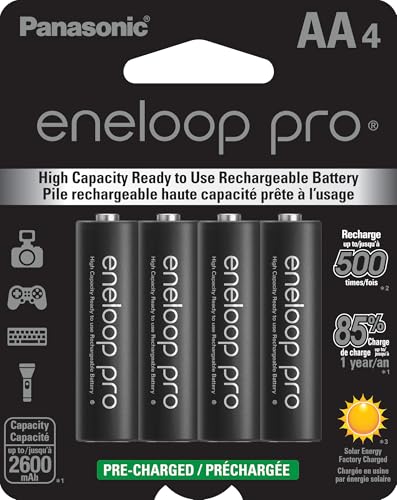
| 1. Panasonic eneloop pro AA — the flash photographer’s benchmark | Check price on Amazon | |
 3. EBL AA 2800mAh — high capacity in a ready-to-file pack | Check price on Amazon | |
 4. Panasonic eneloop AA (standard) — the long-life workhorse | Check price on Amazon |
Key takeaways
- Best AA batteries for camera flash: high-capacity rechargeable NiMH picks for faster recycle times, long shoots and spares that hold their charge.
As an Amazon Associate we earn from qualifying purchases.
A speedlight is one of the hardest jobs you can give an AA battery. A camera flash does not sip power steadily the way a remote control does; it demands a large burst of current every time the capacitor recharges, then does it again seconds later, sometimes hundreds of times in a single event. Batteries that seem fine in everyday devices can slow a flash to a crawl or give up halfway through a wedding reception. Choosing the best AA batteries for a camera flash therefore comes down to a specific set of qualities: high capacity, the ability to deliver current quickly so recycle times stay short, low internal resistance, and — for spares that live in a camera bag — a low self-discharge rate so they are still charged when you reach for them months later.
This guide explains how flash power demands differ from ordinary use, why rechargeable NiMH cells have become the standard choice among flash photographers, and which specific AA batteries are worth buying. Every recommendation below is a rechargeable AA NiMH battery sold on Amazon US, because for flash use that chemistry hits the best balance of recycle speed, capacity, running cost and reliability. Disposable alkaline and lithium cells are covered too, so you can judge when they make sense as backups.
Why flash photography is hard on batteries
When a speedlight fires, its capacitor dumps stored energy into the flash tube in a fraction of a second. The batteries then have to refill that capacitor before the next shot. That refill — the recycle time — is where battery quality becomes visible. A fresh set of strong cells might recycle a full-power flash in a couple of seconds, while a tired set can stretch the same recycle to ten seconds or more, with the flash eventually refusing to fire until it has caught up. In a fast-moving situation such as a reception, a procession or a press scrum, those extra seconds are missed photographs.
Three battery characteristics drive recycle performance. The first is voltage behaviour under load: NiMH cells hold a steadier voltage through their discharge curve than alkalines, which sag progressively, so a flash fed by NiMH cells keeps recycling briskly until the cells are nearly empty, then stops fairly suddenly. The second is internal resistance: cells designed for high-drain use deliver current more freely, which shortens recycle times and reduces wasted energy. The third is capacity, measured in milliamp-hours, which decides how many full-power flashes you get from a set before swapping. High-capacity NiMH cells in the class covered here range from around 2,000 to 2,800 milliamp-hours per cell, and a typical speedlight takes four of them at a time.
Heat is the other factor to respect. Rapid firing warms both the flash head and the batteries, and sustained bursts can overheat either. Sensible technique — pausing between bursts, letting a hot flash rest, and rotating battery sets — protects your equipment regardless of which cells you choose.
Why rechargeable NiMH wins for flash use
Disposable alkaline AAs start at a higher nominal voltage, but their voltage falls steadily as they drain, so recycle times lengthen noticeably through an event. They also struggle to deliver the repeated high-current pulses a flash demands, which means a significant part of their rated capacity is never usable in this application. For occasional flash use they are acceptable in an emergency, but as a main supply they are slow and wasteful.
Single-use lithium AA cells perform much better: they are light, tolerate cold well, hold their charge in storage for years and keep a flash recycling quickly. Their drawback is cost per shot — every set is thrown away — which makes them best kept as the emergency set in the bottom of the bag rather than the working set.
Rechargeable NiMH cells are the working photographer’s default for good reasons. Their nominal 1.2 volts per cell sounds lower than an alkaline’s 1.5 volts, but because they hold voltage steadily and deliver high current with little sag, flashes typically recycle as fast or faster on NiMH than on alkaline. Modern low-self-discharge NiMH cells arrive pre-charged, keep most of their charge for a year or more in storage, and can be recharged hundreds of times, so a handful of sets covers years of shooting. The four batteries below are the picks that best match flash demands, each with a different balance of capacity, cycle life and storage behaviour.
The best AA batteries for camera flash
1. Panasonic eneloop pro AA — the flash photographer’s benchmark
The eneloop pro line is the battery most often found in working photographers’ speedlights, and Panasonic’s own listing names digital camera flash units among its recommended uses. These high-capacity NiMH cells are rated at a minimum of 2,450 milliamp-hours per cell, deliver strong current for fast recycle times, and are made in Japan. They retain up to 85 percent of their charge after a year in storage, which means a spare set charged after your last event is still ready for the next one, and they keep working in temperatures down to minus 4 degrees Fahrenheit, a real consideration for winter outdoor work. The trade-off for the high capacity is cycle life: the cells are rated for up to 500 recharges, fewer than the standard eneloop line, though for flash use — where sets are rotated and recharged after events rather than daily — that still represents years of service. The four-pack is the natural unit for a single speedlight, since one pack fills one flash exactly.
2. Powerex PRO AA — maximum capacity for long events
Powerex, made by Maha Energy, builds its PRO cells specifically for high-drain professional devices, and the 2,700 milliamp-hour rating is the highest in this guide alongside the EBL cells below. That extra capacity translates directly into more full-power flashes per set, which is what matters at long events where changing batteries mid-ceremony is not an option. The cells are low self-discharge designs that retain up to 75 percent of their charge after a year in storage — a little less retention than the eneloop pro, so they suit photographers who shoot regularly and cycle their sets often rather than leaving spares untouched for months. The eight-pack is a practical size: two complete sets for one flash, or one full load for two flashes, from a single purchase. Photographers who use battery grips or external flash battery packs that take eight cells at once will also find the pack size convenient.
Powerex PRO High Capacity Rechargeable AA NiMH Batteries, 8-Pack (MH-8AAPRO-BH)
ASIN: B06XDHM839
https://www.amazon.com/dp/B06XDHM839
3. EBL AA 2800mAh — high capacity in a ready-to-file pack
EBL’s 2,800 milliamp-hour AA cells carry the largest capacity figure in this guide, and the listing states they hold up to 80 percent of their capacity after three years of non-use, the longest storage claim here. They arrive partially pre-charged so they can be used straight from the pack in a pinch, and the eight-pack includes battery storage cases, a small detail that matters more than it sounds: loose cells rolling around a camera bag can short against keys or coins and are awkward to keep in matched, charged sets, while cased sets stay organised and identifiable. EBL positions these as general-purpose high-capacity cells for cameras and other demanding devices rather than flash-specific cells, so photographers who shoot events every weekend may prefer the proven flash pedigree of the eneloop pro, but for enthusiasts who want maximum stated capacity, tidy storage and spares that tolerate long gaps between shoots, this pack is a strong fit.
4. Panasonic eneloop AA (standard) — the long-life workhorse
The standard white eneloop trades some capacity for longevity. Rated at up to 2,000 milliamp-hours per cell with a minimum of 1,900, it gives up some flashes per set compared with the pro version, but it is rated for up to 2,100 recharge cycles — more than four times the cycle count of the eneloop pro — and holds its charge exceptionally well in storage, retaining around 70 percent even after years on the shelf according to Panasonic’s published figures. For photographers who use flash constantly and recharge constantly — studio shooters running speedlight setups daily, teachers, content creators — that cycle life can make the standard cell the cheaper battery over its working life, and its slightly lower capacity per charge is easy to manage when a charger is always nearby. It is also a sensible choice for the second and third spare sets in a kit, where storage retention matters more than squeezing out every last flash. Like the pro version, the four-pack matches one speedlight load exactly.
How the picks compare
All four recommendations are low-self-discharge NiMH AA cells, and any of them will run a speedlight well. The differences are in emphasis. The eneloop pro pairs high capacity with the best combination of fast recycle behaviour and one-year storage retention, which is why it leads this guide for event and wedding work. The Powerex PRO and the EBL cells push capacity a little higher, suiting long events and high-volume shooting, with the EBL adding storage cases and the longest stated shelf retention. The standard eneloop is the endurance pick, with a cycle life several times higher than the rest, aimed at shooters who recharge after every session. A practical kit for a working photographer is two sets of a high-capacity cell for the flashes in use, one standard eneloop set as the deep spare, and a charger that can handle at least eight cells at once so the whole rotation can be refreshed overnight.
Charging and care: getting the most from NiMH cells
Batteries are only half of the system; the charger and your habits decide how close you get to the rated performance. A smart charger that monitors each cell individually is strongly preferable to a basic timer charger, because flash sets age unevenly and individual-cell charging stops one weak cell from dragging down or being overcharged alongside stronger partners. Some advanced chargers can also test capacity and refresh tired cells, which is valuable for diagnosing a set that has started recycling slowly.
Keep cells in matched sets. Buy them together, charge them together, use them together and store them together in a labelled case, so every cell in a flash has the same history and state of charge. Mixing cells of different ages or charge levels forces the weakest cell to do the hardest work and shortens the life of the whole set. Charge your sets the day before an event rather than weeks ahead, even with low-self-discharge cells, so every set starts at a true full charge. Store spares somewhere cool and dry rather than in a hot car, and if a set comes out of the flash hot after heavy firing, let it cool before charging. Finally, retire cells that no longer hold a useful charge: a set that recycles noticeably slower than its siblings is telling you it is done, and keeping it in rotation risks a dead flash at the worst moment.
How many sets do you actually need
A single speedlight holds four AA cells, and a set of high-capacity NiMH cells will typically deliver several hundred full-power flashes, with far more at the partial power settings used for fill flash and close work. For a casual shooter, one set in the flash and one charged spare set is a complete system. For an event photographer running one flash hard for hours, two working sets plus a spare is a sensible minimum, and shooters running two flashes — one on camera, one off camera — should plan on at least two sets per flash so a fresh rotation is always ready. External battery packs that supplement or replace the internal cells extend runtime further and speed up recycling, and they use the same AA cells, so a healthy stock of matched sets serves both.
Verdict
For most flash photographers, the Panasonic eneloop pro AA is the battery to buy first: high capacity, fast recycle behaviour, dependable storage retention and a listing that names camera flash units as an intended use. Add Powerex PRO or EBL high-capacity sets if your events are long and your flashes work hard, and keep standard eneloop sets in the bag if you recharge constantly and want maximum cycle life. Whichever you choose, buy them in matched sets of four, charge them on a smart charger, and keep one set aside as a charged spare — that system, more than any single specification, is what keeps a flash firing all day.
More from Amazon
Programs that pair well with the guide above. Offers and eligibility are set by Amazon and may change.
Free shipping on eligible items, Prime Video and more. Eligible new members can start with a free trial.
Start a Prime free trialAudiobooks and podcasts to listen to on the go. Eligible new members can start with a free trial.
Try Audible freeAd-free music streaming. Eligible new subscribers can start with a free trial.
Try Music Unlimited freeA free business account with business pricing and bulk-buying tools for work, shop or home office.
Create a business accountAs an Amazon Associate we earn from qualifying purchases.