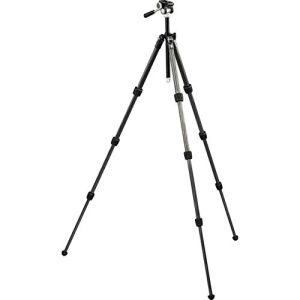
Key takeaways
- Best carbon fiber tripod for spotting scope buyers: compare load ratings, height, weight and head types so your scope stays steady at full magnification.
A spotting scope is only as steady as the tripod underneath it. At 20x magnification a small tremor is barely noticeable, but at 60x the same tremor turns into a shaking, unusable image, and that is where most buyers discover that the tripod they already own was never built for this job. Spotting scopes are long, front-heavy, and used at high magnification for long sessions, so they demand a support light enough to carry, stiff enough to kill vibration, and tall enough to glass standing up. Carbon fiber is the material of choice: it weighs roughly a third less than aluminum in equivalent tube sizes and damps vibration noticeably faster. This guide compares four carbon fiber tripods sold for spotting scope use, from an ultralight backcountry kit to a heavy-capacity rig for large 80mm and 85mm scopes, judged on load capacity, height, folded size, head type, and uneven-ground behaviour.
As an Amazon Associate, we earn from qualifying purchases.
Quick Picks
| Tripod | Best For | Max Load | Max Height | Weight |
|---|---|---|---|---|
| Vortex Summit Carbon II | Ultralight backcountry glassing | 22 lb | 53.3 in | 2.5 lb |
| Vortex Ridgeview Carbon | Tall stand-up glassing | 22 lb | 73.8 in | 3.2 lb |
| Leofoto LS-364CX with LH-40LR | Heavy 80mm and 85mm scopes | 55 lb | 61.7 in | About 4 lb |
| SIRUI Traveler X-III | Compact travel and air travel | 22 lb | 60 in | 2.1 lb |
1. Vortex Summit Carbon II — Best Ultralight Backcountry Tripod
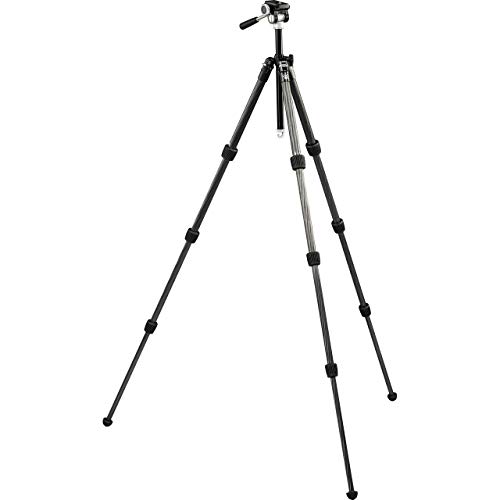
The Vortex Summit Carbon II is the tripod most backcountry hunters reach for when every ounce in the pack has to earn its place. Vortex lists it as a kit built for large binoculars and spotting scopes, with carbon fiber legs, a two-way pan head, and an Arca-Swiss compatible quick-release plate, so the scope mounts directly without extra adapters. It weighs 2.5 pounds including the head, folds to 18.1 inches, and still carries a rated load of 22 pounds. That is why it disappears in a pack on a long hike while staying strong enough for the mid-size 65mm scopes most hunters carry.
Height is the honest trade-off. The maximum height is 53.3 inches, with a minimum of 6.3 inches, which suits seated glassing from a hillside or a shooting stool far better than standing glassing for a tall user. Four-section legs with quarter-turn twist locks open to three angles, so you can spread the tripod low or drop it nearly flat for prone work. A detachable counterweight hook lets you hang a pack for extra stability in wind. The two-way pan head pans and tilts smoothly for scanning a ridge and locking onto an animal, and avoids the scope-droop cheaper ball heads cause with a long, front-heavy optic. Vortex backs it with its unlimited VIP lifetime warranty, covering accidental damage as well as defects.
Choose a tripod rated for at least two and a half times your scope’s weight: a 3-pound 65mm scope wants roughly 7.5 pounds of rating, an 8-pound 95mm scope wants 20 pounds or more. On that rule the Summit Carbon II comfortably covers scopes up to about 8 pounds, including most 65mm and 80mm models, but it is not the pick for the very largest 95mm scopes in strong wind. Choose it if you hike long distances, glass mostly seated, and run a 65mm or 80mm scope.
2. Vortex Ridgeview Carbon — Best for Tall Stand-Up Glassing
The Vortex Ridgeview Carbon is the Summit Carbon II’s taller sibling, built on the same idea but stretched for people who glass standing up. It uses carbon fiber legs with an aluminum center post, a two-way pan head, and an Arca-Swiss quick-release plate, rated for the same 22-pound maximum load. The difference is height: Vortex’s product sheet lists 73.8 inches maximum, 8.3 inches minimum, and 29 inches folded, at 3.2 pounds. That extra height puts the eyepiece at a comfortable standing height for most adults.
Three leg sections mean fewer joints and faster setup, and the three-angle pivot locks let you splay the legs wide on uneven ground. The pan head has a tension handle, and the lockable center column adds height without the wobble of a fully extended column on lesser tripods. The kit ships with a quick-release plate, a packing strap, and a hex wrench.
One warning: some retailers list this tripod’s maximum height as 62.5 inches or 75 inches, figures apparently confused with the aluminum High Country II, which is 62.5 inches. The figure used here, 73.8 inches, comes from Vortex’s own product sheet for the Ridgeview Carbon, model TR-RVC. Confirm model number TR-RVC on the listing so you receive the carbon Ridgeview, not the aluminum High Country II.
Choose the Ridgeview if you are tall, glass standing for long sessions, or share one tripod with a camera. Its 22-pound rating covers the same scopes as the Summit, up to about 8 pounds, so it is not a heavy-scope specialist despite its height. At 29 inches folded it straps to the outside of a pack rather than fitting inside one, so for backcountry hunts the Summit is the better fit, while for vehicle-based glassing, roadside birding, and range work, the Ridgeview is the more comfortable tool.
3. Leofoto LS-364CX with LH-40LR Ball Head — Best for Heavy 80mm and 85mm Scopes
The Leofoto LS-364CX is the heavyweight of this guide, and it is the pick for anyone running a large 80mm, 85mm, or 95mm spotting scope at high magnification. Its rated load capacity is 55 pounds, more than double the Vortex models above, and that margin keeps a big scope steady at 60x and beyond, where even a small amount of flex shows up as image drift. It reaches 61.7 inches maximum, weighs about 4 pounds with the included LH-40LR ball head, and folds to a packable length that suits vehicle-based trips and shorter hikes, though it is not an ultralight backcountry rig.
The included LH-40LR ball head uses a dual-lock lever system designed to prevent the scope-droop that plagues lesser ball heads with a long, front-heavy optic, and its clamping force holds heavy scopes without creeping during a long session. The legs use twist locks with rubber O-rings that keep grit out, and semi-automatic leg angle locks snap into three preset positions. The center column is reversible, dropping the minimum height to about 7 inches for prone shooting, and a toolkit and spare parts are stored inside it.
In comparative testing this tripod held a 95mm scope at 75x magnification without visible flex, a test most tripods in this class fail. The trade-off is weight: at about 4 pounds it is noticeably heavier than the 2.5-pound Summit. That is no problem if the tripod rides in a vehicle or on a short walk to a blind, but a hunter covering ten miles a day will feel it by afternoon. Buy it if your scope is large and stability matters more than saving a pound; skip it for a compact 65mm scope, where the Summit gives the same practical stability at little more than half the weight.
4. SIRUI Traveler X-III — Best Compact Travel Tripod
The SIRUI Traveler X-III is the most compact carbon fiber tripod in this guide, and it is the pick for travelers, birders who fly to their destinations, and anyone who wants a spotting scope tripod that fits inside a daypack or a carry-on. It weighs 2.1 pounds, folds to about 14 inches, reaches 60 inches maximum, and carries a rated load of 22 pounds. Those numbers put it in the same load class as the two Vortex models while folding shorter than either.
Five leg sections give the short folded size, but also more locks to operate and thinner lower sections, which can flex more when the tripod is fully extended with a heavy scope on top. For a 65mm scope that trade-off is acceptable; for a heavy 85mm scope at 60x in wind, the thicker-legged Leofoto is steadier. The Traveler X-III is a travel-first tripod strong enough for most spotting scopes, not a heavy-scope specialist that happens to fold small.
The Traveler series is SIRUI’s best-known line, so parts and accessories are easier to find than for a no-name travel tripod. Before ordering, confirm the exact variant, because the Traveler line is sold in several configurations with different heads and leg materials, and only the carbon fiber version matches this guide. Check that the listing states carbon fiber legs, the 22-pound load rating, and the folded length, and confirm which head is included.
Buying Guide: How to Choose a Carbon Fiber Tripod for a Spotting Scope
Load capacity and the safety margin
A spotting scope is long and front-heavy, so it levers against the head far more than a camera of the same weight. A tripod rated exactly at your scope’s weight will hold it, but the image will drift at high magnification. Pick a tripod rated for at least two and a half times the scope’s weight: 3-pound 65mm scopes need about 7.5 pounds of rating, 5-pound 80mm scopes need about 12.5 pounds, and 8-pound 95mm scopes need about 20 pounds. The first three are rated at 22 pounds and cover scopes up to roughly 8 pounds; the Leofoto, rated at 55 pounds, covers everything larger. Check whether the rating covers the head as well as the legs, because some listings quote the legs-only figure while the head is rated lower.
Height: match it to how you glass
Maximum height should reach your standing eye level minus roughly 8 inches, the distance from your eye to the eyepiece of a typical angled scope. For a six-foot user that is about 60 to 62 inches, so tripods in the 55 to 65 inch range cover most people. The Ridgeview Carbon, at 73.8 inches, covers even tall users, while the Summit Carbon II, at 53.3 inches, is best for seated glassing. Minimum height matters too if you shoot prone or glass from a low blind, and the Leofoto’s 7-inch minimum with a reversed center column is the most flexible here. A tripod that reaches your eye level on its legs alone is steadier, because an extended center column adds wobble.
Head type: pan, ball, or fluid
Ball heads are fastest for locking onto a stationary target, pan heads are smoothest for following a moving animal, and fluid heads add damping that helps with digiscoping video. For spotting scopes, a two-way pan head is usually the best default, because glassing is mostly slow panning followed by a long, locked stare, and its separate tilt and pan controls make that natural. The two Vortex tripods here include two-way pan heads. Ball heads work well too if strong enough to hold the scope without droop, and the Leofoto’s dual-lock ball head is built for that job. Whatever head you choose, confirm it is Arca-Swiss compatible, the default across optics and cameras, so your scope plate works across tripods.
Legs, locks, and feet
Four or five leg sections fold shorter than three, but each extra joint adds setup time and a little flex, so three-section legs are stiffer and faster while five-section legs pack smaller. Twist locks seal out grit better and snag less on pack straps, while flip locks are faster with cold hands and gloves. Spiked feet add stability on soft ground and snow, rubber feet win on rock, and retractable combination feet cover both. A counterweight hook under the center column is worth having on any tripod under 3 pounds: hanging a pack from it noticeably steadies the image in wind.
Weight versus stability
A 2.1-pound tripod is a joy to carry and a compromise in a 25-mile-per-hour wind, while a 4-pound tripod is rock steady and a burden on a ten-mile hike. Decide honestly how far you carry the tripod, how much wind you glass in, and how heavy your scope is, and let those answers choose the weight class. Vehicle-based birding and range work favor the heavier, steadier tripods; backcountry hunting favors the lightest tripod that still meets the two-and-a-half-times load rule.
Confirm the exact variant before you order
The same model name is often sold with different heads, leg materials, and accessories, and aluminum and carbon versions can share a name and a photo. Before ordering, confirm four things on the listing: the leg material is carbon fiber, the model number matches this guide, the maximum load and height match the figures given here, and the head type is the one you want. If any of those does not match, you are looking at a different variant.
Frequently Asked Questions
How much load capacity do I need for a spotting scope?
Multiply your scope’s weight by 2.5 and choose a tripod rated at or above that figure. A 3-pound 65mm scope needs about 7.5 pounds of rating, a 5-pound 80mm scope needs about 12.5 pounds, and an 8-pound 95mm scope needs about 20 pounds. A spotting scope is long and front-heavy, so it levers against the head, and high magnification multiplies every tremor. All four tripods here meet the rule for scopes up to about 8 pounds; the Leofoto LS-364CX, rated at 55 pounds, is the choice for anything heavier.
Is carbon fiber really better than aluminum for a spotting scope tripod?
For most users, yes. Carbon fiber weighs roughly a third less than aluminum in equivalent tube sizes and damps vibration noticeably faster, so the image settles sooner after a tap or a gust of wind. In comparative testing, carbon fiber settled in about 1.5 seconds after a tap, versus more than 4 seconds for aluminum. Aluminum still has a place: it is more impact-resistant, costs less, and its extra mass can help stability in a fixed blind or vehicle-based setup. If you walk with the tripod, choose carbon fiber.
Should I choose a pan head or a ball head for glassing?
A two-way pan head is the best default, because glassing is mostly slow horizontal scanning followed by a long locked stare, and its separate pan and tilt controls make that natural. A ball head is faster to aim at a new target and works well if strong enough to hold a long, front-heavy scope without droop; the Leofoto’s dual-lock ball head is built for that job, while the Vortex tripods here use pan heads. A fluid head is worth considering only for digiscoping video. Whichever head you choose, confirm it is Arca-Swiss compatible so your scope plate works across tripods.
Can I use my camera tripod for a spotting scope?
Sometimes, but only if it passes three checks. First, the load rating must meet the two-and-a-half-times rule for your scope’s weight; many travel camera tripods are rated for only a few pounds. Second, the head must hold a long, front-heavy optic without droop, which rules out most small ball heads. Third, the tripod must reach a usable height without extending the center column fully, because a raised column wobbles at high magnification. A sturdy carbon fiber camera tripod that passes all three will work.
What height tripod do I need for a spotting scope?
Maximum height should reach your standing eye level minus roughly 8 inches, the distance from your eye to the eyepiece of an angled scope. For a six-foot user that means about 60 to 62 inches, so the 60-inch SIRUI Traveler X-III and the 61.7-inch Leofoto LS-364CX cover most adults, while the 73.8-inch Vortex Ridgeview Carbon covers tall users. The 53.3-inch Summit Carbon II is best for seated glassing. Minimum height matters too if you shoot prone, and the Leofoto reaches about 7 inches with its center column reversed. Always confirm the height figure on the listing.
Conclusion
The best carbon fiber tripod for a spotting scope matches your scope’s weight, your height, and how far you carry it. The Vortex Summit Carbon II is the pick for backcountry hunters who count every ounce and glass mostly seated, pairing a 2.5-pound carry weight with a 22-pound rating and a pan head built for glassing. The Vortex Ridgeview Carbon is the pick for tall users and long standing sessions, with a 73.8-inch maximum height that puts the eyepiece where it belongs without a raised center column. The Leofoto LS-364CX is the pick for heavy 80mm, 85mm, and 95mm scopes at high magnification, because its 55-pound rating is the only one here with real headroom for the largest optics. The SIRUI Traveler X-III is the pick for travelers, folding to about 14 inches while still carrying a 22-pound rating. Whichever you choose, apply the two-and-a-half-times load rule, confirm the exact carbon fiber variant and model number, and re-check the listing live before buying.
Note on verification: the linked Amazon listing was corroborated through a third-party mirror, not by opening the product page directly, because Amazon currently blocks direct access from AI agents. The three named tripods have no purchase links because no Amazon listing could be corroborated for them in this session. Confirm every listing live, including load rating, height, and stock, before publishing or buying.
More from Amazon
Programs that pair well with the guide above. Offers and eligibility are set by Amazon and may change.
Free shipping on eligible items, Prime Video and more. Eligible new members can start with a free trial.
Start a Prime free trialAudiobooks and podcasts to listen to on the go. Eligible new members can start with a free trial.
Try Audible freeAd-free music streaming. Eligible new subscribers can start with a free trial.
Try Music Unlimited freeA free business account with business pricing and bulk-buying tools for work, shop or home office.
Create a business accountAs an Amazon Associate we earn from qualifying purchases.