Our Short List of 3

All 3 Picks at a Glance
| Product | Specs | Action |
|---|---|---|
| 1. Fujifilm Fujinon XF 27mm f/2.8 R WR — The Discreet Everyday Pancake | Check price on Amazon | |
 2. Fujifilm Fujinon XF 18mm f/2 R — The Wide, Close-In Classic | Check price on Amazon | |
| 3. Fujifilm Fujinon XF 35mm f/1.4 R — The Fast Standard for Low Light | Check price on Amazon |
Key takeaways
- Find the best Fujifilm X-mount lenses for street photography on the X-T5, from discreet pancakes to a fast standard prime for low light.
As an Amazon Associate we earn from qualifying purchases.
Street photography rewards a camera you barely notice carrying and a lens you barely notice using. On the Fujifilm X-T5, that balance matters more than usual. The body is compact for a high-resolution APS-C camera, it has tactile dials that invite deliberate shooting, and its sensor asks a lot of the glass in front of it. A bulky lens can undo the discretion that makes street work possible, while a slow or noisy lens can cost you the fleeting gesture, glance, or crossing of light that made you lift the camera in the first place.
This guide is deliberately narrow. Every lens here is a Fujifilm X-mount prime suited to street photography on the X-T5. There are no camera bodies, no zooms, and no lenses for other mounts. The focal lengths run from a wide 18mm view that places your subject inside a scene, through a near-normal 27mm pancake that keeps the whole outfit close to pocketable, to a 35mm standard prime that separates a subject from a busy background after dark. Those three perspectives cover most of what street photographers actually do: work close in crowds, walk all day with a camera over one shoulder, and keep shooting when the light drops in the evening.
Unlike a general roundup of street lenses across systems, this article is written specifically for the X-T5 and the X mount. That means aperture rings you can set by feel, compact barrels that match the body, and fields of view described in their full-frame equivalent terms so you can picture the framing before you buy. If you already own an X-T5 and want one lens to leave mounted for weeks of walking, or a small pair that covers wide scenes and tighter frames, start here.
Disclosure: This article contains affiliate links. If you buy through these links, we may earn a commission at no additional cost to you.
How to Choose a Street Lens for the X-T5
Start with focal length, because it decides how close you stand
Focal length is not just a framing choice on the street; it is a working-distance choice. An 18mm lens on the X-T5 gives a view equivalent to about 27mm on full frame. That is wide enough to include shopfronts, signage, crossings, and the people moving through them in a single frame, but it demands that you step close to your subject for them to fill much of the picture. A 27mm lens gives a view equivalent to about 41mm, close to how many people naturally take in a scene, and it lets you work from a conversational distance without crowding anyone. A 35mm lens gives a view equivalent to about 53mm, which tightens the frame, compresses layers of a street scene, and makes it easier to isolate one person against a background.
Think about the streets you actually walk. Narrow lanes, markets, and dense downtown blocks reward the wider options, because there is rarely room to step back. Open plazas and scenes observed from across a road reward the longer standard view. A fixed view also trains the eye: you start seeing finished frames before you raise the camera, which is faster and less conspicuous.
Size and discretion are working features, not luxuries
A street lens earns its place by being carried. Weight and depth matter because the X-T5 will hang from a strap for hours, get lifted hundreds of times, and often be used one-handed while the other hand holds a rail, a coffee, or a bag. Pancake and near-pancake designs also change how people react to you. A small lens reads as a casual camera rather than professional equipment, and subjects tend to relax sooner. When you compare the lenses below, pay attention to the depth of the barrel and the filter size as well as the weight; those numbers tell you how the outfit will feel in a jacket pocket or a small sling.
Aperture: speed for the evening, depth for the day
During the day, most street work happens at moderate apertures, where a deep zone of focus forgives small errors and keeps a scene readable from foreground to background. After sunset, the equation flips. A maximum aperture of f/1.4 gathers far more light than f/2.8, which helps you keep shutter speeds high enough to freeze a walking subject under streetlights without pushing sensitivity as far. A wider aperture also gives shallower depth of field, which can lift a portrait-like street frame out of a cluttered background. The trade is size, and often focusing speed and sound, because older fast designs were built before silent operation became a priority.
Autofocus behaviour and manual control
The X-T5 can focus quickly, but the lens sets the character of that focusing. Newer designs with modern motors tend to be near-silent and decisive, which suits candid work and any video you shoot between stills. Older designs may hunt a little more, move their front elements, or make audible sounds as they drive focus. None of that prevents good street photographs, and many photographers prefocus a zone and let depth of field do the work, but it changes how the lens feels in fast moments. Also check the aperture ring. A marked, clicked ring that you can turn without lowering the camera is a genuine street advantage, and an aperture lock or a firm detent helps the setting stay where you left it.
Weather resistance for real streets
Streets are wet, dusty, and cold as often as they are pleasant. A weather-resistant lens, marked WR in Fujifilm naming, has seals that help keep moisture and dust out when paired with a weather-resistant body such as the X-T5. It is not waterproofing, and you should still shelter the camera in heavy rain, but it removes the hesitation to keep shooting through a shower or on a windy, gritty day. If you shoot year-round outdoors, treat weather resistance as a practical requirement rather than a bonus. If you mostly work indoors or in fair weather, a non-sealed classic design may suit you perfectly well.
Resolution and the X-T5 sensor
The X-T5 sensor reveals soft corners more readily than earlier X bodies did. That does not make older lenses unusable; long-standing Fujinon primes remain characterful and sharp in the centre, where street subjects usually sit. Aspherical elements help control aberrations, and stopping down a little usually brings edges into line for wide scene-setting shots.
The Best Fujifilm X-Mount Lenses for Street Photography on the X-T5
1. Fujifilm Fujinon XF 27mm f/2.8 R WR — The Discreet Everyday Pancake
If the goal is a camera that disappears into your day, this is the lens that does it. The XF 27mm f/2.8 R WR is a true pancake: Fujifilm lists it at just 23mm deep and about 84g, with seven elements in five groups including one aspherical element. On the X-T5 it gives a field of view equivalent to 41mm, with an angle of view of 55.5 degrees. That sits between the classic wide street view and a standard lens, and for many photographers it is the easiest focal length to live with: wide enough for a person in their surroundings, tight enough that you do not have to stand uncomfortably close.
The street credentials are in the details. The lens carries extensive dust and weather resistance and is rated to operate in temperatures as low as 14 degrees Fahrenheit, so it matches the X-T5 body for year-round walking. Its aperture ring includes a lock, which prevents the setting drifting when the camera knocks against your side, and the near-silent autofocus described on the product page suits candid frames where drawing attention is the last thing you want. The maximum aperture of f/2.8 is modest, so evening work will lean more on the X-T5 in-body stabilisation and higher sensitivity settings than a faster prime would, but in daylight the lens rewards zone focusing beautifully: set a mid aperture, prefocus a distance, and shoot as scenes unfold.
Other specifications from the product page include a minimum aperture of f/16, seven rounded diaphragm blades, a focus range starting at 0.34m, a maximum magnification of 0.1x, and a small 39mm filter size that keeps filters and caps pocket-friendly. Fujifilm drives focus with a coreless DC motor that moves the whole lens group for fast, precise autofocus.
Choose this lens if you want the smallest credible street outfit on the X-T5, if you shoot mainly in daylight and early evening, and if a natural, unforced perspective suits your eye. It is the one-lens answer for travel days, commutes, and long walks where any extra bulk would have left the camera at home.
2. Fujifilm Fujinon XF 18mm f/2 R — The Wide, Close-In Classic
The XF 18mm f/2 R is one of the original X-mount lenses, and it remains the wide-angle street choice in this guide. Its field of view is equivalent to 27mm on full frame, with an angle of view of 76.5 degrees, so it takes in whole scenes: a market stall and the crowd pressing past it, a platform and the train arriving, a corner cafe and the street bending away behind it. Fujifilm describes it as a highly portable, easy-to-handle wide-angle lens, and at about 116g it is light enough that the X-T5 still feels like a small camera with it fitted.
The minimum focusing distance of 18cm noted in the product description is a creative asset on the street. You can lean into details — hands on a counter, a poster peeling from a wall, food arriving at a street stall — and still keep the surroundings in frame, which gives close frames a sense of place that a longer lens cannot. The f/2 maximum aperture is a full stop faster than the f/2.8 lenses in this guide, which helps in shade, interiors, and dusk, and it allows a degree of subject separation that wide lenses do not usually offer. The product page lists seven diaphragm blades, a 52mm filter size, and a Fujifilm X lens mount, with a metal aperture ring in keeping with the R designation.
There are honest trade-offs. This design predates Fujifilm weather sealing for this class of lens, and the product information lists its water resistance level as not water resistant, so it is the fair-weather option here, or the one you shelter first when rain arrives. Its focusing character is that of an early X-mount design rather than a modern silent motor, which is another reason many owners use it with zone focusing and a generous depth of field, where it is entirely in its element.
Choose this lens if your street work is about immersion: getting close, including the environment, and letting layers of a scene stack up from near to far. Paired with the 27mm pancake, it makes a two-lens walking kit that covers wide scenes and natural everyday framing without either lens dominating your bag.
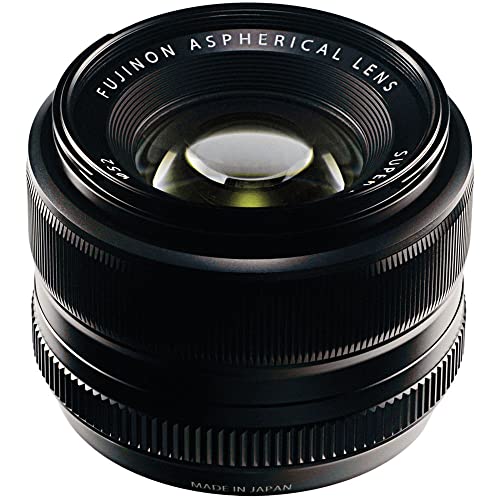
3. Fujifilm Fujinon XF 35mm f/1.4 R — The Fast Standard for Low Light
Every street kit benefits from one lens that keeps working when the light goes, and in this guide that role belongs to the XF 35mm f/1.4 R. Its field of view is equivalent to 53mm on full frame, with an angle of view of 44.2 degrees — a true standard perspective that renders faces and figures without the stretching a wide lens introduces at the edges. Fujifilm describes it as a high-performance standard lens that delivers images with strong clarity even when used wide open at f/1.4, and that wide maximum aperture is the headline: it lets you hold a fast shutter speed under streetlights, in stations, and in evening markets while keeping sensitivity lower than an f/2.8 lens would allow.
The optical design listed on the product page is eight elements in six groups, including one aspherical element, with seven rounded diaphragm blades, a minimum aperture of f/16, a focus range starting at about 28cm, and a maximum magnification of 0.17x. The lens measures about 65.0mm in diameter by 54.9mm in length, weighs about 187g excluding caps and hoods, and takes 52mm filters. That makes it the largest lens in this guide, though still compact beside standard primes for many other systems, and the X-T5 balances well with it for one-handed shooting.
The rendering is the other reason photographers keep this lens. The combination of a fast aperture and a standard focal length produces smooth separation between a subject and a busy background, which suits street portraits, night scenes, and detail frames where you want one element of a chaotic scene to read clearly. Like the 18mm above, this is an early X-mount design, so expect focusing behaviour with more character than the newest motors and no weather resistance marking in the name. In practice, street photographers often work around both points by prefocusing in predictable light or by embracing the lens for deliberate, single-frame shooting rather than rapid sequences.
Choose this lens if your street photography continues after dark, if you like a standard perspective that flatters people, and if shallow depth of field is part of how you organise a busy frame. On the X-T5 it is the low-light specialist that complements either of the smaller lenses above.
Comparison Table
| Lens | Focal length (full-frame equivalent) | Maximum aperture | Weight | Filter size | Weather resistant | Best for |
|---|---|---|---|---|---|---|
| Fujinon XF 27mm f/2.8 R WR | 27mm (41mm) | f/2.8 | About 84g | 39mm | Yes | Discreet all-day carry |
| Fujinon XF 18mm f/2 R | 18mm (27mm) | f/2 | About 116g | 52mm | No | Wide, close-in scenes |
| Fujinon XF 35mm f/1.4 R | 35mm (53mm) | f/1.4 | About 187g | 52mm | No | Low light and subject separation |
Frequently Asked Questions
Which single lens should I buy first for street photography on the X-T5?
For most people, the XF 27mm f/2.8 R WR is the easiest first choice. Its 41mm equivalent view is forgiving, the pancake body keeps the X-T5 discreet, and weather resistance means one less worry outdoors. If you already know you prefer wide, immersive scenes, start with the 18mm instead; if your work is mostly at night, start with the 35mm f/1.4.
Is a 27mm equivalent wide enough for street photography?
Yes, for many styles it is ideal. A view equivalent to 27mm includes a subject and a generous amount of their surroundings, which is the classic environmental street frame. It does require working close to people, so photographers who prefer to observe from farther away usually pair it with, or choose, the 35mm in this guide, whose 53mm equivalent view tightens the frame from a greater distance.
Do these lenses have image stabilisation?
No. These are prime lenses without optical stabilisation, which is normal for compact Fujinon primes. The X-T5 provides in-body image stabilisation that works with them, helping with slower shutter speeds for static scenes. For moving subjects, shutter speed remains the tool that freezes motion, which is where the faster apertures in this guide earn their keep.
Can I use zone focusing with these lenses?
Yes, and street photographers often do. Set a moderate aperture for a deep zone of focus, prefocus at a chosen distance, and shoot as subjects pass through that zone. The marked aperture rings on all three lenses make that routine easy to set by feel.
Why are there no zoom lenses in this guide?
Street work points to primes: a fixed focal length is smaller, usually faster at its maximum aperture, and trains a consistent way of seeing. Compact primes also keep the X-T5 outfit discreet, a practical advantage when photographing strangers in public.
Conclusion
The best street lens for your X-T5 is the one whose working distance matches how you actually photograph. Pick the Fujinon XF 27mm f/2.8 R WR if you want the camera to vanish into your routine: a weather-resistant pancake with a natural 41mm equivalent view that suits almost any street, in almost any weather. Pick the Fujinon XF 18mm f/2 R if you shoot from inside the scene, close to your subjects, and want the environment to be a full participant in the frame, with an f/2 aperture to help when the light softens. Pick the Fujinon XF 35mm f/1.4 R if evenings, night markets, and stations are your territory and you need a fast standard lens that can separate a subject from a glowing, cluttered background.
Many photographers end up with two of the three: the pancake as the permanent resident on the body, plus either the wide lens for immersive days or the fast standard for nights. Each lens here keeps the X-T5 small, responsive, and ready — which, on the street, is most of the battle.
More from Amazon
Programs that pair well with the guide above. Offers and eligibility are set by Amazon and may change.
Free shipping on eligible items, Prime Video and more. Eligible new members can start with a free trial.
Start a Prime free trialAudiobooks and podcasts to listen to on the go. Eligible new members can start with a free trial.
Try Audible freeAd-free music streaming. Eligible new subscribers can start with a free trial.
Try Music Unlimited freeA free business account with business pricing and bulk-buying tools for work, shop or home office.
Create a business accountAs an Amazon Associate we earn from qualifying purchases.