Key takeaways
- For general garage storage: A 48-inch-wide, 24-inch-deep steel rack rated around 800–1,000 lb per shelf is a practical balance of footprint and capacity. Particleboard or MDF decks suit dry, clean storage.
- For heavy workshop materials: Look for a rack rated at least 1,000 lb per shelf, with substantial steel beams, a braced frame, and a steel or wire deck. Confirm that the rating applies to an evenly distributed load.
- For damp or dusty spaces: A galvanized or powder-coated frame helps resist corrosion. Wire decking sheds dust and moisture, while a solid deck is better for small parts that could fall through.
- For small garages: A 36-inch-wide or 18-inch-deep unit may be more useful than a large rack that blocks a vehicle door, walkway, or electrical panel.
The best heavy-duty storage shelves for most garages and workshops are steel boltless racks with at least 800 lb of evenly distributed capacity per shelf, adjustable beams, and a deck suited to the goods you store. Choose deeper, wider shelves for bulky equipment; pick a narrower rack with a higher per-shelf rating for dense loads. The rating matters only when the floor is level, the frame is assembled correctly, and weight is spread across the deck.
Our top picks


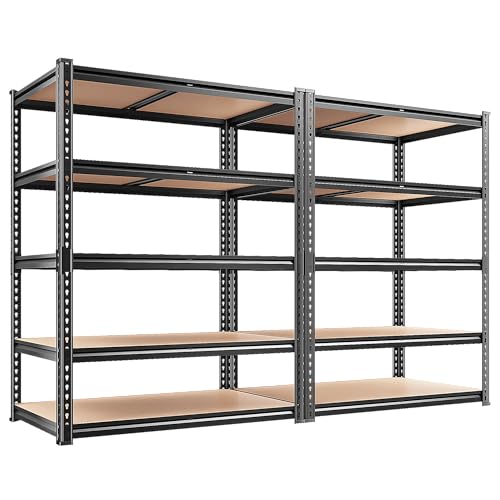
As an Amazon Associate we earn from qualifying purchases at no extra cost to you. Ratings are shown as listed on Amazon.
Best heavy-duty storage shelves by situation
- For general garage storage: A 48-inch-wide, 24-inch-deep steel rack rated around 800–1,000 lb per shelf is a practical balance of footprint and capacity. Particleboard or MDF decks suit dry, clean storage.
- For heavy workshop materials: Look for a rack rated at least 1,000 lb per shelf, with substantial steel beams, a braced frame, and a steel or wire deck. Confirm that the rating applies to an evenly distributed load.
- For damp or dusty spaces: A galvanized or powder-coated frame helps resist corrosion. Wire decking sheds dust and moisture, while a solid deck is better for small parts that could fall through.
- For small garages: A 36-inch-wide or 18-inch-deep unit may be more useful than a large rack that blocks a vehicle door, walkway, or electrical panel.
Compare common heavy-duty shelf configurations
Specifications vary by model, so use this table as a comparison of common rack sizes and rating ranges—not as a guarantee for any specific product. Check the manufacturer’s label and manual before loading a rack.
| Typical rack size | Common shelf count | Typical capacity per shelf | Common deck | Best fit |
|---|---|---|---|---|
| 36 × 18 × 72 in | 4–5 | 500–800 lb | Particleboard, MDF, or wire | Compact garages and lighter workshop supplies |
| 48 × 18 × 72 in | 4–5 | 600–1,000 lb | Particleboard or wire | General storage with a narrower footprint |
| 48 × 24 × 72 in | 4–5 | 800–1,200 lb | Particleboard, MDF, or steel | Bulky tools, totes, and workshop materials |
| 60 × 24 × 72 in | 4–5 | 800–1,500 lb | Steel, wire, or reinforced wood | Wide loads, if there is room to maneuver around the rack |
These are approximate dimensions and capacity ranges found in the heavy-duty shelving category, not standardized specifications. Overall capacity is not always the sum of each shelf’s maximum rating: the frame, connections, and load distribution can impose a lower limit.
What to compare before you buy
Capacity and steel thickness
Look for a clearly stated capacity per shelf and whether it assumes an evenly distributed load. A shelf rated for 1,000 lb may not safely support one 1,000 lb machine concentrated in the center. Put heavy items low and distribute them across the beams. If the manufacturer publishes steel gauge or thickness, compare those figures between otherwise similar frames; gauge numbering is counterintuitive, so a lower gauge generally indicates thicker steel. If thickness is not listed, the capacity, beam design, bracing, and connection details provide more useful comparisons than a vague “heavy-duty” label.
Deck materials
- Particleboard or MDF: Usually offers a flat, inexpensive surface for boxes and bins. Keep it dry, support it on the specified beams, and avoid overloading a small area; moisture or sagging can shorten its life.
- Wire: Allows airflow and makes it easier to see stored items. It can be a poor match for tiny hardware, narrow feet, or items that need a level surface unless you add compatible shelf liners.
- Steel: Suits demanding shop use and is less vulnerable to moisture than wood-based panels, though edges and damaged coatings can still corrode. Check whether the deck is solid or perforated and how it attaches to the frame.
Adjustability, assembly, and stability
Beam slots or keyhole connections let you reposition shelves, but spacing increments differ. Measure your tallest bins and tools, then leave enough clearance to lift them off the shelf—not just enough room for them to fit. Boltless racks can assemble quickly, but their tabs must be fully seated and the frame squared. Bolted designs take longer but can make connections easier to inspect and tighten. Either way, follow the manual and have a second person help handle long beams or tall frames.
Check whether the rack needs wall anchoring. Tall, narrow units and racks placed where people might pull on them deserve particular attention. Anchoring hardware should suit the wall material, and the manufacturer’s instructions should take priority. A level floor, secure connections, and heavy items stored on lower shelves all improve stability.
Choose by space and workload
| Your situation | A sensible starting point | Why |
|---|---|---|
| Tight garage; occasional access | 36 × 18 in rack, 4 shelves, 500–800 lb per shelf | Smaller footprint leaves room for parking and walking. |
| Typical garage; frequent access | 48 × 18 or 48 × 24 in rack, 4–5 shelves, 800–1,000 lb per shelf | Balances capacity with room for common bins and tools. |
| Workshop; dense or heavy materials | 48 × 24 or 60 × 24 in rack, 1,000 lb or more per shelf | Prioritizes load rating and usable deck area; verify concentrated-load limits. |
| Humid or frequently cleaned area | Coated or galvanized frame with wire or steel decking | Reduces reliance on moisture-sensitive wood-based decks. |
Measure first: a quick fit calculation
Suppose you have a 52-inch-wide wall section and are considering a 48-inch-wide rack. The nominal leftover width is 52 − 48 = 4 inches, or about 2 inches per side if centered. That may be too little clearance for assembly, nearby trim, or access to wall fixtures. Measure the rack’s full outside dimensions—not just its advertised shelf width—and leave additional clearance where you need to pass, open a door, or reach stored items.
Measure ceiling height, baseboards, overhead doors, and vehicle clearance too. For shelf depth, account for items projecting beyond the rack; a deep shelf can create a trip hazard or interfere with a car door even when the frame itself fits.
Ownership details that affect longevity
In many racks, the deck or its supports show wear before the upright frame: particleboard can swell, wire coatings can get scratched, and loose connections can cause wobble. Inspect the rack periodically for bent beams, rust, damaged decks, and connections that have shifted. Replace a damaged part only with a compatible component approved for that rack; mixing parts from different systems can weaken connections.
Keep loads within the stated limits, avoid climbing on shelves, and do not drag heavy equipment across a deck unless its manufacturer allows it. Clean dust and spills promptly, especially on wood-based panels, and avoid storing wet items against steel. These habits often matter more to service life than choosing the highest number on a capacity label.
Bottom line
For a typical garage, start with a 48 × 18- or 48 × 24-inch steel boltless rack rated around 800–1,000 lb per shelf, then choose the deck based on moisture, airflow, and the size of stored items. For a crowded space, prioritize footprint and access; for a workshop, prioritize verified capacity, frame construction, and a deck that handles the actual load. The best heavy duty storage shelves are the ones that fit the room, match the load, and remain stable when assembled and used as directed.