Key takeaways
- Under 1,000 tips: usually an intentionally open or budget tree; ornaments remain highly visible.
- 1,000–1,800 tips: appropriate for many slim 9-foot trees and lighter decoration.
- 1,800–2,800 tips: a practical fullness range for a standard 9-foot family tree.
- Over 2,800 tips: very dense foliage, often with a longer shaping session and heavier packed weight.
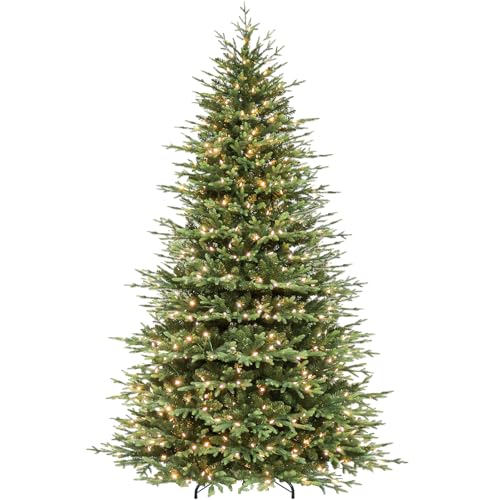
The best 9 foot Christmas trees are the ones that leave 6–12 inches of clearance above the top, provide enough branch tips for your ornament collection, and use pre-lit wiring you can realistically repair or replace; for most homes, a slim or full-profile artificial tree with 1,500–2,500 branch tips is the safest choice.
Our top picks



As an Amazon Associate we earn from qualifying purchases at no extra cost to you. Ratings are shown as listed on Amazon.
Quick picks by room and priority
| Best for | Tree type or example | Typical width | Typical branch tips | Typical setup |
|---|---|---|---|---|
| Large room and maximum fullness | Full-profile 9-foot Fraser fir, such as the styles sold by National Tree Company | 56–62 inches | 2,000–3,500 | 45–75 minutes |
| Traditional silhouette with premium foliage | 9-foot Vermont White Spruce style, including Balsam Hill’s tall-tree range | 55–60 inches | 2,000–3,000 | 45–75 minutes |
| Best balance of price and fullness | 9-foot King Noble or similar full artificial fir from King of Christmas | 54–60 inches | 1,800–2,800 | 40–70 minutes |
| Tight corners and smaller apartments | 9-foot slim or pencil fir | 36–48 inches | 900–1,800 | 25–50 minutes |
| Lowest long-term bulb hassle | Unlit hinged tree with separate LED light strings | 36–62 inches | Varies by tree | 30–60 minutes, plus lighting |
These are useful comparison ranges rather than universal specifications. A “9-foot” tree can vary substantially in diameter, tip count, base design, lighting, and packed-box size between editions and retailers.
First, calculate whether a 9-foot tree fits
Measure from the floor to the lowest obstruction—not merely to the ceiling. Include crown molding, a ceiling fan, a sprinkler head, a hanging light, or a topper. The basic calculation is:
Available tree height = ceiling height − fixed obstructions − desired clearance − topper height.
For a 10-foot ceiling with 4 inches of crown molding, 3 inches of practical clearance, and a 10-inch topper:
120 inches − 4 − 3 − 10 = 103 inches.
A 9-foot tree is 108 inches before its topper, so this arrangement is too tall. You would need to omit the topper, choose an 8.5-foot tree, or accept that the tree will sit almost against the ceiling. In a room with a true 10-foot ceiling and no obstruction, a 9-foot tree plus a modest 6-inch topper leaves approximately 6 inches of clearance.
Do not assume the advertised height includes the stand. Check whether the measurement is taken from the floor with the stand installed, and allow extra height for a star or angel. If your ceiling is 9 feet, a 9-foot tree is generally impractical unless the top section is removed or the tree is placed on a very low base.
Full, slim, or pencil: choose by floor space
Full-profile trees
Full trees create the most convincing wall of greenery and are easiest to decorate with large ornaments, ribbon, and deep branches. They commonly require a 55- to 65-inch diameter footprint. Leave another 6–12 inches around that footprint for walking, curtain clearance, and access to the plug. A full 9-footer is best in a room where the tree can remain the visual centerpiece rather than sharing a narrow passage.
Slim trees
Slim trees usually measure about 40–50 inches wide. They are a better choice beside a fireplace, in a dining room, or in an apartment with high ceilings but limited floor area. The trade-off is less interior depth for large ornaments and a less expansive appearance. Look for layered branches and at least 1,200 tips if you want a slim tree that does not look sparse from across the room.
Pencil trees
Pencil trees can be under 36 inches wide and are useful for corners, entryways, and narrow stair landings. They hold fewer decorations and can look top-heavy if overloaded with a heavy topper. Use lightweight ornaments and secure the stand if children or pets can reach the lower branches.
Branch tip counts: what the number actually tells you
Branch tip count is helpful, but it is not a quality score by itself. A tip is usually a small end segment, and manufacturers may count different components in different ways. Two trees with 2,000 tips can look different if one has long, widely spaced branches and the other has shorter, densely layered needles.
- Under 1,000 tips: usually an intentionally open or budget tree; ornaments remain highly visible.
- 1,000–1,800 tips: appropriate for many slim 9-foot trees and lighter decoration.
- 1,800–2,800 tips: a practical fullness range for a standard 9-foot family tree.
- Over 2,800 tips: very dense foliage, often with a longer shaping session and heavier packed weight.
Also check the material. Polyvinyl chloride needles are usually flatter and help create fullness at a lower price. Molded polyethylene branch tips tend to look more realistic and hold their shape well, but trees using more molded tips are often more expensive and heavier. A mixed construction can provide realistic outer tips with affordable inner filler.
Pre-lit bulb types: compare the failure plan, not just brightness
Warm-white LED lights use less electricity and produce less heat than older incandescent strings. They are the most practical choice for a tree used every year. Many pre-lit trees use replaceable mini LEDs, but replacement procedures vary.
Incandescent mini lights can provide a familiar, warmer glow, but they consume more power and run hotter. They are less common on new tall trees and may be harder to match when a section fails.
Color-changing LEDs add flexibility but introduce a controller, remote, or app that can become the first failed component. Confirm that the tree can remain on one setting without the controller and that replacement control boxes are available.
For a 9-foot tree, expect roughly 600–1,200 factory-installed bulbs depending on density and manufacturer. A tree with 800 bulbs is not automatically brighter than one with 600; spacing, lens design, and branch placement matter. Before buying, confirm whether one failed bulb turns off a small section or the entire tree, whether spare bulbs are included, and whether each section has a labeled connector.
Assembly, shaping, and storage: the hidden workload
Most 9-foot hinged trees arrive in three or four sections. Assembly itself may take only 10–20 minutes, but shaping is the part that determines the final appearance. A dense tree with many hinged branches can require 30–60 minutes of branch separation and another 15 minutes to adjust visible gaps around the trunk.
- Place the stand where the tree will remain; moving a fully shaped 9-footer is awkward and can loosen the sections.
- Install the bottom section and confirm that the trunk is vertical before tightening the stand.
- Connect each light plug or section connector before adding the next section.
- Open major branches first, then spread individual tips outward and upward.
- Rotate the tree while shaping so the front is not fuller than the sides.
- Add the topper only after checking both ceiling clearance and stability.
For storage, measure the packed box rather than relying on the tree’s display height. A typical 9-foot tree breaks down into a box roughly 50–65 inches long, 18–28 inches wide, and 18–28 inches high. That is approximately 9–18 cubic feet of storage space, although a storage bag may require a different footprint. A full tree can weigh 35–75 pounds; a slim tree may be closer to 20–45 pounds.
If attic access involves a narrow hatch or steep ladder, choose a lighter three-section tree or a bag with handles and compression straps. Store it in a dry area. Damp basements can corrode connectors and encourage odors, while hot attics can make plastic branches brittle over time.
Decision matrix for choosing among the best 9 foot Christmas trees
| Your situation | Recommended specification | Why |
|---|---|---|
| First artificial tree | Hinged, 3-section tree with 1,800–2,500 tips and a metal stand | Moderate shaping effort without excessive assembly or storage weight |
| Decorated heavily every year | Full profile, 2,300+ tips, strong branch hinges, unlit or replaceable-LED design | Deeper branches support ribbon and heavier ornaments |
| Used only occasionally | Unlit slim tree or basic warm-white LED tree | Lower purchase cost and fewer electronic parts to age in storage |
| Small floor area | 36–48-inch slim or pencil profile | Preserves walking space while using vertical height |
| Limited lifting ability | Three or four lighter sections, under 45 pounds packed if possible | Sections are easier to carry and place safely |
| Lowest initial budget | PVC-dominant tree with 1,000–1,800 tips | Usually costs less, though it may need more careful shaping |
Ownership costs and common mistakes
General market pricing for a 9-foot artificial tree ranges from roughly $150–$350 for basic unlit or lightly lit models, $350–$800 for fuller pre-lit trees, and $800 or more for premium molded-tip constructions. A $500 tree used for ten seasons costs about $50 per season before electricity and replacement parts. A $250 tree used for three seasons costs about $83 per season, so durability and storage conditions can matter more than the initial price.
The parts most likely to cause trouble are light connectors, foot-pedal switches, controller boxes, and branch hinges—not usually the trunk itself. Never pull a section apart by its light wires. Label connectors before storage, wrap cords loosely, and keep the original assembly instructions in the storage bag. Use a soft brush or a vacuum’s low-suction brush attachment to remove dust; high suction can pull off fine needle tips.
The most common buying mistake is selecting a tree by height alone. A 9-foot tree that is 62 inches wide may be unsuitable where a 44-inch slim tree would fit perfectly. The second is buying an extremely dense tree without allowing extra shaping and storage capacity. Measure the ceiling, doorway, storage route, and floor footprint first; then compare tip density and lighting.
Frequently asked questions
How many lights do I need for a 9-foot unlit tree?
Plan on approximately 800–1,200 mini LED bulbs for a traditionally bright look, or about 500–800 for a lighter, ornament-forward display. Use multiple shorter strings rather than one excessively long string so a single failure does not darken the whole tree.
Is a 9-foot tree too large for an 8-foot ceiling?
Yes. Even without a topper, the tree’s advertised height typically leaves no practical clearance and may press against the ceiling. Choose a tree around 7–7.5 feet instead.
Are more branch tips always better?
No. Tip count should be considered with width, needle material, branch spacing, and your decoration style. A well-shaped 1,700-tip slim tree can look better in a small room than a poorly proportioned 3,000-tip full tree.