Key takeaways
- Looking for the best cameras for rock-thrush photography? Compare five mirrorless bodies built for distant birds on rocky mountain slopes in 2026.
The common rock-thrush is a bird of high, open ground. In spring the male perches on a boulder or a ruined wall, blue-grey head catching the light, orange underparts glowing against grey stone, and sings a short, fluty phrase before dropping to the turf for an insect. It is a bird you watch from a distance, and that distance is the whole problem for a photographer. A rock-thrush will not let you walk up to it. It keeps a gap of tens of metres between itself and any walker, and it slips behind a ridge the moment you step off the path.
As an Amazon Associate, we earn from qualifying purchases.
Why a Rock-Thrush Demands Reach
Rock-thrush live where the ground is broken and the wind never quite stops. Rocky mountain slopes, old quarries, scree edges and dry stone walls are their home, and every one of those places puts the bird a long way from the nearest path. You cannot creep closer. The ground is loose underfoot, the bird sees you coming across open rock, and it has a dozen perches to choose from when it moves on. Most rock-thrush frames are taken at the far end of a long lens, with the bird small in the viewfinder and the mountain doing most of the talking.
That changes what a camera has to do. Autofocus has to find a small, colourful bird against a busy background of stone and scrub, and it has to do it fast, because the bird may only sit still for a few seconds. Resolution matters more than it does for a garden bird, because you will crop. A 45 or 61 megapixel file survives a heavy crop and still holds feather detail; a 24 megapixel file can do the job too, but it leaves less room to recompose after the fact. Weight matters most of all. Every gram rides on your back up a slope, and a body that feels fine in a shop can feel like a brick by the third hour of a climb.
None of the five cameras below comes with a lens in the box. Each one is a body, and each one needs a long lens before it can do rock-thrush work at all. A 100-400mm zoom is the sensible floor, and a 200-600mm or a 100-500mm zoom is better. Budget for the lens first, then choose the body that fits what is left.
Rock-Thrush Is Not a Whinchat
Before you buy anything, make sure you know which bird you are chasing. The rock-thrush, Monticola saxatilis, belongs to the family Muscicapidae, the chats and flycatchers. So does the whinchat, Saxicola rubetra, which was covered in drones form in an earlier batch. Same family, different genera, and the two birds could hardly look more different in the field.
A male rock-thrush in spring is unmistakable once you have seen one. The head and throat are blue-grey, the breast and belly are a warm orange, the back carries a white patch, and the tail is a rusty orange that flashes as the bird drops to the ground. It is a bird of rock and ruin, perched high on a boulder, a wall or a roof tile, singing from an exposed point. The female is quieter, mottled brown above and barred below, but she keeps the same shape and the same love of high perches.
A whinchat is a smaller, plainer bird of grassland. It perches on grass stems, fence posts and low bushes in meadows, not on mountain boulders. Its upperparts are streaked brown, its breast is a soft buff, and its most useful field mark is a bold pale stripe above the eye. It has no blue-grey head, no orange belly, no white back patch. Grass stem and pale eyebrow means whinchat; boulder and blue-grey head with an orange breast means rock-thrush.
The Five Cameras
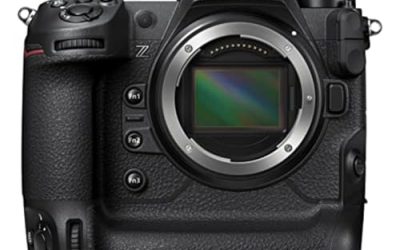
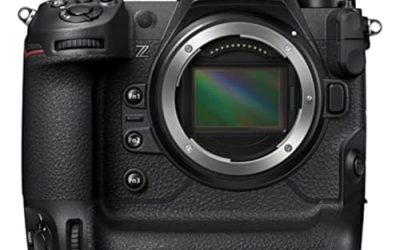
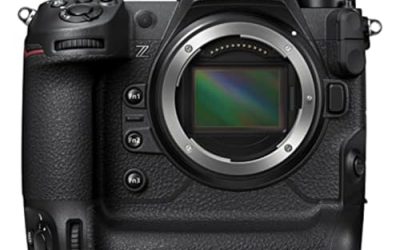
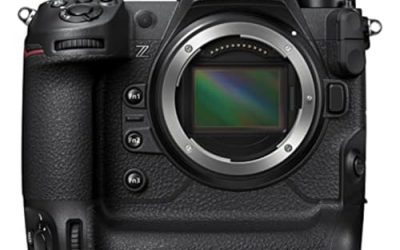
1. Nikon Z9

The Z9 is the heavyweight of this group, and it earns that place with autofocus that finds a small bird against stone and holds it. Its subject detection was built for exactly this kind of work: a colourful bird, far away, against a busy background, moving in short hops between perches. The 45.7 megapixel stacked sensor gives you room to crop hard, and the blackout-free viewfinder means you never lose sight of the bird during a burst. The trade-off is weight: a big body with a built-in vertical grip, around 1,340 grams with battery and card, and heavier still once you add a long lens. Its menus also run deep. But if you want the best chance of a sharp frame of a distant bird on a windy ridge, this is the body to beat.
Specs
- 45.7MP stacked full-frame CMOS, EXPEED 7, 20 fps RAW, 120 fps JPEG, 8K 30p, blackout-free EVF, around 1,340 g with battery and card, body only
2. Sony A7R V

The A7R V takes a different route to the same goal. Where the Z9 leans on speed, the Sony leans on resolution: 61 megapixels, the highest in this group by a wide margin, with an AI processing unit that drives its subject recognition. You frame wide, you let the autofocus find the bird, and you crop in later, keeping feather detail that a lower resolution body would have lost.
The trade-off is speed. Ten frames per second is plenty for a perched bird, but it is not the burst rate of the Z9 or the R7, and a rock-thrush in flight will test it. The files are also large, so you will want fast cards and plenty of storage. If your priority is detail and cropping room above all else, this is the strongest pick in the group.
Specs
- 61.0MP full-frame Exmor R CMOS, BIONZ XR plus AI unit, 10 fps, 8K 24p, 8-stop IBIS, dual CFexpress Type A plus SD slots, model ILCE7RM5/B, body only
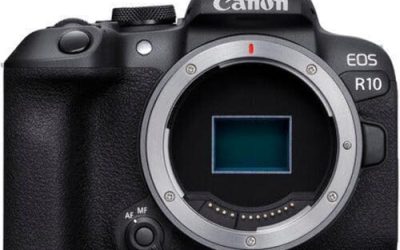
3. Canon EOS R7

The R7 is the reach king of this group, and reach is what rock-thrush photography is about. Its APS-C sensor gives every lens an effective 1.6x crop, so a 100-400mm zoom behaves like a 160-640mm lens. That is a huge advantage on a ridge where the bird will not let you closer. The 32.5 megapixel sensor holds detail well for its size, the autofocus tracks birds with confidence, and the burst rate of 15 frames per second mechanical and 30 frames per second electronic is fast enough for a bird dropping from a perch.
The trade-offs are honest ones. An APS-C sensor gathers less light than a full-frame sensor, so high ISO work in dawn or dusk light is noisier. The electronic viewfinder is good but not as large or as bright as the full-frame bodies here. If you want the most reach for the least weight and the least outlay, this is the pick.
Specs
- 32.5MP APS-C CMOS, DIGIC X, 15 fps mechanical, 30 fps electronic, 4K 60p oversampled from 7K, 7-stop IBIS, model 5137C002, around 611 g, body only
4. Canon EOS R6 Mark II

The R6 Mark II is the all-rounder of the group, and all-rounders suit mountain work. Its 24.2 megapixel full-frame sensor is the lowest resolution here, but it is also the cleanest at high ISO, which matters when you are shooting a rock-thrush in the soft light of dawn or under a grey mountain sky. Its autofocus is fast and sure, its burst rate of 12 frames per second mechanical and 40 frames per second electronic is more than enough for a perched bird, and its 8-stop stabilisation helps with a long lens in your hands.
The trade-off is cropping room. At 24.2 megapixels you cannot crop as hard as you can with the Z9 or the A7R V, so you need to get closer or use a longer lens to fill the frame.
Specs
- 24.2MP full-frame CMOS, DIGIC X, 12 fps mechanical, 40 fps electronic, 4K 60p oversampled from 6K uncropped, 8-stop IBIS, model 5666C002, body only
5. Fujifilm X-S20

The X-S20 is the lightest and most travel-friendly body in this group, and that matters on a mountain. At 491 grams it all but disappears in a pack, and its deep grip makes it comfortable to hold with a long lens attached. The 26.1 megapixel APS-C sensor gives the same 1.5x crop advantage as the R7, so your long lens reaches further than it would on a full-frame body. Its autofocus is quick, and its 20 frames per second electronic burst is fast enough for a bird in motion.
The trade-offs are modest. The electronic viewfinder is smaller than the ones on the full-frame bodies, and the battery, while good for its size, will not last as long as the bigger bodies on a cold day. The X-S20 is also the least weather-sealed body here, so a sudden mountain shower calls for a cover or a quick retreat. If you want a light, capable body that you will actually carry to the top of the slope, this is the pick.
Specs
- 26.1MP APS-C X-Trans CMOS 4, X-Processor 5, 20 fps electronic, 6.2K 30p, 7-stop IBIS, 491 g, NP-W235 battery, model 16781852, body only
How the Five Compare
Put the five side by side and the choice comes down to what you value most. The Z9 is the best all-round tool for distant birds, but it is the heaviest and the hardest to learn. The A7R V is the detail king, letting you crop hardest and keep feather detail, but its burst rate is the slowest and its files are the largest. The R7 gives the most reach for the least weight, but gives up some high ISO cleanliness. The R6 Mark II is the low-light pick, but has the least room to crop. The X-S20 is the lightest and easiest to carry, but is the least weather-sealed with the smallest viewfinder.
There is no wrong answer here, only a wrong lens. Every one of these bodies needs a long lens before it can do rock-thrush work, and the lens you choose will shape your results more than the body will. A 100-400mm zoom is the floor. A 200-600mm or a 100-500mm zoom is better. If you already own a long lens in one mount, let that decide your body.
Field Notes for Rocky Slopes
Go early, while the light is soft and the bird is singing from its highest perch. Walk the ridge line slowly and scan every boulder and wall before you move. The male often sings from the same few perches, so if you hear him, stop and watch. He will come back to the same stone.
Stay on the path. The ground off the path is loose, the turf is fragile, and a slip on scree can end a day and damage a camera. Keep your distance and let a long lens do the work. Never chase a bird from perch to perch; it will only move further away. Sit still, be patient, and let the bird come back to its favourite stone.
Carry water, carry a spare battery, and keep a lens cloth in a pocket you can reach without taking your pack off. Wind on a ridge drives dust onto the front element, and a dirty front element costs you contrast in every frame.
Frequently Asked Questions
How far away will a rock-thrush let me get?
Most of the time, tens of metres. A rock-thrush on a ridge will watch you from a boulder and slip away the moment you step off the path toward it. Plan on shooting from 30 metres or more. A 100-400mm zoom is the floor, and a longer zoom is better.
Is a full-frame camera better than APS-C for rock-thrush work?
It depends on what you value. Full-frame bodies like the Z9, A7R V and R6 Mark II give cleaner high ISO files and bigger viewfinders. APS-C bodies like the R7 and X-S20 give extra reach from the same lens, because the smaller sensor crops the image.
Can I photograph a rock-thrush with the kit lens that came with my camera?
In most cases, no. A kit lens is too short for a bird that keeps tens of metres between itself and you. You need a long telephoto zoom, at least 100-400mm, and ideally longer. The body matters, but the lens matters more.
How do I tell a rock-thrush from a whinchat in the field?
Look at the place, the perch and the colours. A rock-thrush sits on boulders, walls and roof tiles on rocky slopes, with a blue-grey head and an orange breast in the male. A whinchat sits on grass stems, fence posts and low bushes in meadows, with streaked brown upperparts and a bold pale stripe above the eye.
A rock-thrush is a bird that rewards patience and reach in equal measure. Pick a body you will carry to the top of the slope, put the longest lens you can afford in front of it, and let the bird come to its favourite stone.
More from Amazon
Programs that pair well with the guide above. Offers and eligibility are set by Amazon and may change.
Free shipping on eligible items, Prime Video and more. Eligible new members can start with a free trial.
Start a Prime free trialAudiobooks and podcasts to listen to on the go. Eligible new members can start with a free trial.
Try Audible freeAd-free music streaming. Eligible new subscribers can start with a free trial.
Try Music Unlimited freeA free business account with business pricing and bulk-buying tools for work, shop or home office.
Create a business accountAs an Amazon Associate we earn from qualifying purchases.