Key takeaways
- A harvestman rests low on meadow-edge plants, at ankle height. These five monopods hold a camera steady at the edge without blocking the path.
A harvestman is one of the quietest subjects you can photograph. It hangs beneath a leaf or rests on a grass stem at the edge of a meadow, its body no bigger than a pea and its legs reaching out like thin threads. It does not build a web, it does not hunt, and it does not hurry away when you approach slowly.
As an Amazon Associate, we earn from qualifying purchases.
A monopod is a weak tool for harvestman photography, and this guide says so from the outset. The animal is small, low down, and often tucked under leaves at ankle height, exactly where a monopod is least comfortable. A tripod would hold the camera steadier at ground level, and a bean bag on the soil would do the same job for less effort. What a monopod offers is a light, quick support for a camera with a macro lens when you are walking a meadow edge. If you already own one, the five picks below will serve you well. If you do not own one, do not buy one only for harvestmen.
Where to Find a Harvestman
Harvestmen live in meadows, gardens, and woodland edges, usually close to the ground. Look for them on low plants, on the undersides of leaves, on fence posts, and on tall grass near a hedge. They are most often seen from late summer into autumn, when the adults are out in numbers. A damp morning after rain is a good time to look, because the animals sit still on wet leaves and the light is soft.
Work from the path. Walk slowly along the edge, scan the leaves at knee height and below, and stop when you see one. Do not reach in to move a leaf aside; if the harvestman is hidden, leave it hidden. Keep the walkway clear, and in a garden ask permission first and leave gates as you found them. A harvestman is fragile: its long legs break off easily, so never touch one, pick one up, or prod it to move.
A Harvestman Is Not a Spider
A harvestman is not a spider, even though the two animals are related and are often confused. Both belong to the arachnids, the group that also includes scorpions and mites, but a harvestman belongs to the order Opiliones while a spider belongs to the order Araneae, and the difference is easy to see once you know what to look for.
A spider has two distinct body parts: a front section that carries the legs and a separate abdomen joined to it by a narrow waist. A harvestman has a single fused body, one compact oval with no waist at all. That single body is the most reliable field mark. A spider also has silk glands and can spin a web. A harvestman has no silk glands and never builds a web. It feeds on small dead animals, plant matter, and fungi.
The legs tell the same story. A harvestman has eight legs, like a spider, but its legs are far longer in proportion to its body, and the second pair is the longest of all. That second pair works like feelers, tapping the surface ahead as the animal walks. A harvestman also has no venom glands and no fangs, so it cannot bite.
This matters for the photograph: a good harvestman image shows the fused body, the long legs spread across a leaf, and the second pair reaching forward. A macro lens held steady at close range can capture all of that. A lens that cannot focus close enough will only show a dark speck with threads, and no support will fix that. The lens matters more than the monopod here.
What a Monopod Can and Cannot Do Here
A monopod takes some of the camera’s weight and steadies it in one plane, but it does not hold the camera still the way a tripod does. It stops the worst vertical shake, but it cannot stop side-to-side sway or hold a long exposure. For a harvestman at ankle height, that limit is real: crouching at the meadow edge with the pole at an angle, the camera will still move a little. A fast shutter and a stabilised lens will do more for the image than the monopod will.
What a monopod does well is speed. Walking a meadow edge, you can plant the foot, lean the camera in, and take the photograph in a few seconds, where a tripod would need a minute of setup. The monopod is also light, and easy to carry for an hour along a hedge. The honest limit is height: a harvestman sits at ankle height, so you will work with the pole collapsed to two or three sections, using it as a short brace. That is why the GorillaPod matters: it is the only pick that can hold a camera still at ground level.
The Five Picks
1. Sirui P-326 Carbon Fiber Monopod
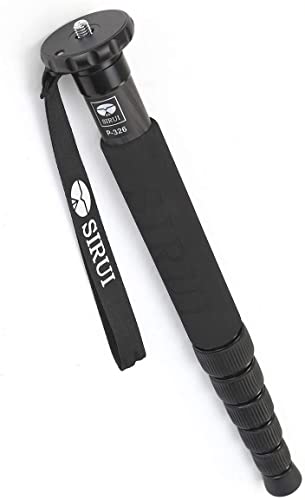
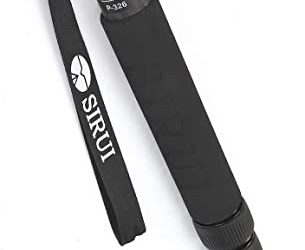
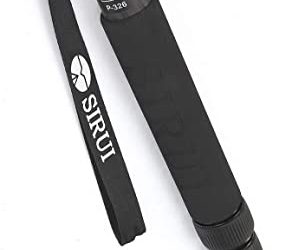
The Sirui P-326 is the lightest full-height monopod in this guide, and that lightness is its main strength on a meadow walk. Six carbon fiber sections fold down to 15 inches and weigh about 400 grams, so the pole disappears into a day bag. It extends to 60.6 inches for a harvestman on a fence post or a tall stem, and the twist locks are quick to set with one hand.
Six sections mean six locks to check, and the thinnest sections flex a little at full extension with a heavy camera. For harvestman work the pole is usually collapsed, so that flex is not a problem. The head is sold separately, and the reversible mounting screw fits both common thread sizes.
Specs
- 6 sections; carbon fiber; 60.6 in max height; 15 in folded; about 400 g; 22 lb load limit; reversible 1/4 in and 3/8 in mounting screw; wrist strap included; head sold separately.
2. Manfrotto XPRO Carbon Monopod

The Manfrotto XPRO Carbon Monopod is the most solid pole in this guide, and it is the one to choose if your camera and macro lens are heavy. Four carbon fiber sections reach 64.76 inches, fold to 20.47 inches, and weigh 1.3 lb, and the pole carries a 20 kg load limit. The flip locks are large and easy to work with cold or damp hands, and the D-shaped tube stops the pole from twisting.
The trade-off is bulk: four sections fold longer than six, and the pole is heavier than the Sirui, while the extra reach is mostly unused at ankle height. The head is sold separately and the pole has no feet. What it offers is rigidity: leaned into at an angle with a heavy camera, it does not bend.
Specs
- Model MPMXPROC4US; 4 sections; carbon fiber; 64.76 in max height; 20.47 in folded; 1.3 lb; 20 kg load limit; flip locks; D-shaped tube; head sold separately.
3. JOBY GorillaPod 3K PRO Stand

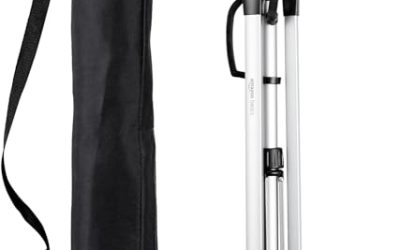
The JOBY GorillaPod 3K PRO Stand is not a monopod at all, and this guide says so plainly. It is a flexible stand with three jointed legs that can wrap around a branch, grip a fence rail, or sit on the soil beside a plant. That makes it the most useful pick here for a harvestman, because a harvestman sits low, and this is the only support that can hold a camera still at ground level.
The stand is anodized aluminum, weighs 9.6 oz, measures 9.25 inches long, and holds up to 3 kg, which covers a mirrorless camera with a macro lens. The ball head is sold separately, and the flexible legs take a little practice to set. It cannot reach eye level or carry a heavy full-frame camera with a long lens. But set it on the ground beside the plant, angle the camera down, and the frame stays still while you focus.
Specs
- Model JB01569-BWW; flexible jointed legs; anodized aluminum; 9.25 in long; 9.6 oz; 3 kg load limit; ball head sold separately; wraps around branches and rails.
4. Manfrotto 290 Carbon Monopod

The Manfrotto 290 Carbon Monopod is the steady middle of this list, a four-section carbon pole that balances weight, height, and rigidity. It reaches 59.4 inches, folds to 19.29 inches, and weighs 1.1 lb, with a comfortable rubber grip and a wrist strap. The flip locks are quick and positive, and the D-shaped tube keeps the pole from twisting.
The datasheet gives a safe working load of 5 kg, which is the figure this guide uses; the retail listing shows a higher figure, but the datasheet is the safer guide. The head is sold separately and the pole has no feet. At the meadow edge the 290 is a reliable brace at knee height.
Specs
- Model MM290C4US; 4 sections; carbon fiber; 59.4 in max height; 19.29 in folded; 1.1 lb; 5 kg safe working load per datasheet; flip locks; rubber grip; wrist strap; head sold separately.
5. NEEWER T222 Monopod
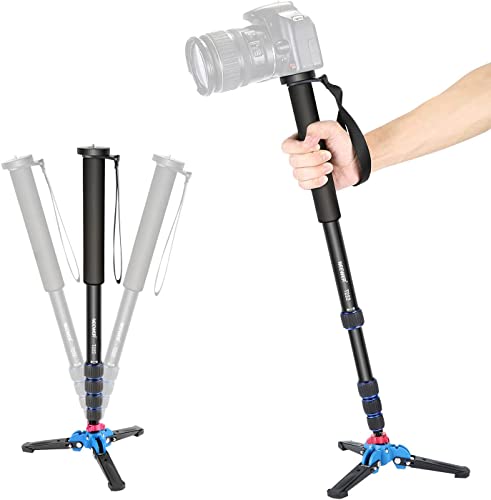
The NEEWER T222 is the most versatile pole in this guide, because it comes with a detachable folding stand base. The monopod itself is aluminum, with five sections that extend from 20.5 inches to 66 inches and weigh 1.3 lb. The stand base clips on to the foot and opens into three small legs, giving the pole a measure of self-support that no other monopod here offers. The base also pans a full circle and tilts a little.
The trade-off is weight and bulk: aluminum is heavier than carbon fiber, and the base adds size. The 5 kg load limit suits a mirrorless camera with a macro lens, not a heavy full-frame body with a long lens. Set the pole low, open the base on firm ground at the path edge, and the camera stays put while you work the focus.
Specs
- Model T222; 5 sections; aluminum alloy; 66 in max height; 20.5 in folded; 1.3 lb; 5 kg load limit; detachable folding stand base with 360-degree pan; wrist strap and spike foot included; head sold separately.
Which One to Choose
If you walk a long way and want the lightest carry, choose the Sirui P-326: six sections fold to 15 inches and the pole weighs about 400 grams. If your camera and lens are heavy, choose the Manfrotto XPRO Carbon Monopod, with its 20 kg load limit and stiff four-section build.
If you want the best photograph of a harvestman, choose the JOBY GorillaPod 3K PRO Stand: it is the only pick that holds a camera still at ground level. For a reliable middle ground, choose the Manfrotto 290 Carbon Monopod. If you want a pole that can stand on its own, choose the NEEWER T222.
None of these picks changes the honest limit. A monopod is a weak tool for this subject, and anyone who does not already own one should not buy one only for harvestmen. A tripod holds a camera steadier at ground level, and a bean bag on the soil does the same job for less effort. Buy a monopod because you walk meadow edges often and want a light, quick support for many subjects, not because of one small arachnid.
Frequently Asked Questions
Is a harvestman a spider?
No. A harvestman belongs to the order Opiliones, while a spider belongs to the order Araneae. A spider has two body parts joined by a narrow waist, and it can spin silk. A harvestman has a single fused body with no waist, no silk glands, and no web. It also has no venom and cannot bite. The long second pair of legs, which works like feelers, is another field mark.
Do I need a monopod to photograph a harvestman?
No. A monopod is a weak tool for this subject, because a harvestman sits low and a monopod is least comfortable at ankle height. A tripod holds a camera steadier at ground level, and a bean bag on the soil does the same job for less effort. A monopod is useful if you already own one and walk meadow edges often; if you do not own one, do not buy one only for harvestmen.
What lens do I need for harvestman photography?
You need a macro lens, or a lens that focuses close enough to fill the frame with a body the size of a pea. A standard kit lens cannot focus close enough, and the monopod cannot fix that. A 90 mm or 100 mm macro lens is a good choice, because it lets you work from a little farther back. A lens with stabilisation helps, because a monopod cannot stop side-to-side sway on its own.
Where is the best place to look for a harvestman?
Look at meadow edges, gardens, and woodland edges, on low plants, on the undersides of leaves, on fence posts, and on tall grass near a hedge. A damp morning after rain is a good time, because the animals sit still on wet leaves. Work from the path, keep the walkway clear, and never touch the animal or move the leaf it sits on.
More from Amazon
Programs that pair well with the guide above. Offers and eligibility are set by Amazon and may change.
Free shipping on eligible items, Prime Video and more. Eligible new members can start with a free trial.
Start a Prime free trialAudiobooks and podcasts to listen to on the go. Eligible new members can start with a free trial.
Try Audible freeAd-free music streaming. Eligible new subscribers can start with a free trial.
Try Music Unlimited freeA free business account with business pricing and bulk-buying tools for work, shop or home office.
Create a business accountAs an Amazon Associate we earn from qualifying purchases.