
Key takeaways
- Five sharp, quiet, full-frame E-mount lenses for the Sony A7S, from a fast 35mm prime to a long telephoto zoom, chosen for low light and video.
The Sony A7S remains a remarkable camera for low light work, even though it arrived in 2014 with only 12 megapixels. That modest sensor count is a strength in disguise. Large photosites gather light with ease, files stay small, and high ISO footage holds together in conditions where other bodies fall apart. The sensor is also forgiving of lens flaws, because it does not demand the extreme corner sharpness that a 40 megapixel body would. What it does demand is fast glass, quiet autofocus, and a focal range that suits the way you actually shoot.


This guide picks five full-frame E-mount lenses that match those needs: a fast wide prime for night skies, a classic 35mm for documentary work, a true macro lens for close detail, a compact telephoto zoom for events, and a long reach zoom for wildlife and distant subjects. Every lens here mounts directly on the A7S with no adapter and covers the full sensor. Together they cover wide, normal, short telephoto, and long telephoto work, so you can build a kit around one or two of them and add the rest over time.
As an Amazon Associate, we earn from qualifying purchases.
How to Choose a Lens for the Sony A7S
Begin with the way you shoot, not with a specification sheet. The A7S was built for video and low light stills, and its best lenses share a few traits. A wide maximum aperture matters more here than on a high resolution body, because it lets you keep ISO low and shutter speed high in dim rooms, on streets at night, and in venues where flash is not welcome.
Autofocus behaviour matters just as much. Modern linear and stepping motors move silently, hold focus on a moving subject, and let you record clean audio without motor noise bleeding into the clip. If you shoot video, look for a lens with minimal focus breathing, so the framing does not shift as focus moves from a near subject to a distant one.
Weight and balance deserve attention too. The A7S body is compact, and a heavy front element can make a handheld rig feel nose heavy on a long shoot. A 470 gram prime balances better on a gimbal than a 1,100 gram zoom, and a lens with a 67mm filter thread keeps your filter kit small and light. Weather sealing is a bonus for outdoor work, and a close minimum focus distance adds versatility.
Focal length is the last piece. A 20mm lens suits interiors, architecture, and night skies. A 35mm lens suits documentary work, weddings, and everyday shooting. A 105mm lens suits portraits and macro detail. A 70-180mm zoom suits events where you cannot move closer. A 50-400mm zoom suits wildlife, sports, and travel where one lens must do the work of three.
1. Sigma 35mm f/1.4 DG II Art for Sony E Mount
The 35mm focal length is the natural home of the A7S. It is wide enough for a room, tight enough for a portrait, and fast enough for a street at night. This second generation Sigma Art prime brings that classic view to the A7S with a bright f/1.4 aperture, a stepping motor for quiet autofocus, and a build that feels solid without being heavy.
For video, the 35mm is a workhorse. It is wide enough to hold a subject in frame while you walk, yet it keeps faces natural rather than stretched at the edges. The autofocus motor runs quietly, so dialogue and ambient sound stay clean, and the aperture ring lets you change exposure smoothly during a take.
The DG II version updates the original DG DN design with a revised optical formula and a more compact barrel. It keeps the 67mm filter thread of the earlier lens, so existing filters carry over, and it adds a de-clickable aperture ring and a customisable function button for video shooters.
Specs: Mount Sony E, Focal length 35mm, Maximum aperture f/1.4, Minimum aperture f/16, Focus Auto focus with stepping motor, Filter thread 67mm, Model 304965, Lens design Prime
2. Sigma 20mm f/1.4 DG DN Art for Sony E Mount
Night skies, interiors, and architecture call for a wide lens that stays fast, and the Sigma 20mm f/1.4 DG DN Art answers that call. At 20mm, the field of view is broad enough to hold a whole room or a stretch of Milky Way, while the f/1.4 aperture gathers enough light to keep shutter speeds sensible and ISO values low on the A7S.
On the A7S, the 20mm shines in video as well. A wide lens forgives small camera movements, so handheld walking shots look smoother, and the deep depth of field at moderate apertures keeps more of a scene in focus while you move through it. The autofocus motor is a stepping design, so focus changes are quiet and smooth, and manual focus override lets you pull focus by hand when a shot demands it.
Weight is 630 grams on the Sony E version, which is reasonable for a lens this fast and wide, and the 82mm front filter thread takes standard filters for daytime landscape work. Distortion is well controlled for a 20mm lens, and straight lines near the edges stay straight enough for architecture.
Specs: Mount Sony E, Focal length 20mm, Maximum aperture f/1.4, Minimum aperture f/16, Focus Auto focus with stepping motor, Filter thread 82mm, Weight 630 g, Minimum focus distance 0.23 m
3. Sigma 105mm f/2.8 DG DN Macro Art for Sony E Mount

A macro lens changes the way you see a subject, and the Sigma 105mm f/2.8 DG DN Macro Art brings true 1:1 magnification to the A7S in a lens that also works beautifully as a portrait prime. At 105mm, the working distance is comfortable, so you can photograph flowers, insects, jewellery, and small products without casting a shadow on the subject or disturbing it. The f/2.8 aperture gives a soft background at portrait distances, while the macro range lets you fill the frame with detail that a normal lens cannot reach.
Autofocus uses a Hyper-Sonic Motor, which is fast for a macro lens and quiet enough for video work. A focus limiter switch keeps the lens from hunting through the full macro range when you are shooting portraits, and the focus ring has a long, smooth throw for fine manual adjustment at close distances.
The lens weighs 710 grams on the Sony E version, with a 62mm filter thread and a 29.5 cm minimum focus distance. Build quality is high, with weather sealing at the mount and a solid metal barrel that feels reassuring in the hand.
Specs: Mount Sony E, Focal length 105mm, Maximum aperture f/2.8, Minimum aperture f/22, Focus Auto focus with Hyper-Sonic Motor, Filter thread 62mm, Weight 710 g, Minimum focus distance 0.295 m, Maximum magnification 1:1
4. Tamron 70-180mm f/2.8 Di III VXD for Sony E Mount
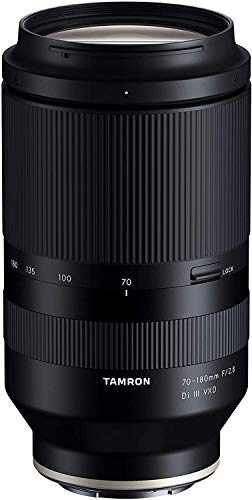
Events, ceremonies, and stage work call for a telephoto zoom that stays fast and light, and the Tamron 70-180mm f/2.8 Di III VXD is one of the most compact lenses in its class. It covers the classic portrait and event range from 70mm to 180mm at a constant f/2.8, yet it weighs only 810 grams and takes 67mm filters, so it balances well on the A7S and on a gimbal.
The VXD linear motor is the key feature for A7S owners. It focuses quickly and almost silently, which matters when you are recording a ceremony, a speech, or a performance and cannot afford motor noise in the audio. Focus breathing is well controlled, so a zoom or a focus pull does not distract from the subject.
Image quality is strong across the range, with good contrast and sharp detail at f/2.8, and the f/2.8 aperture keeps ISO low in dim halls and theatres. Weather sealing protects the lens in light rain, and the compact barrel fits easily in a small bag beside a 35mm prime.
Specs: Mount Sony E, Focal length 70-180mm, Maximum aperture f/2.8, Minimum aperture f/22, Focus Auto focus with VXD linear motor, Filter thread 67mm, Weight 810 g, Minimum focus distance 0.85 m, Maximum magnification 0.5x
5. Tamron 50-400mm f/4.5-6.3 Di III VC VXD for Sony E Mount

When one lens must cover everything from a standard view to a long telephoto, the Tamron 50-400mm f/4.5-6.3 Di III VC VXD is the most flexible option in this guide. It begins at 50mm, which is wide enough for a landscape or a group, and it reaches 400mm, which brings distant wildlife, sports, and architecture into range.
Built in Vibration Compensation helps at the long end, where camera shake is most visible, and the VXD linear motor keeps autofocus fast and quiet across the range. On the A7S, the combination works well for video, because the stabilisation smooths handheld shots at 200mm and beyond, and the quiet motor keeps audio clean.
The lens weighs 1,155 grams on the Sony E version and takes 67mm filters, which is compact for a lens that reaches 400mm. It is weather sealed, with a zoom lock to keep the barrel from creeping when you walk. The variable aperture is the trade for the range, so you will lean on the A7S high ISO ability in low light, but in daylight and at dusk this lens covers more ground than any other single lens here.
Specs: Mount Sony E, Focal length 50-400mm, Maximum aperture f/4.5-6.3, Minimum aperture f/22-32, Focus Auto focus with VXD linear motor, Stabilisation Vibration Compensation, Filter thread 67mm, Weight 1,155 g, Minimum focus distance 0.25 m, Maximum magnification 0.5x
Which Lens Should You Buy First
Buy the Sigma 35mm f/1.4 DG II Art first if you shoot a mix of stills and video. It is the most useful single focal length for the A7S, it is fast enough for night work, and it is quiet enough for video. Add the Tamron 70-180mm f/2.8 next if you shoot events, because the two lenses together cover 35mm to 180mm with fast apertures and quiet autofocus, and they share 67mm filters.
Choose the Sigma 20mm f/1.4 if your work is mostly night skies, interiors, or immersive video. Choose the Sigma 105mm f/2.8 Macro if you shoot products, portraits, or nature detail and want true close up ability. Choose the Tamron 50-400mm if you travel light and need one lens for wildlife, sports, and landscapes.
FAQ
Is the original Sony A7S still good for video in 2026?
Yes, the A7S remains useful for video because its 12 megapixel full frame sensor gathers light well, its files stay small, and its clean high ISO output suits dim venues and night shooting. Pair it with a fast, quiet lens and it still delivers footage that holds up for web delivery, events, and documentary work.
Can the Sony A7S use APS-C lenses?
The A7S can mount APS-C E-mount lenses, and it will crop the sensor to cover the smaller image circle, which reduces the field of view and the effective resolution. Full frame lenses are the better choice, because they use the whole sensor and keep the intended focal length.
Do I need image stabilisation in the lens for the A7S?
The original A7S has no in body stabilisation, so a stabilised lens helps for handheld stills and video, especially at longer focal lengths. A fast prime can compensate by letting you use a faster shutter speed, and a gimbal or tripod helps for video, but for telephoto work a lens with built in stabilisation is worth having.
Why does the A7S suit fast prime lenses so well?
The A7S sensor is forgiving of minor lens flaws because of its modest resolution, while its large photosites reward fast glass with clean shadows and low noise. A fast prime lets you keep ISO low, shutter speed high, and depth of field shallow, which are the three qualities that make the most of this body in low light.
Conclusion
The Sony A7S may be an older body, but it remains a capable tool when paired with the right glass. Fast primes make the most of its low light sensor, quiet motors keep video audio clean, and a well chosen zoom covers the range you cannot reach on foot. The five lenses in this guide cover wide, normal, macro, event, and long telephoto work, and each one mounts directly on the A7S with no adapter.
More from Amazon
Programs that pair well with the guide above. Offers and eligibility are set by Amazon and may change.
Free shipping on eligible items, Prime Video and more. Eligible new members can start with a free trial.
Start a Prime free trialAudiobooks and podcasts to listen to on the go. Eligible new members can start with a free trial.
Try Audible freeAd-free music streaming. Eligible new subscribers can start with a free trial.
Try Music Unlimited freeA free business account with business pricing and bulk-buying tools for work, shop or home office.
Create a business accountAs an Amazon Associate we earn from qualifying purchases.









