
Key takeaways
- Five full-frame FE lenses that suit the original Sony A7R, from a light kit zoom to wide, fast primes for landscapes, travel, and portraits.
The original Sony A7R arrived in 2013 with a 36.4 megapixel full-frame sensor, and it still rewards careful lens choice today. That sensor records fine detail in landscapes, architecture, and studio work, yet it also shows every weakness in a soft or poorly matched lens. The camera has no in-body stabilisation, and its autofocus is slower than later Sony bodies, so the lens in front of it matters more than it does on many newer bodies. Choose well, and the A7R remains a capable tool for deliberate, high-detail photography.


As an Amazon Associate, we earn from qualifying purchases.
This guide focuses on FE lenses, the native full-frame E-mount lenses made for the A7 series. FE glass covers the whole sensor, so there is no crop and no wasted resolution. The five lenses below cover the most useful ground for an A7R owner: a wide zoom, a light everyday zoom, a fast ultra-wide zoom, a fast portrait prime, and a fast ultra-wide prime. Each one is a proven full-frame design.
What the Original A7R Needs From a Lens
The A7R sensor has no optical low-pass filter, which helps it record very fine detail, but it also means that a lens with weak corners will show that weakness clearly. Look for lenses that stay sharp away from the centre, especially at wide apertures, and lenses that control colour fringing and distortion well. A lens that is only sharp in the middle will leave landscape edges and architectural lines looking smeared,
Stabilisation matters more on this body than on later models. Because the A7R has no sensor stabilisation, an optically stabilised lens helps a great deal when shooting handheld in low light or at longer focal lengths. Optical SteadyShot, the name Sony uses for stabilisation built into a lens, steadies the view through the finder as well as the image, which makes framing easier at 70mm and beyond. Lenses without stabilisation are still fine on a tripod, and fast primes with wide apertures can gather enough light to keep shutter speeds high, Autofocus is another point to weigh: the A7R uses contrast-detection autofocus, which is accurate but unhurried, and it works best with lenses that have responsive focus motors. For still subjects, landscapes, and portraits, it is perfectly usable.
1. Sony FE 16-35mm f/4 ZA OSS
The Sony FE 16-35mm f/4 ZA OSS is the classic wide zoom for the original A7R, and it remains one of the most sensible first wide lenses for this body. At 16mm it takes in broad landscapes, tight interiors, and tall architecture without forcing you to step back, and at 35mm it works as a general wide lens for street scenes and environmental portraits. The constant f/4 aperture stays the same across the whole zoom range, so exposure stays predictable as you zoom, and the built-in Optical SteadyShot helps when you shoot handheld at slower shutter speeds in dim churches, museums, and evening streets.
On the 36.4 megapixel sensor, this lens shows its Zeiss heritage in the centre of the frame, where detail is crisp and contrast is strong even at f/4. Corners improve as you stop down to f/5.6 or f/8, which is the usual working range for landscape work on a tripod anyway. It is not the fastest wide zoom, and it will not isolate a subject with a soft background the way a fast prime can, yet for the deliberate landscape and travel work the A7R does best, that trade is easy to accept.
Specs: 16-35mm focal length, constant f/4 maximum aperture, Sony E-mount full-frame, Optical SteadyShot, 518 g, 72mm filter thread, 0.28 m minimum focus, 7-blade circular aperture, 12 elements in 10 groups.
2. Sony FE 28-70mm f/3.5-5.6 OSS
The Sony FE 28-70mm f/3.5-5.6 OSS was the kit lens for the first A7 bodies, and it is still the lightest and simplest way to give an A7R a useful everyday zoom. It weighs only 295 g, it is short enough to fit in a small bag, and it covers the focal lengths most people reach for most often, from a moderately wide 28mm for street scenes and interiors to a short telephoto 70mm for portraits and details. For a photographer who wants one lens for travel, family outings, and general walk-around shooting, this is the most practical pick in this guide.
Image quality is better than its modest specification suggests. At 28mm and f/5.6 to f/8, the centre is sharp and colours are clean, and the lens holds up well on the A7R sensor when you avoid the extreme corners at the widest aperture. It will not match a fast prime for low-light work or for soft backgrounds, because the maximum aperture narrows to f/5.6 at the long end, yet in daylight and in well-lit interiors it delivers clean, usable files.
Specs: 28-70mm focal length, f/3.5-5.6 maximum aperture, Sony E-mount full-frame, Optical SteadyShot, 295 g, 55mm filter thread, 0.45 m minimum focus, 7-blade circular aperture, 9 elements in 8 groups.
3. Tamron 17-28mm f/2.8 Di III RXD

The Tamron 17-28mm f/2.8 Di III RXD is the fast ultra-wide zoom in this guide, and it is a strong choice for A7R owners who shoot landscapes, architecture, interiors, and night scenes. Its constant f/2.8 aperture is a full stop faster than the f/4 wide zooms, which helps in dim light and gives more control over depth of field, while the 17mm wide end reaches noticeably wider than most kit lenses.
At only 420 g and 99mm long, this Tamron is remarkably compact for a fast full-frame ultra-wide zoom, and it balances well on the A7R. The RXD stepping motor focuses quietly and smoothly, which suits both stills and video, and the lens supports full-time manual focus override, so you can fine-tune focus by hand without switching modes. Close focusing to 0.19 m also lets you get near to a foreground subject and use it as a strong anchor in a landscape composition. Like most ultra-wide zooms, it shows some distortion at the wide end and some softness in the far corners at f/2.8, yet those traits are manageable, and the extra speed is worth the trade for photographers who shoot at dawn, at dusk, or indoors.
Specs: 17-28mm focal length, constant f/2.8 maximum aperture, Sony E-mount full-frame, RXD stepping motor, 420 g, 67mm filter thread, 0.19 m minimum focus, 9-blade circular aperture, 13 elements in 11 groups.
4. Sigma 85mm f/1.4 DG DN Art

The Sigma 85mm f/1.4 DG DN Art is the portrait prime in this guide, and it is the lens to choose when you want a subject to stand out from a soft, smooth background. The 85mm focal length is a classic portrait length on full frame, long enough to flatter faces and compress a scene gently, yet short enough to use indoors and in a studio without standing far away. The f/1.4 aperture gathers a great deal of light, which helps the A7R in dim rooms and at evening events, and it creates a shallow depth of field that separates a person from a busy background in a way no f/4 zoom can match.
On the 36.4 megapixel sensor, this Sigma is impressively sharp where it matters. At f/1.4 the centre is already strong, with fine detail in eyes and hair, and stopping down to f/2 or f/2.8 brings the whole frame to a very high standard. The lens is heavier than the zooms in this guide at 630 g, yet that weight brings a solid build and a smooth focus ring that suits careful portrait work. If you shoot portraits, weddings, or close head-and-shoulders work with your A7R, this is the single lens most likely to change how your images look.
Specs: 85mm focal length, f/1.4 maximum aperture, Sony E-mount full-frame, DG DN Art design, 630 g, 77mm filter thread, 0.85 m minimum focus, 11-blade rounded aperture, 15 elements in 11 groups.
5. Sony FE 20mm f/1.8 G
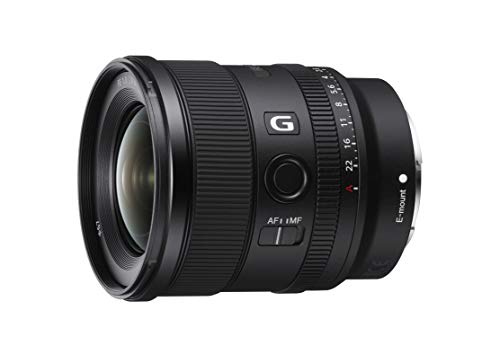
The Sony FE 20mm f/1.8 G is the fast ultra-wide prime in this guide, and it is the best fit for A7R owners who shoot landscapes at night, architecture in tight spaces, and environmental portraits with a strong sense of place. A 20mm lens takes in a very wide view, so it suits tall buildings, narrow streets, and broad skies, and the f/1.8 aperture makes it far more useful after dark than a slower wide zoom. Two XD linear motors drive the autofocus quickly and quietly, which helps on the A7R, and the lens focuses as close as 0.19 m, so you can fill the frame with a near foreground subject while keeping a distant scene in view.
Sharpness is the headline here. This lens holds detail well into the corners, even at f/1.8, and it controls coma, the smearing of bright points near the edges of the frame, better than many older wide lenses. Stopped down to f/5.6 or f/8, it is an excellent landscape lens, with strong contrast and clean edges across the 36.4 megapixel frame.
Specs: 20mm focal length, f/1.8 maximum aperture, Sony E-mount full-frame, two XD linear motors, 373 g, 67mm filter thread, 0.19 m minimum focus, 9-blade circular aperture, 14 elements in 12 groups.
How to Choose Between These Five Lenses
If you can only buy one lens, let your subject decide. For travel and everyday shooting, the Sony 28-70mm kit zoom is the lightest and simplest choice, and it covers the most ground with the least fuss. For landscapes and architecture, the Sony 16-35mm f/4 ZA OSS is the steadier and more flexible wide zoom, with stabilisation that helps the A7R handheld. For low-light wide work and night scenes, the Tamron 17-28mm f/2.8 and the Sony 20mm f/1.8 G are the two fast options, and the choice between them comes down to zoom flexibility against the extra speed and corner sharpness of a prime.
A sensible two-lens kit pairs one zoom with one prime. The 16-35mm f/4 with the Sigma 85mm f/1.4 covers wide landscapes and portraits with little overlap, and both lenses are strong where they are used most.
Using These Lenses Well on the A7R
The A7R rewards a slow, deliberate way of working, and a few habits will help any lens in this guide perform at its best. Use a tripod for landscapes and architecture whenever you can, and use the two-second self-timer or a remote release so that pressing the shutter does not shake the camera. When you must shoot handheld, keep the shutter speed fast enough for the focal length, lean on Optical SteadyShot where your lens has it, and brace the camera against a wall or a railing in dim light. Focus with care: magnify the view to check focus on a landscape foreground or on a portrait subject’s eye, and take a test frame at your working aperture before you commit to a full set of images.
FAQ
Is the Sony A7R still worth using with modern FE lenses?
Yes, for deliberate work it is. The 36.4 megapixel sensor still records fine detail for landscapes, architecture, studio work, and portraits, and modern FE lenses bring fast, quiet autofocus and strong optics to the older body.
Do I need a full-frame FE lens for the A7R?
Yes, a full-frame FE lens is the right choice. FE lenses cover the whole sensor, so you keep all 36.4 megapixels and the full field of view.
Which lens in this guide is best for landscapes on the A7R?
The Sony FE 16-35mm f/4 ZA OSS is the most flexible landscape choice here, with a useful wide-to-moderate range and stabilisation for handheld work. The Sony FE 20mm f/1.8 G is the sharper choice for night skies and for very wide scenes,
Can the A7R handle an 85mm f/1.4 lens for portraits?
Yes, it can, and the Sigma 85mm f/1.4 DG DN Art is a good match. The focal length flatters faces, the wide aperture separates a subject from the background, and the lens is sharp enough to show fine detail on the 36.4 megapixel sensor.
More from Amazon
Programs that pair well with the guide above. Offers and eligibility are set by Amazon and may change.
Free shipping on eligible items, Prime Video and more. Eligible new members can start with a free trial.
Start a Prime free trialAudiobooks and podcasts to listen to on the go. Eligible new members can start with a free trial.
Try Audible freeAd-free music streaming. Eligible new subscribers can start with a free trial.
Try Music Unlimited freeA free business account with business pricing and bulk-buying tools for work, shop or home office.
Create a business accountAs an Amazon Associate we earn from qualifying purchases.









