Key takeaways
- Very small and light for a full-frame body.
- Raw video capability aimed at filmmakers.
- Works with L-mount lenses from Sigma, Leica and Panasonic.
Sigma makes very few cameras, so the choice is simple: the Sigma BF suits people who want a minimalist, design-led full-frame body for everyday photos, the Sigma fp suits video and hybrid shooters who want a tiny modular body, and the fp L suits those who want high resolution in the same compact shell. The maker’s current camera page also lists an fp2, so buyers should compare it with the original fp line before choosing. All of these are L-mount, so the lens you buy matters as much as the body.
Our top picks



As an Amazon Associate we earn from qualifying purchases at no extra cost to you.
How Sigma cameras differ from mainstream brands
Sigma is best known for lenses, and its camera range is small and unusual. The current bodies are compact full-frame mirrorless cameras built around the L-mount, a mount shared through the L-Mount Alliance with Leica and Panasonic. That means you can use lenses from all three companies, which is a real advantage given how few bodies Sigma sells. The cameras place less emphasis on sports autofocus and burst speed, and more on small size, build and a distinctive way of working. If you want a fast action camera, a mainstream brand will serve better. If you want a different shooting experience, Sigma is interesting.
At a glance
| Camera | Best for | Key stated specs | Limits |
|---|---|---|---|
| Sigma BF | Street, travel and design-minded photographers | Full-frame sensor, L-mount, machined aluminium body, simplified controls, built-in storage per the maker | Deliberately few buttons; not aimed at sports or heavy video |
| Sigma fp | Hybrid stills and video, small kits, cinema-style rigs | Full-frame 24.6 MP sensor, L-mount, very small body, video-oriented design, CinemaDNG raw video, per the maker | No built-in viewfinder; add-on electronic finder is optional; contrast-detect style autofocus performance debated by reviewers |
| Sigma fp L | Higher resolution in a tiny body | Full-frame 61 MP sensor, L-mount, compact fp-style body, per the maker | Slower than mainstream high-resolution bodies; same viewfinder limitation |
| Sigma fp2 | Buyers who want the latest fp-family body | Listed on the maker’s camera page; detailed specs not confirmed in this guide | Read the maker’s specification page before comparing it to the fp and fp L |
Sigma BF: the minimalist
The Sigma BF is a recent full-frame body that Sigma presents as a design object as much as a camera. It is cut from a block of aluminium, uses a stripped-back set of controls, and aims to make the camera feel closer to a tool you carry every day than a gadget with menus. Reviewers describe the approach as refreshing for people who find mainstream cameras fussy, and as limiting for those who want customisable buttons or advanced autofocus tracking. If your use is street photography, travel snapshots and family photos with one prime lens, the BF fits. If you shoot sports, birds or fast video, it does not.
Who should skip it
Anyone who relies on a built-in eye-level viewfinder, advanced subject tracking or fast continuous shooting should look at mainstream mirrorless bodies from other makers. The BF is deliberately simple, and you cannot make it behave like a flagship.
Sigma fp: small, modular, video-minded
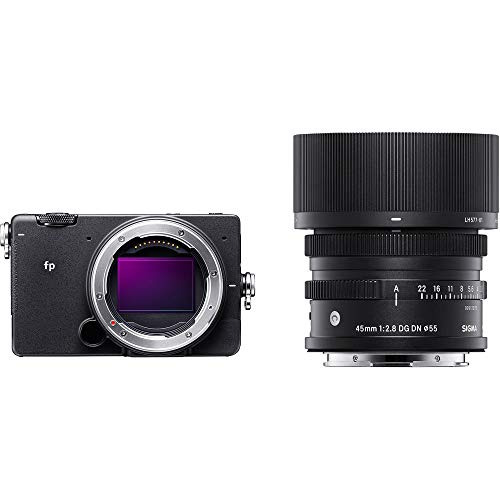
The fp was introduced as the world’s smallest full-frame mirrorless camera, according to Sigma, and it remains an unusual option. It takes a modular approach: the bare body is tiny, and you add an electronic viewfinder, a grip, cages and monitors depending on the job. It records raw video, which attracts filmmakers who want to build a compact cinema rig. Stills photographers get a 24.6 MP sensor suitable for general work, along with a Cine mode that lays out controls in a video-style fashion. Reviewers often note that autofocus is not as capable as on current mainstream rivals, so the fp suits deliberate shooting more than action.
Strengths
- Very small and light for a full-frame body.
- Raw video capability aimed at filmmakers.
- Works with L-mount lenses from Sigma, Leica and Panasonic.
Trade-offs
- No built-in finder; a separate one is an extra cost.
- Autofocus and stabilisation depend on the lens and are weaker than flagship rivals.
- Accessories add up to a rig that is no longer small.
Sigma fp L: more resolution
The fp L uses the same compact concept as the fp but with a 61 MP sensor, which Sigma positions for landscape, studio and product work where cropping and large prints matter. It is the right choice if you love the fp’s size and need detail. It is still a camera for careful shooting rather than fast action, and files from a 61 MP sensor need more storage and processing power, so budget for memory cards and a capable computer.
Sigma fp2: check before buying
Sigma’s camera page lists an fp2 alongside the BF. This guide does not repeat specifications that could not be confirmed from the maker’s page, so read the product page and recent reviews to see how it differs from the fp and fp L. As a general rule, newer bodies in a line add improved autofocus and video features, and you should confirm that by looking at the maker’s list, not assuming.
Lenses: where Sigma is strongest
Sigma’s lens catalogue is the main reason to consider the L-mount. Its Art, Contemporary and Sport lines include fast primes and zooms for the L-mount, and its compact I-series primes are designed to match small bodies like the BF and fp. Leica and Panasonic add more choice, though often at a premium tier. If you plan to use a body for years, price the lens kit as well as the body, because lenses will be the larger share of the spend.
Fit and compatibility notes
- L-mount lenses from Sigma, Leica and Panasonic work on all current Sigma bodies, with features varying by lens.
- Adapters from other mounts exist, but autofocus and stabilisation may be limited.
- Small bodies feel unbalanced with large telephoto lenses; consider a grip or cage.
Budget tiers
| Tier | Option | Notes |
|---|---|---|
| Mid-range | Sigma fp or BF with one prime | Enters full-frame L-mount; sensible for casual and travel use |
| Upper mid-range | Sigma fp L with a prime or zoom | High-resolution stills; plan storage |
| Premium | Sigma body plus accessories such as viewfinder, cage and monitor | Video or studio rigs that grow beyond a simple kit |
Pick X if…
| If you… | Pick | Why |
|---|---|---|
| Want a simple, beautiful carry camera | Sigma BF | Minimal controls and a refined body |
| Shoot video or hybrid and like building rigs | Sigma fp | Small modular body with raw video |
| Need large files and detail | Sigma fp L | 61 MP sensor in the same compact shell |
| Want the newest fp-family body | Sigma fp2 | Read its specification page first |
| Shoot fast action or wildlife | Another brand | Mainstream bodies have faster autofocus tracking |
Alternatives
- Panasonic Lumix S series: also L-mount, with stronger autofocus and video features for the money. Lenses are shared.
- Leica SL and CL families: premium-tier L-mount bodies with high build quality.
- Sony, Canon, Nikon full-frame mirrorless: broader lens ranges, better action performance and bigger used markets.
- Fujifilm X-series: a different sensor size, though the controls and film simulations attract similar design-minded buyers.
Care and use notes
Compact bodies with a bare sensor opening need careful lens changes: point the camera down, change quickly and use a lens cap. Keep firmware up to date through the maker’s tools, carry spare batteries since compact bodies hold small cells, and use fast memory cards for raw video. For heavy video, an external recorder or SSD can help, as the maker’s accessories list explains.
Frequently Asked Questions
Which Sigma camera is best for beginners?
The Sigma BF is the easiest to live with because its controls are limited and its design is simple. A beginner who wants to learn manual photography can also start with the fp, though it needs accessories. If autofocus tracking is a priority, a mainstream beginner camera may be easier.
Do Sigma cameras take Sigma lenses only?
No. They use the L-mount, so lenses from Sigma, Leica and Panasonic fit directly. Some other brands make L-mount lenses too. Features such as stabilisation and autofocus can vary by lens.
Is the Sigma fp good for video?
The maker designed it with video in mind, including raw video recording and a Cine mode. Reviewers praise its size and image quality for filmmakers. They also point out that autofocus and stabilisation are less advanced than on current mainstream hybrid cameras.
Why does the fp not have a viewfinder?
The body was designed to be as small as possible and modular. An optional electronic viewfinder can be attached, or you can use the rear screen. If you shoot outdoors in bright light, the viewfinder is worth adding.
Should I get the fp or the fp L?
Pick the fp for general use, video and smaller files, and the fp L when you need 61 MP detail for large prints or heavy cropping. They look similar, so the decision comes down to resolution, storage and budget tier.
Are Sigma cameras good for sports or wildlife?
Generally no. Reviewers consider the bodies better for deliberate shooting than for fast action. If you photograph sports or birds in flight, compare cameras from Sony, Canon, Nikon or Panasonic with strong subject-tracking autofocus.
More from Amazon
Programs that pair well with the guide above. Offers and eligibility are set by Amazon and may change.
Free shipping on eligible items, Prime Video and more. Eligible new members can start with a free trial.
Start a Prime free trialAudiobooks and podcasts to listen to on the go. Eligible new members can start with a free trial.
Try Audible freeAd-free music streaming. Eligible new subscribers can start with a free trial.
Try Music Unlimited freeA free business account with business pricing and bulk-buying tools for work, shop or home office.
Create a business accountAs an Amazon Associate we earn from qualifying purchases.