
Key takeaways
- Balance: Big telephoto lenses are heavy. A tripod collar, monopod or good strap eases fatigue.
- Weather sealing: The Z8 has a weather-sealed body, and S-line lenses typically carry sealing from the maker. Seal quality is not waterproofing; follow the manual.
- Filters: Check the filter thread size. A single set of step-up rings can save money.
- Memory cards: The Z8 uses CFexpress Type B and SD cards. Fast cards are needed for video and high-speed bursts.
- Firmware: Keep lens and camera firmware updated via Nikon’s instructions.
- Cleaning: Use a blower and microfibre cloth. Do not force a stuck zoom ring.
For the Nikon Z8, the most useful first lens is a fast standard zoom such as the Nikkor Z 24-70mm f/2.8 S, followed by the Z 70-200mm f/2.8 VR S for sports, events and portraits and the Z 100-400mm f/4.5-5.6 VR S or Z 180-600mm for wildlife; prime shooters have excellent choices in the Z 50mm f/1.8 S and Z 85mm f/1.8 S, and the Z 14-24mm f/2.8 S suits landscapes. The Z8 has a 45.7 MP stacked sensor, so lens sharpness shows, and S-line lenses are designed for that kind of resolution.
Our top picks


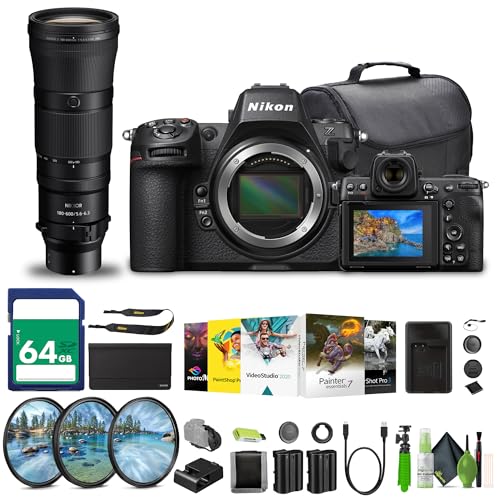

As an Amazon Associate we earn from qualifying purchases at no extra cost to you.
What the Z8 Needs From a Lens
The Z8 is Nikon’s high-resolution, fast-action body in a smaller shell than the flagship Z9. The maker lists a 45.7 MP stacked full-frame sensor, in-body stabilisation, 8K video and a fully electronic shutter. High resolution means lens flaws become visible, while fast autofocus tracking means lenses with quick, quiet motors work best. Nikon’s S-line lenses are the company’s top optical tier, and several come with a control ring or L-Fn button that suits video users.
Weight matters too. The Z8 body is relatively heavy for a mirrorless body, and many pro-grade lenses add to the total. Plan your bag, strap and tripod collar accordingly.
At a Glance
| Lens | Best for | Stated highlights | Limit |
|---|---|---|---|
| Nikkor Z 24-70mm f/2.8 S | Weddings, events, general work | Constant f/2.8, S-line optics | Heavier than f/4 alternatives |
| Nikkor Z 24-120mm f/4 S | Travel, one-lens kit | Wide zoom range, constant f/4 | Slower aperture |
| Nikkor Z 14-24mm f/2.8 S | Landscapes, astro, architecture | Ultra-wide f/2.8 | Large front element, filter system needed |
| Nikkor Z 70-200mm f/2.8 VR S | Sport, portraits, events | Fast zoom, vibration reduction | Weight and size |
| Nikkor Z 100-400mm f/4.5-5.6 VR S | Wildlife, field sports | Versatile telephoto, VR | Slower aperture |
| Nikkor Z 180-600mm f/5.6-6.3 VR | Long-reach wildlife and aviation | Long zoom range | Heavy, slower at the long end |
| Nikkor Z 400mm f/4.5 VR S | Serious wildlife and sport | Prime sharpness, compact for a 400mm | Fixed focal length, premium |
| Nikkor Z 50mm f/1.8 S and Z 85mm f/1.8 S | Portraits, low light | Sharp, relatively light primes | No stabilisation in the lens |
| Nikkor Z 105mm f/2.8 VR S MC | Macro and portraits | 1:1 macro, VR | Specialised |
Check weight, filter size and minimum focusing distance on the maker’s pages before buying.
Standard Zooms
The Z 24-70mm f/2.8 S is the usual workhorse. Reviewers describe it as very sharp across the range with fast, quiet autofocus. If you value lighter weight and range, the Z 24-120mm f/4 S gives you more reach and is often chosen as a travel lens, at the cost of one stop of light. For the Z8’s resolution, either is a strong choice, and the f/2.8 lens gives more background blur and low-light capability.
Wide-Angle Options
The Z 14-24mm f/2.8 S is a favourite for landscapes and astrophotography thanks to its sharpness and compact size compared with older F-mount equivalents. Because the front element is bulbous, it does not take a standard screw-in filter, so you may need a dedicated filter holder. The Z 20mm f/1.8 S and Z 24mm f/1.8 S are lighter prime options, and the Z 14-30mm f/4 S accepts screw-in filters and is lighter still.
Telephoto Zooms and Primes
The Z 70-200mm f/2.8 VR S is the standard for sport and portraits. Nikon’s Z 100-400mm f/4.5-5.6 VR S is a flexible lens for wildlife photographers who need range without carrying a heavy prime. The Z 180-600mm f/5.6-6.3 VR gives extra reach, but its aperture narrows at the long end and it is heavier. The Z 400mm f/4.5 VR S and the Z 600mm f/6.3 VR S are lenses for dedicated wildlife and sports photographers, with the 600mm using lightweight design features according to Nikon. Teleconverters from Nikon’s range can extend reach on selected lenses; read the compatibility notes.
Prime Lenses
For portraits and low-light work, the Z 85mm f/1.8 S is widely praised for sharpness and smooth rendering. The Z 50mm f/1.8 S is a standard prime that pairs well with the Z8’s resolution. Nikon’s f/1.2 S primes are larger and more expensive, with a stronger background blur. For macro, the Z 105mm f/2.8 VR S is a sharp lens with 1:1 reproduction. Remember that primes have no stabilisation, but the Z8’s in-body system helps.
Third-Party and Adapted Lenses
Nikon has allowed selected third-party lenses on Z mount. Tamron has released Z-mount versions of lenses such as the 35-150mm f/2-2.8 and 28-75mm f/2.8 G2, and Viltrox and Sigma are also present in the Z mount, with availability varying by model. These can lower cost, though autofocus speed and tracking with the Z8’s fastest modes may differ from Nikon’s native lenses, so read reviews for specific models.
F-mount lenses can be used on the Z8 through the FTZ II adapter. Lenses with built-in autofocus motors work, while older screw-drive lenses may be manual focus only. Native Z lenses are usually the better partner for the Z8’s autofocus performance.
Fit, Size and Care Notes
- Balance: Big telephoto lenses are heavy. A tripod collar, monopod or good strap eases fatigue.
- Weather sealing: The Z8 has a weather-sealed body, and S-line lenses typically carry sealing from the maker. Seal quality is not waterproofing; follow the manual.
- Filters: Check the filter thread size. A single set of step-up rings can save money.
- Memory cards: The Z8 uses CFexpress Type B and SD cards. Fast cards are needed for video and high-speed bursts.
- Firmware: Keep lens and camera firmware updated via Nikon’s instructions.
- Cleaning: Use a blower and microfibre cloth. Do not force a stuck zoom ring.
Building a Kit Over Time
Most Z8 owners build a kit in stages. A common path begins with one fast standard zoom, adds a telephoto for the subject they care about most, and fills in with a prime or two for low light and portraits. Landscape photographers might begin with the 14-24mm or a lighter wide zoom, while wildlife photographers might start with the 100-400mm and later add a longer prime. Because Nikon’s S-line is consistent in handling and optical quality, mixing lenses in the same family keeps files uniform.
When money is tight, buy the lens you will use most rather than the most prestigious. A lens that stays in your bag because it is too heavy is a poor investment. Rental services can help you test a heavy telephoto on a trip before purchase, and used S-line lenses can be a way to reach the premium tier at lower cost.
Whichever lenses you pick, update firmware, test autofocus calibration with your own subjects and learn the Z8’s custom buttons for focus mode switching. A well-configured camera with a modest lens often beats an expensive lens used with default settings.
Budget Tiers
- Budget: Z 50mm f/1.8 S, third-party zooms, adapted F-mount lenses.
- Mid-range: Z 24-120mm f/4 S, Z 14-30mm f/4 S, Z 85mm f/1.8 S, Z 100-400mm.
- Premium: Z 24-70mm f/2.8 S, Z 70-200mm f/2.8 VR S, Z 400mm f/4.5 VR S and the f/1.2 primes.
Pick X If …
| Pick | If you … |
|---|---|
| Z 24-70mm f/2.8 S | want one fast lens for events and portraits |
| Z 24-120mm f/4 S | travel and want maximum range in one lens |
| Z 14-24mm f/2.8 S | shoot landscapes, interiors or the night sky |
| Z 70-200mm f/2.8 VR S | shoot sport, portraits and weddings |
| Z 100-400mm f/4.5-5.6 VR S | photograph wildlife and want flexibility |
| Z 180-600mm | need extra reach for birds and aircraft |
| Z 85mm f/1.8 S | love portraits and want a lighter lens |
| Z 105mm f/2.8 VR S | shoot macro and portraits |
Alternatives
- Tamron Z-mount zooms: Lower cost options for standard and telephoto zooms.
- Sigma Z-mount primes: Compact primes aimed at filling gaps in Nikon’s range.
- Adapted F-mount glass: Useful if you already own lenses, via the FTZ II.
Frequently Asked Questions
What is the best first lens for the Nikon Z8?
For most people it is the Nikkor Z 24-70mm f/2.8 S for its versatility and sharpness. If you shoot wildlife, the Z 100-400mm is a more likely first purchase. Pick according to your subject.
Can I use F-mount lenses on the Z8?
Yes, with the FTZ II adapter. Lenses with built-in motors autofocus, and many older lenses work well. The Z8’s best autofocus performance is with native Z lenses.
Do I need S-line lenses on a 45 MP camera?
Not strictly, but S-line lenses are designed for high-resolution sensors, so they show the camera’s detail best. Non-S lenses can be good, but check reviews for sharpness at the edges.
Is the Z8 good for wildlife?
Reviewers report that the Z8’s subject detection and burst speed suit wildlife. Pair it with a long lens such as the Z 100-400mm, 180-600mm or 400mm f/4.5.
Do Z lenses have stabilisation?
Many Nikkor Z telephoto lenses have VR, and the Z8 has in-body stabilisation. The two can work together, according to Nikon, but primes in the standard range rely on the body.
Are third-party lenses reliable on the Z8?
Quality varies. Tamron, Sigma and Viltrox lenses have received positive reviews for some models, but tracking with fast bursts can differ from Nikon’s own lenses, so research the specific lens.





