Key takeaways
- The best film scanners in 2026 are the Epson V850 Pro for mixed formats, the Plustek OpticFilm 8200i SE for detailed 35mm work, and a dedicated batch scanner such as the Reflecta RPS 10M when speed matters more than flexibility.…
The best film scanners in 2026 are the Epson V850 Pro for mixed formats, the Plustek OpticFilm 8200i SE for detailed 35mm work, and a dedicated batch scanner such as the Reflecta RPS 10M when speed matters more than flexibility.
Our top picks

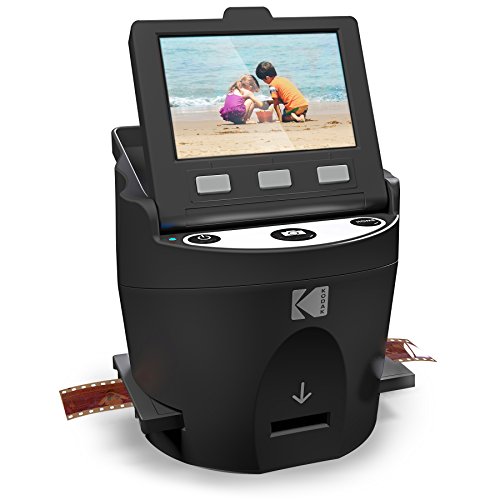


As an Amazon Associate we earn from qualifying purchases at no extra cost to you. Ratings are shown as listed on Amazon.
Quick comparison: the best film scanners by use case
| Scanner | Supported film | Advertised optical resolution | Dust and scratch removal | Best for | Typical market range |
|---|---|---|---|---|---|
| Epson Perfection V850 Pro | 35mm, 120/220 medium format, 4×5-inch sheet film, prints | Up to 6,400 dpi | Digital ICE infrared cleaning for compatible color film | Archives containing several film formats | About $700–$1,000 |
| Plustek OpticFilm 8200i SE | 35mm strips and mounted slides | Up to 7,200 dpi | Infrared dust and scratch detection through bundled software | High-detail 35mm scanning on a modest desk | About $400–$550 |
| Reflecta RPS 10M | 35mm strips and mounted slides | Up to 10,000 dpi | Infrared cleaning with suitable software | Large 35mm collections and batch scanning | About $700–$1,000 |
| Pacific Image PrimeFilm XEs | 35mm strips and mounted slides | Up to 10,000 dpi, depending on version | Infrared correction on supported models and film | Users prioritizing resolution and manual control | About $600–$1,000 |
| Flatbed scanner with film adapters | Often 35mm, 120, and sheet film | Usually 4,800–6,400 dpi claimed | Model-dependent infrared correction | Occasional scanning and prints | About $250–$1,000 |
Manufacturer resolution figures are not directly comparable. A scanner may capture at 7,200 or 10,000 dpi while producing less effective detail because of lens quality, sensor design, film flatness, vibration, and software sharpening. For most 35mm originals, a good 3,200–4,000 dpi scan contains enough real information for excellent prints. Higher settings can still be useful when cropping heavily or preserving every possible detail.
Best overall for mixed collections: Epson Perfection V850 Pro
The V850 Pro is the most practical choice when your archive includes 35mm negatives, mounted slides, medium-format film, and 4×5 transparencies. Its film holders and large scanning bed make it far more versatile than a 35mm-only scanner. It also supports reflective originals, so the same device can handle photographs, documents, and artwork.
Its main advantage is format coverage rather than maximum 35mm sharpness. A dedicated 35mm scanner generally resolves fine grain and small details more crisply than a flatbed. The V850 is therefore a strong archival tool for mixed collections, but a specialist 35mm photographer may prefer the Plustek or Reflecta.
Digital ICE can reduce dust and many surface defects in color film. Infrared cleaning is less reliable with traditional black-and-white film containing silver, and it should not be assumed to work perfectly with every emulsion. You will still need a blower, anti-static brush, and occasional manual retouching.
Best 35mm detail for most photographers: Plustek OpticFilm 8200i SE
The OpticFilm 8200i SE is a compact, dedicated 35mm scanner with a strong balance of resolution, output quality, and price. It scans both negative strips and mounted slides, and its narrow design suits a desk where a flatbed would be inconvenient.
The bundled SilverFast software provides color correction, infrared dust removal, multi-exposure options, and tools for recovering shadow and highlight information. Software quality matters here: a good scan is not only about the sensor, but also about how the application converts an orange mask, controls contrast, and preserves subtle tones.
The limitation is throughput. The film holder is advanced manually, and scanning a full collection requires repeated loading, previewing, adjustments, and saving. It is well suited to carefully selecting and digitizing a few rolls, but less attractive for thousands of frames unless you value maximum control over speed.
Best for large 35mm archives: Reflecta RPS 10M
A batch-oriented scanner such as the Reflecta RPS 10M is the better choice when you have many similar 35mm strips and want less manual handling. Its automatic transport can move through a strip of frames, allowing you to set up a sequence instead of positioning every frame individually.
That convenience comes with trade-offs. Automatic film transport is sensitive to curled, brittle, poorly cut, or damaged film. A strip that is slightly warped can misalign frames or stop the process. Inspect and flatten film before loading, and never force a jammed strip through the mechanism.
High advertised resolution does not guarantee a visibly sharper scan than a good 7,200-dpi dedicated model. The RPS 10M makes the most sense for a substantial archive where reduced handling and batch capability are worth paying for. Confirm software and operating-system compatibility before buying, since availability and bundled applications can vary by region.
How the important specifications affect your decision
Film format
Start with the largest format in your collection. A 35mm-only scanner cannot digitize 120 film or 4×5 sheets, while a flatbed can often cover several formats. If more than 80 percent of your archive is 35mm, a dedicated scanner usually gives better detail and easier framing. If your collection is mixed, buying one flexible flatbed may cost less than buying separate devices.
Optical resolution and output detail
For web images and small prints, 2,400 dpi is often sufficient. At 3,200 dpi, a 35mm frame produces roughly a 3,400-by-2,250-pixel file after cropping, depending on the frame dimensions. At 4,000 dpi, the theoretical file is approximately 5,700 by 3,800 pixels. Those figures are calculated from the film area, not from the final cropped borders.
For a 10-by-8-inch print, 3,000 pixels across the long dimension gives 300 pixels per inch. More resolution helps with large prints and cropping, but it also increases scan time and file size. Scan a representative frame at two settings before digitizing everything; the difference in real detail is often smaller than the specification suggests.
Dynamic range
Dynamic range describes how well the scanner separates very dark shadow detail from bright highlights. This is particularly important for slide film, which can contain dense, high-contrast areas. Published Dmax figures are useful as a rough guide, but they are not measured identically across manufacturers. A scanner with strong exposure control and multi-exposure software can produce better practical results than one with a larger headline number.
Dust removal
Infrared-based systems can identify dust and many scratches in color negative and slide film, then remove them during processing. This can save hours of retouching. It is generally unsuitable for traditional silver-based black-and-white film because the silver can interfere with the infrared channel. Digital ICE also cannot repair missing emulsion, severe fingerprints, or damage that obscures image content.
Scanning speed
Speed depends on resolution, color depth, infrared cleaning, multi-exposure, and whether the scanner advances film automatically. A single frame may take seconds at a preview setting but several minutes at a high-resolution archival setting with dust removal. Batch transport reduces the time spent loading film, not necessarily the exposure time for each frame.
Decision matrix: which scanner fits your situation?
| Your situation | Best direction | Why |
|---|---|---|
| Small budget, occasional 35mm scans | Dedicated 35mm scanner in the midrange | Better negative detail than many inexpensive flatbeds without paying for unused formats |
| Large 35mm archive | Batch-capable dedicated scanner | Reduces repeated loading and frame alignment |
| 35mm plus 120 or 4×5 film | Epson V850 Pro or comparable film flatbed | One device covers multiple formats and reflective originals |
| Very limited desk space | Plustek OpticFilm 8200i SE | Dedicated, narrow, and easier to store between sessions |
| Large exhibition prints and aggressive cropping | High-resolution dedicated scanner or professional scanning service | Maximizes real detail and reduces the risk of spending days rescanning |
A practical scanning workflow
- Sort and label the film. Record roll number, date, camera, and frame sequence before scanning. Use non-adhesive archival sleeves for storage.
- Clean the workspace. Dust the scanner glass, holders, and film with a hand blower. Do not use compressed air, which can propel propellant or moisture onto the film.
- Make a low-resolution preview. Correct orientation, crop borders, and select only worthwhile frames. This saves storage and scanning time.
- Set the final resolution. Use approximately 2,400–3,200 dpi for routine viewing and moderate prints, or 4,000 dpi and above for heavy cropping and large prints.
- Scan as a high-bit-depth master. Save a minimally adjusted TIFF when storage permits. Export JPEG copies for sharing rather than treating JPEG as the only archive.
- Apply infrared cleaning carefully. Compare a cleaned and uncleaned preview. Some damaged or unusual films can produce artifacts that are harder to remove than ordinary dust.
- Back up the files. Keep at least two copies on different storage devices, and retain the original film as the physical master.
Ownership realities and common mistakes
Film holders, rubber rollers, and transport mechanisms are the parts most likely to wear or become troublesome. Holders can warp or lose tension; rollers can collect residue; and old film can shed particles inside a batch mechanism. Store film cool, dry, and away from direct sunlight, and clean the scanning path according to the manufacturer’s instructions.
Do not scan every frame at the maximum setting by default. A 6,400-dpi scan with infrared correction and multi-exposure can create very large files while adding little visible detail. A useful approach is to make a high-quality master for selected images and a faster, smaller scan for ordinary snapshots.
For most buyers, choose the Epson V850 Pro if format flexibility is the priority, the Plustek OpticFilm 8200i SE for controlled 35mm quality, and the Reflecta RPS 10M or comparable batch model for a large, consistently cut 35mm archive. If your film is rare, badly damaged, or destined for very large professional prints, compare the total cost of equipment, software, cleaning, and time with a specialist scanning service before committing.