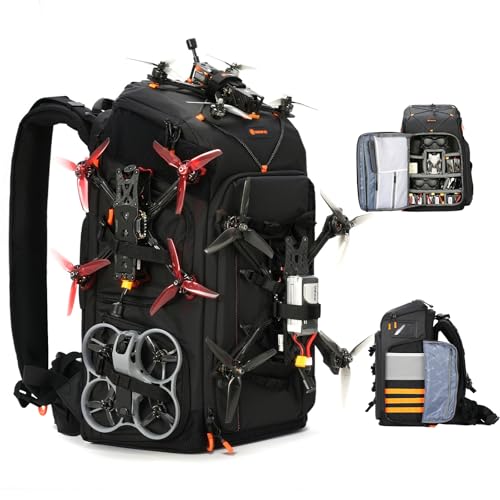
The best drone backpack for most pilots is a dedicated camera-and-drone pack from a known bag maker, such as the Lowepro DroneGuard series, sized to your drone and any extras; if you already own a camera bag, a modular pack like the Peak Design Everyday Backpack with padded dividers can carry a small drone as well, and for rough transport a hard case such as a Pelican-style case offers the most protection. This guide explains how to choose by drone size, what to carry beyond the aircraft, how to move batteries safely and which bag types suit which kind of trip.
Our top picks


As an Amazon Associate we earn from qualifying purchases at no extra cost to you.
At a glance
| Bag type or model | Best for | Key stated features | Limits | Tier |
|---|---|---|---|---|
| Lowepro DroneGuard BP 450 AW (large drone backpack) | Folding drones plus controller and accessories | Padded drone compartment, all-weather cover as listed by the maker, laptop pocket on some models | Bulky for a small drone | Mid-range to premium |
| Lowepro DroneGuard BP 250 (smaller) | Smaller folding drones | Compact dedicated drone section | Limited room for extras | Mid-range |
| Peak Design Everyday Backpack | Photographers who also fly a small drone | Flexible dividers, weather-resistant fabric as listed by the maker, side and top access | Not drone-specific, needs careful arrangement | Premium |
| PGYTECH drone backpacks and bags | Mavic- and Mini-class drones, hobbyists | Drone-shaped compartments and hard shells on some models | Fit is model-specific | Mid-range |
| Manufacturer carry bags (DJI shoulder and sling bags) | Small drones and light trips | Fitted to the drone, battery pockets | Little room for other gear | Budget |
| Hard cases (Pelican-style, hard shell) | Checked baggage, field work | Crush and water resistance, customizable foam | Heavy, not worn on the back | Premium |
Start with the drone and the kit
List what you carry before comparing bags. A typical folding drone kit includes the aircraft, a controller, two or three batteries, a charger or hub, propellers, filters, memory cards and a cable set. Add a phone, tablet or laptop if you edit in the field. Some pilots also bring a landing pad and a tripod, which require external straps. Measure the folded drone with its propellers and gimbal cover, and compare that to the interior compartment dimensions the maker lists, because the most common mistake is buying a bag that fits a different generation of the same drone line.
Bag types
Dedicated drone backpacks
The Lowepro DroneGuard line is the most commonly cited example. These packs have a shaped compartment for a folding drone, separate sections for controllers and batteries, and often a rain cover that the maker lists as part of the design. The larger models carry a drone plus camera gear, while the smaller ones serve a compact aircraft and a few accessories. The trade-off is that dedicated packs can be large and, on some models, less comfortable for everyday use than a standard backpack.
Camera backpacks with modular dividers
If you already carry a mirrorless camera, a bag such as the Peak Design Everyday Backpack gives you configurable padding and quick access. A small folding drone can sit in a divided section, but it is not designed specifically for drones, so check that the aircraft and its arms fit without pressure on the gimbal. The advantage is that the bag looks like a normal backpack and suits city use and travel.
Brand-specific bags
PGYTECH and DJI offer bags fitted to particular drones, from sling bags to hard shells. They hold the aircraft snugly and keep batteries separate, at the cost of flexibility: a bag shaped for a Mavic-class drone may not accommodate another model. For a Mini-class drone, the maker’s own shoulder bag in a Fly More kit often covers day trips.
Hard cases
Hard cases offer the best protection against impact, dust and water, which makes them useful for vehicle transport, boat trips and checked baggage where permitted. They are heavy and cannot be worn easily on a trek, so some pilots use a hard case for the aircraft and a lighter backpack for the field. Foam inserts can usually be cut or rearranged, so confirm that the insert matches your drone before buying.
Features to look for
- Padded, adjustable compartments: Dividers protect the gimbal and propellers from knocks.
- Battery pockets: Separate, preferably fire-resistant sleeves keep battery terminals from touching metal objects. Some makers sell fire-resistant pouches, but their claims are limited and no pouch removes the risk of a damaged battery.
- Weather protection: Water-resistant fabric and a rain cover help in drizzle. Few bags are fully waterproof, so read the maker’s description.
- Access: Rear or side access means you can retrieve the drone without placing the bag on the ground, which matters in sand and mud.
- Harness and comfort: Padded straps, a chest strap and a waist belt help with longer hikes. Capacity should match the carry weight you are comfortable with.
- Carry-on compliance: If you fly with the bag, confirm the dimensions against your airline’s cabin limits.
Travelling with batteries
Lithium batteries have special rules in air travel. Airlines and aviation authorities generally require spare lithium batteries to be carried in the cabin, not in checked baggage, with terminals protected, and they limit watt-hour capacity. The rules vary by country and airline, so read both the airline’s policy and the battery maker’s guidance before travel. Never carry a swollen, damaged or hot battery, and store batteries partially charged for longer trips. A good bag keeps batteries in a separate padded section where they cannot be crushed. If you are unsure whether a battery qualifies, ask the airline in advance.
Pick X if…
| If you want… | Pick | Why |
|---|---|---|
| A drone plus camera and laptop | Lowepro DroneGuard BP 450 AW | Dedicated compartments, room for extras |
| A small pack for a compact drone | Lowepro DroneGuard BP 250 or maker’s own bag | Smaller footprint |
| A bag that looks like a normal backpack | Peak Design Everyday Backpack | Modular and discreet |
| A snug fit for a particular drone | PGYTECH or DJI bag for your model | Shaped for the aircraft |
| Maximum impact protection | Hard case with foam | Crush and water resistance |
| A cheap light solution | Maker’s shoulder bag | Fitted and portable |
Alternatives
- Standard camera bag with custom padding: Works if you already own one and are willing to rearrange dividers.
- Sling bags: Good for small drones and short outings, with fast access but less capacity.
- Roller cases: Suitable for airports and studio use, but impractical for hiking.
Care notes
Fold the drone and fit protective covers before packing. Remove debris and sand before closing the bag, because grit can scratch gimbal parts. Dry the pack after rain with the compartments open. Avoid leaving batteries in hot vehicles, since high temperatures shorten life and raise risk. Check zips and stitching periodically, since a failing zip is more likely to damage gear than a worn strap.
Common buying mistakes
The most frequent error is buying for the drone you own today and ignoring the one you may buy next. If an upgrade is likely, choose a bag with adjustable dividers rather than a shaped insert. A second mistake is ignoring the carrying position: a pack that opens only from the top forces you to unload everything on a beach or trail. Third, many buyers forget that a controller with a built-in screen is larger than one that holds a phone, so measure the controller you actually use. Finally, do not overfill the bag. Compression on a folded gimbal or arm during a hike is a common cause of damage, and a slightly larger pack is cheaper than a repair.
Frequently Asked Questions
Do I need a drone-specific backpack?
No, but it helps. A dedicated pack keeps the aircraft, controller and batteries organised and protected, while a modular camera bag can work if the drone fits securely without pressure on the gimbal. The key is protection and a snug fit, not the label.
How big a backpack do I need for a DJI Mini?
A Mini-class drone is small, so a sling bag or the maker’s shoulder bag often suffices for the aircraft, controller and a few batteries. If you add a camera, laptop or tripod, step up to a backpack with dividers. Measure your folded kit before you decide.
Can I take drone batteries in my carry-on?
Generally, spare lithium batteries must travel in the cabin, with terminals protected and within capacity limits. Rules differ by airline and country, so read the policy before flying. Do not pack damaged or swollen batteries.
Are drone backpacks waterproof?
Most are water-resistant rather than fully waterproof. Some include a rain cover, and hard cases provide better sealing. Read the maker’s description and do not expect any soft bag to protect against full immersion.
Will a drone backpack fit on a plane?
Many fit within standard cabin dimensions, but larger packs may not. Check the pack’s measurements against your airline’s limits and consider that the full bag may weigh more than a standard carry-on. Hard cases are often too large for the cabin.
Can I use a normal hiking backpack for a drone?
You can, with padding. Wrap or pad the drone in a protective case and keep batteries in a separate pouch. A hiking pack provides comfort, but it lacks the shaped compartments that protect the gimbal and arms from pressure.
More from Amazon
Programs that pair well with the guide above. Offers and eligibility are set by Amazon and may change.
Free shipping on eligible items, Prime Video and more. Eligible new members can start with a free trial.
Start a Prime free trialAudiobooks and podcasts to listen to on the go. Eligible new members can start with a free trial.
Try Audible freeAd-free music streaming. Eligible new subscribers can start with a free trial.
Try Music Unlimited freeA free business account with business pricing and bulk-buying tools for work, shop or home office.
Create a business accountAs an Amazon Associate we earn from qualifying purchases.