Key takeaways
- Best all-round design: Riedel Cabernet Decanter, for its generous bowl, familiar pouring shape, and capacity suited to a standard bottle.
- Best for older red wines: Riedel Ultra Decanter or a similar narrow-neck, moderate-bowl design, because it offers controlled pouring and less aggressive exposure to air.
- Best value crystal option: Spiegelau Definition or a comparable lead-free crystal decanter, especially for regular use where replacement cost matters.
- Best statement piece: Waterford Lismore Essence Decanter, when cut-crystal decoration and formal presentation matter as much as aeration.
- Best lightweight modern design: Zalto Denk’Art Axium or a similar hand-blown, thin-walled decanter, provided the owner is comfortable with more careful handling.
- Best for occasional entertaining: Nachtmann Vivendi or a comparable broad-based decanter, offering an elegant appearance without requiring an unusually large storage space.
Best Crystal Wine Decanters for Elegant Serving
The best crystal wine decanters combine clear, thin glass with a stable base, a controlled pour, and an opening wide enough to clean properly; for most households, a 1.5-liter lead-free crystal decanter with a 750-milliliter wine capacity is the most versatile choice in 2026.
Decanters differ more than their polished appearance suggests. A broad bowl can accelerate aeration for a young Cabernet Sauvignon, while a narrower vessel better preserves the aroma of an older Pinot Noir. Capacity, neck shape, stopper fit, glass thickness, and cleaning access all affect whether a decanter becomes a useful serving tool or an attractive object that stays in a cabinet.
Our top picks

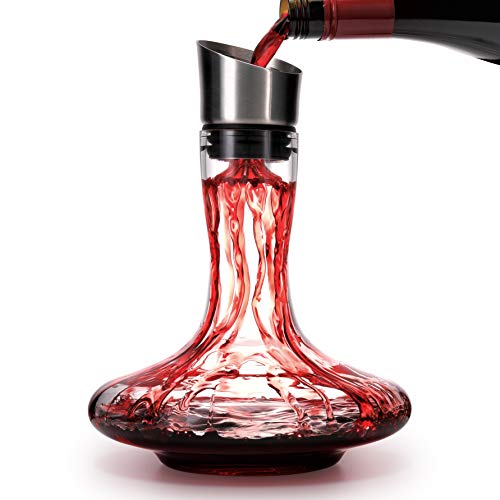


As an Amazon Associate we earn from qualifying purchases at no extra cost to you. Ratings are shown as listed on Amazon.
Our top picks by situation
- Best all-round design: Riedel Cabernet Decanter, for its generous bowl, familiar pouring shape, and capacity suited to a standard bottle.
- Best for older red wines: Riedel Ultra Decanter or a similar narrow-neck, moderate-bowl design, because it offers controlled pouring and less aggressive exposure to air.
- Best value crystal option: Spiegelau Definition or a comparable lead-free crystal decanter, especially for regular use where replacement cost matters.
- Best statement piece: Waterford Lismore Essence Decanter, when cut-crystal decoration and formal presentation matter as much as aeration.
- Best lightweight modern design: Zalto Denk’Art Axium or a similar hand-blown, thin-walled decanter, provided the owner is comfortable with more careful handling.
- Best for occasional entertaining: Nachtmann Vivendi or a comparable broad-based decanter, offering an elegant appearance without requiring an unusually large storage space.
Crystal wine decanter comparison
The figures below are practical buying ranges or commonly specified capacities for representative designs. Exact dimensions can vary by model and production run, so check the manufacturer’s current specification before ordering.
| Decanter type or example | Typical capacity | Approximate empty weight | Best wine use | Cleaning access | Typical market range |
|---|---|---|---|---|---|
| Riedel Cabernet-style broad bowl | 1,500 ml | 700–1,000 g | Young, full-bodied reds | Good; wide opening | $60–$140 |
| Riedel Ultra or narrow-neck red-wine design | 1,200–1,500 ml | 600–900 g | Older reds and controlled service | Moderate; long neck | $90–$180 |
| Spiegelau lead-free crystal decanter | 1,000–1,500 ml | 500–850 g | Frequent everyday use | Good to moderate | $45–$120 |
| Zalto hand-blown modern decanter | 1,400–1,900 ml | 450–750 g | Presentation and fine wine service | Moderate to difficult | $120–$220 |
| Waterford cut-crystal decanter | 750–1,000 ml | 1,000–1,600 g | Whisky, fortified wine, and formal serving | Moderate; decorative cuts retain moisture | $150–$400+ |
| Nachtmann decorative crystal decanter | 750–1,500 ml | 800–1,400 g | Entertaining and gift use | Moderate | $60–$180 |
What to look for before buying
Crystal clarity and composition
Clarity is primarily a visual benefit, but it also helps you inspect sediment, color, and the wine’s changing appearance. Modern lead-free crystal, often made with titanium or another strengthening mineral, can provide high clarity without requiring lead oxide. Traditional lead crystal may have a heavier, more brilliant appearance, but it needs careful cleaning and should not be used for long-term wine storage.
Look through the bowl under bright, indirect light. A premium decanter should have an even surface without obvious bubbles, ripples, cloudy patches, or a visibly uneven rim. A thin rim improves pouring, but an extremely fine edge is more vulnerable to impact around a sink or drying rack.
Capacity and shape
A 750-milliliter bottle needs more than 750 milliliters of usable space. Pouring wine into a decanter that is filled to the neck leaves little surface area for aeration and increases the chance of spilling. For one bottle, choose at least 1,000 milliliters; 1,500 milliliters is more comfortable for swirling and serving. A 2,000-milliliter model is useful for two bottles but takes more storage space and may be unnecessarily heavy when full.
Broad bowls expose more wine to oxygen and suit young, tannic reds such as Cabernet Sauvignon, Syrah, and Nebbiolo. Narrower bowls and longer necks favor measured pouring and are more appropriate for older wines, where separating sediment is often more important than maximizing aeration. White wine can be decanted, but a smaller, narrower vessel is usually easier to chill and manage.
Pour control and stability
A flared lip can reduce drips, while a narrow neck gives you better control over sediment when pouring an aged bottle. Avoid a design that requires gripping the wet bowl with one hand and balancing the base with the other. A broad foot, low center of gravity, and a neck that remains comfortable when the decanter is half full are more useful than an elaborate silhouette.
Test the relationship between the bottle and decanter opening in your imagination: if the neck is too narrow, a fast pour can back up and run down the outside. If it is too wide, the decanter may be easy to fill but less precise when separating sediment.
Cleaning access and durability
The bowl is not clean merely because it looks clear. Wine residue collects beneath the shoulder, around decorative cuts, and inside the lower curve. Choose a mouth wide enough for a soft brush or your hand if the design allows it. A long, narrow neck can look elegant but may require a purpose-made decanter brush and a drying stand.
Crystal is hard but brittle. The rim and pointed transitions usually fail before the main bowl. Decorative cut crystal can hide fine marks, while very thin hand-blown crystal is lighter but less forgiving of knocks. Never pour boiling water into a cold decanter or cold water into a warm one; sudden temperature changes can cause thermal shock.
Decision matrix: which design fits your routine?
| Your situation | Recommended specification | Why it fits |
|---|---|---|
| Budget under $80 | Lead-free crystal, 1,000–1,500 ml, wide opening | Lower replacement cost and easier everyday cleaning |
| New to decanting | Stable 1,500-ml bowl with a flared lip | Forgiving fill level and simple pouring technique |
| Small kitchen or bar cabinet | 1,000–1,200 ml, compact footprint under 20 cm wide | Enough room for one bottle without awkward storage |
| Frequent weekly use | Thicker lead-free crystal and dishwasher guidance from the maker | Better tolerance for repeated handling and washing |
| Older, sediment-heavy wines | Narrow neck, steady base, and 1,000–1,500 ml capacity | Improves control while pouring slowly |
| Young, powerful reds | Broad bowl with at least 1,500 ml capacity | Provides more surface area for aeration |
| Formal dining and gifting | Cut crystal or sculptural hand-blown design | Prioritizes presentation, weight, and visual impact |
How to use and clean a crystal wine decanter
- Rinse before the first use. Use lukewarm water to remove manufacturing dust. Avoid soap unless the manufacturer permits it, because fragrance can cling to crystal.
- Decant at the right fill level. Keep the wine below the shoulder of the bowl. This leaves a larger exposed surface and reduces spills.
- Pour aged wine slowly. Stand the bottle upright beforehand if it contains sediment. Pour toward a light source and stop when sediment approaches the neck.
- Empty promptly. Do not store wine overnight in crystal. Alcohol, acids, pigments, and oxygen can leave stubborn films and odors.
- Rinse immediately. Lukewarm water is safer than extreme temperatures. For residue, use a small amount of unscented detergent and a soft decanter brush.
- Dry upside down only with support. A dedicated drying stand allows air into the bowl while protecting the rim. Do not balance a heavy decanter precariously over a dish towel.
For a rough ownership calculation, a $100 decanter used twice a month for five years costs about $0.83 per use before breakage. That makes a moderately priced, easy-to-clean model a better long-term purchase than a $250 showpiece used only twice a year—unless its presentation value is the main reason for buying it.
Common buying mistakes
- Choosing appearance over access: A narrow, sculptural neck can make routine cleaning frustrating.
- Buying too small: A decanter that barely holds one bottle cannot provide useful surface area or safe swirling.
- Assuming crystal is automatically stronger: Thin crystal can be more delicate than ordinary glass at the rim and base.
- Leaving wine in the vessel: Decanters are serving and aeration tools, not storage containers.
- Using abrasive cleaners: Scouring pads and harsh powders can create fine scratches that catch residue.
- Ignoring the stopper: A decorative stopper may not seal securely and can add weight or instability. Treat it as a cover, not a preservation system.
Final verdict
For the widest range of wines and occasions, choose a clear lead-free crystal decanter holding about 1,500 milliliters, with a broad stable base, flared pouring lip, and an opening large enough to clean with a soft brush. Select a broad bowl for young reds, a narrower neck for older bottles, and cut or sculptural crystal only when formal presentation justifies extra weight, cost, and cleaning effort. The most elegant decanter is the one that pours accurately, dries completely, and remains practical enough to use regularly.