Key takeaways
- The best slab rollers are the North Star 32-inch for large, frequent work, the Bailey DRD II for a sturdy studio machine with broad capacity, and the Shimpo SRM-1624 for potters who need a compact, adjustable roller rather than a…
The best slab rollers are the North Star 32-inch for large, frequent work, the Bailey DRD II for a sturdy studio machine with broad capacity, and the Shimpo SRM-1624 for potters who need a compact, adjustable roller rather than a full-size production setup.
Our top picks


As an Amazon Associate we earn from qualifying purchases at no extra cost to you. Ratings are shown as listed on Amazon.
Best slab rollers at a glance
| Model or type | Approx. working width | Typical slab length | Thickness range | Best fit | Approx. market range in 2026 |
|---|---|---|---|---|---|
| North Star 24-inch slab roller | 24 in / 61 cm | Up to about 24 x 36 in with repeated passes | About 1/8 to 1 in, depending on board and guide setup | Serious home studios and medium-sized pottery | $1,300–$1,900 |
| North Star 32-inch slab roller | 32 in / 81 cm | Up to about 32 x 48 in with suitable boards | About 1/8 to 1 in | Large platters, tiles, architectural work | $2,000–$3,000 |
| Bailey DRD II slab roller | Commonly sold in 24- and 32-inch configurations | Roughly width × 36–48 in, depending on model and workspace | Adjustable with thickness guides | High-use studios and classrooms | $1,800–$3,300 |
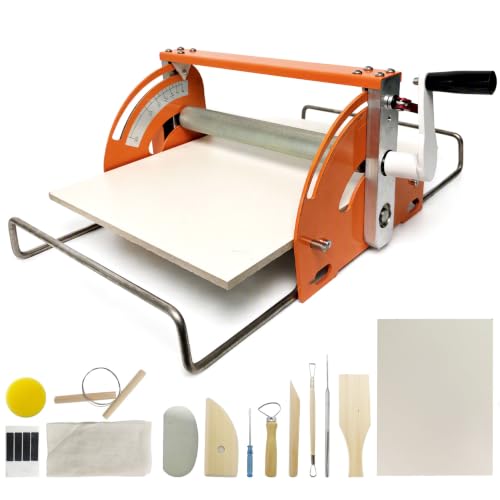
| Shimpo SRM-1624 | 16 in / 41 cm | About 16 x 24 in per working section | Approximately 1/8 to 1 in | Small studios, teaching spaces, and portability | $900–$1,500 |
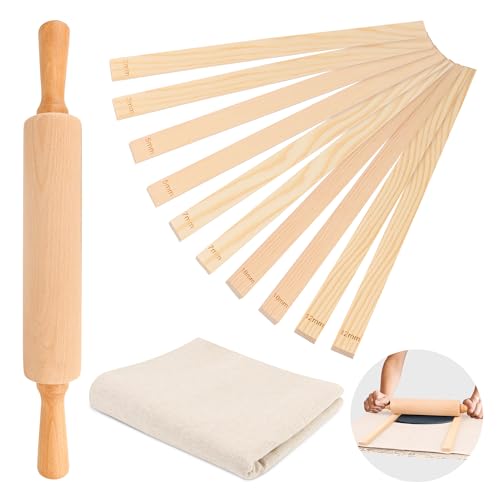
| Rolling pin with removable guide sticks | 6–14 in typical rolling width | Usually 12–24 in after repositioning | Usually 1/8–1/2 in | Occasional use and very limited budgets | $25–$150 |
Dimensions are practical working estimates rather than promises of finished slab size. A slab can be longer than the roller width, but it must be advanced, supported, and sometimes rotated. Check the current manufacturer specification before ordering, particularly for table dimensions and included guide sets.
What matters more than the roller width
1. Working width and usable clay dimensions
Roller width determines the largest slab you can make in one pass. A 16-inch machine is sufficient for mugs, small plates, tiles, handles, and most classroom projects. It becomes restrictive when you make serving platters, large wall pieces, furniture components, or sets of tiles.
A 24-inch roller is the useful middle ground for many home studios. It can produce a full-width slab for a 12- to 18-inch platter with room for trimming. A 32-inch model is preferable when you regularly need broad, single-piece slabs, because joining two narrower slabs introduces a seam and extra compression work.
Do not compare roller width with the machine’s overall footprint. A 24-inch roller may require roughly 30–40 inches of floor or bench width once handles, side clearance, and working boards are included.
2. Thickness guides
Thickness guides, also called rails or battens, control the gap between the roller and the table. They are the main reason a slab roller produces more repeatable sheets than a rolling pin. Common studio thicknesses are 1/8 inch for small tiles, 1/4 inch for many handbuilt forms, 3/8 inch for larger plates, and 1/2 inch or more for structural work.
Look for a machine that accepts multiple guide sizes and holds them securely. A set that skips from 1/4 to 1/2 inch is less useful than a broad selection of incremental sizes. The guide must be at least as long as the clay’s travel path; otherwise the roller can dip at the end of a pass.
Remember that the guide establishes approximate thickness, not a guarantee of equal moisture or strength. Clay compressed more heavily in one direction can still warp or shrink unevenly.
3. Frame stability and roller pressure
A stable frame matters most when rolling thick clay or a large slab. Lightweight machines are easier to move but can shift when the handle is turned. That movement creates thin edges, diagonal thickness differences, and a greater risk of the clay buckling under the canvas.
For regular production, favor a steel frame, broad feet, a rigid table, and a drive mechanism that turns smoothly without sudden resistance. A heavier machine is not automatically better, but a frame that flexes under pressure will be frustrating regardless of its nominal width.
Inspect the roller surface as well. A straight, even roller with durable bearings is more important than decorative finish. If the roller is not parallel to the table, no choice of guide sticks will fully correct the problem.
4. Portability and storage
The Shimpo SRM-1624 is the more practical choice when the roller must be stored between sessions or moved between classrooms. Compact machines generally suit smaller boards and thinner, shorter work. A full-size North Star or Bailey unit is better treated as permanent equipment; moving it safely may require two people and a clear route.
A tabletop roller saves floor space but still needs a strong, level support surface. A folding table that flexes can cancel out the machine’s thickness control. Measure the complete setup, including the clay board extending beyond the roller, rather than measuring only the folded or boxed machine.
Which roller suits your situation?
| Your situation | Best choice | Why | Compromise |
|---|---|---|---|
| Less than one slab session per month | Rolling pin and guide sticks | Lowest cost and easiest storage | More effort and less consistent large slabs |
| Beginner making mugs, tiles, and small plates | Shimpo SRM-1624 | Manageable width with real thickness adjustment | Large platters may require joining or repositioning |
| Weekly home-studio use and 12–18-inch forms | North Star 24-inch | Useful capacity without the footprint of a 32-inch model | Higher price and largely stationary storage |
| Classroom, shared studio, or frequent production | Bailey DRD II | Built for repeated use and broad slab work | Large initial investment and substantial space requirement |
| Large tiles, architectural panels, or platters | North Star 32-inch | Fewer joins and more usable width | Cost, weight, and floor space |
Head-to-head: North Star, Bailey, and Shimpo
North Star versus Bailey
North Star rollers are attractive when you want a straightforward, durable studio machine with a choice of widths. The 24-inch version covers most personal-studio work, while the 32-inch version earns its space when wide slabs are a routine requirement.
Bailey’s DRD II belongs in the same serious-equipment category. It is a sensible option for a classroom or production environment where several people will use the machine and the frame will see frequent loading. The deciding factors are often local availability, included accessories, service support, and whether the quoted price includes a stand or only the roller assembly.
Shimpo versus a full-size machine
The SRM-1624 is easier to justify when space is limited or your largest regular slab is below 16 inches wide. It can still make useful, even sheets, but it cannot provide the same uninterrupted surface as a 24- or 32-inch unit. If you expect to move from small handbuilding to large platters soon, buying the compact model twice can cost more than choosing the wider machine initially.
Setup method for more even slabs
- Prepare the clay first. Wedge or spiral-wedge it until the mass is reasonably uniform. A roller flattens clay; it does not remove every internal variation.
- Choose the target thickness. For a 1/4-inch slab, use matched 1/4-inch guides and place them parallel to the roller.
- Start thicker than your final setting. Compress the clay gradually rather than forcing a thick lump through the smallest gap. This reduces edge tearing and sudden pressure on the frame.
- Roll in alternating directions. Turn the slab 90 degrees between passes when its dimensions allow. This helps limit directional compression and reduces warping.
- Support the exit side. Letting a large slab hang unsupported can stretch the last section and make it thinner than the rest.
- Check with calipers. Measure the center and two edges. If the readings differ, inspect guide placement, roller parallelism, and whether the clay is centered.
- Cut while supported. Transfer the slab on a rigid board or leave it on the canvas until it has stiffened enough to move without stretching.
Ownership costs and common failure points
The clay itself is usually not the main ownership cost. Canvas can collect clay dust, grit, and dried crumbs, so brush or vacuum it after the material has dried and wash it only as the manufacturer permits. Damp canvas can mildew and may transfer texture to the next slab.
Thickness guides wear at their edges first. Replace warped or damaged rails rather than compensating by pressing harder. Bearings, handle joints, and drive components can also develop play after years of use. Excessive force is a warning sign: stop and check for a misplaced guide, a clay lump, or a roller that is out of alignment.
A useful buying calculation is cost per session. A $1,500 roller used twice a month for five years provides about 120 sessions, or approximately $12.50 per session before maintenance. Used weekly over the same period, that falls to about $5.80 per session. If you expect only occasional use, a rolling pin or shared studio access may offer better value.
Final recommendation
Choose the Shimpo SRM-1624 when compact size and moderate slabs matter most. Choose a North Star 24-inch for the best balance of capacity and home-studio practicality. Choose the Bailey DRD II when the roller will serve a busy studio or classroom. Choose the North Star 32-inch only when you regularly need wide, single-piece slabs and have a permanent, level place to operate it. For occasional small projects, skip the machine and use a rolling pin with accurately matched guide sticks.