Key takeaways
- Buying the wheel first: place the wheel, then calculate remaining bedding and floor space. A cage that fits an accessory physically may not leave a useful running and digging layout.
- Using shelves as a substitute for floor area: a platform can add enrichment, but it should not compensate for a narrow main floor.
- Filling too close to doors: deep bedding can create a launch ramp. Keep bedding below the door threshold or add a secure internal barrier.
- Cleaning everything too often: remove wet or soiled areas promptly, but preserve some clean nesting material during larger cleans. This reduces unnecessary disruption.
- Ignoring consumable parts: wheel bearings, plastic clips, wooden chews, and cardboard hides wear before the cage frame does. Budget for replacements rather than treating the enclosure as maintenance-free.
- Trusting a “hamster-proof” claim: inspect every gap after assembly, especially around doors, corners, bottle holders, and detachable tunnels.
Best Hamster Cages for Safe, Easy Care
The best hamster cages in 2026 are large, single-level enclosures with at least 100 × 50 cm of usable floor space, narrow bar spacing, room for deep bedding, and a door wide enough to remove a wheel and hideout without dismantling the habitat.
For most owners, a spacious wire cage with a solid base is the best balance of ventilation, cleaning access, and escape resistance. A large front-opening tank-style enclosure is better if deep bedding and a quieter, less drafty setup matter most. Small modular cages and multi-level habitats are convenient to sell and decorate, but their connected floor area rarely substitutes for one generous continuous floor.
Our top picks



As an Amazon Associate we earn from qualifying purchases at no extra cost to you. Ratings are shown as listed on Amazon.
Our top choices by situation
| Choice | Best for | Approximate enclosure size | Key strengths | Main limitation |
|---|---|---|---|---|
| Savic Hamster Plaza | Owners wanting a practical wire cage | About 100 × 50 × 50 cm | Large continuous floor, good access, solid base | Barred sides limit bedding depth unless a deeper base or barrier is added |
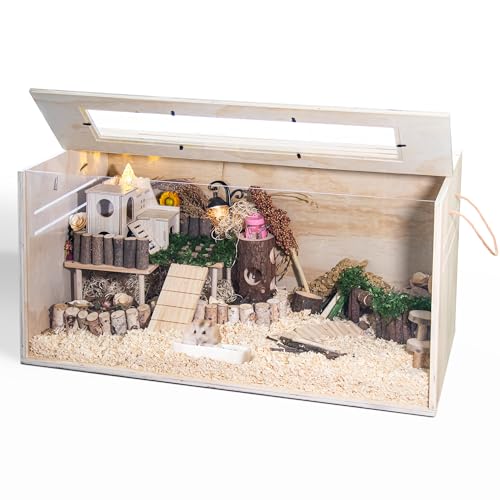
| Niteangel Bigger World | Deep-bedding setups and attractive interiors | Common versions around 120 × 60 × 60 cm | Large footprint, broad viewing area, strong bedding capacity | Heavier and usually more expensive than basic wire cages |
| Ferplast Favola | Compact rooms and first-time owners | About 60 × 40 × 30 cm | Easy-clean base and accessible design | Too small as a permanent choice for many hamsters; confirm the current model’s dimensions |
| Large 100–120 cm wire cage | Best value and maximum ventilation | At least 100 × 50 cm; preferably 120 × 50 cm or larger | Often affordable, light, and easy to modify | Needs a bedding guard and careful door security |
| Large glass or acrylic tank-style enclosure | Deep burrowing and low bar access | At least 100 × 50 cm, with 50–60 cm height | Supports 20–30 cm of bedding and resists bar chewing | Heavy; ventilation and lid design must be checked carefully |
What separates a good hamster cage from a merely large one?
Usable floor space comes first
Measure the uninterrupted interior floor, not the manufacturer’s outside dimensions and not the combined area of platforms, tubes, or upper levels. A practical minimum target is 100 × 50 cm, or 5,000 square centimetres, with 120 × 50 cm providing a more forgiving layout for a wheel, sand bath, hide, food area, and digging zones.
For example, a cage advertised as 100 × 50 cm may lose several centimetres to a thick plastic base, corner posts, or a raised shelf. If the actual floor is 96 × 46 cm, its usable area is 4,416 square centimetres—nearly 12% less than the headline measurement. Check internal dimensions where possible.
Bar spacing must match the hamster, not the label
For dwarf hamsters, choose bar spacing of approximately 7 mm or less. Around 9–10 mm may be suitable for a larger Syrian hamster, but measure the individual animal and inspect the door, corners, and base joins. A young, slim hamster can pass through gaps that appear safe for an adult.
Horizontal bars are useful for attaching accessories, but they also invite climbing and falls. A solid-sided enclosure removes that escape route, provided its lid has secure ventilation panels. Avoid wide mesh openings, flexible wire, or doors that can be pushed up from inside. Every latch should remain closed when the enclosure is lifted or gently shaken.
Ventilation is a design feature, not an afterthought
Wire cages ventilate naturally on all sides, although they can create drafts if placed beside a window, radiator, or air-conditioning outlet. Tank-style habitats need a large mesh lid with openings distributed across the top rather than a few small vents in one location. Solid plastic storage boxes with inadequate mesh are poor substitutes for a purpose-built enclosure.
Ventilation should not be confused with exposure. A cage can be well ventilated while still offering covered areas, opaque hides, and nesting material. Do not cover most of a mesh lid with fabric or bedding to make a tank quieter; this can restrict airflow.
Deep bedding changes the best cage design
Hamsters benefit from having enough bedding to tunnel and create stable chambers. A useful planning range is 20–30 cm over a substantial portion of the floor, while leaving the wheel and food areas level and stable. A shallow wire-cage base may hold only 8–12 cm before bedding spills through the bars.
For a 100 × 50 cm floor covered to an average depth of 20 cm, the theoretical volume is:
100 × 50 × 20 = 100,000 cubic centimetres, or 100 litres.
That does not mean 100 litres of bedding will be required: the wheel, hide, sand bath, and empty air space reduce the filled area, and bedding compresses. In practice, buying roughly 60–90 litres for an initial deep setup is more realistic for this footprint, depending on how much of the floor is raised and how frequently bedding is replaced.
Head-to-head: wire cage or tank-style enclosure?
Choose a wire cage for ventilation and convenience
A large wire cage is usually easier to carry, less expensive, and simpler to inspect. The removable base makes spot cleaning quick, and a wide front door can provide excellent access. Look for a base at least 15–20 cm deep or a compatible bedding guard. If the base is shallow, attach a secure barrier rather than piling bedding against the bars.
The trade-offs are scattered bedding, possible bar chewing, and more exposed surfaces to wipe. Doors are the most common weak point, especially on cages with sliding catches or spring clips. A small secondary clip can improve security, but it should not create a sharp edge or obstruct emergency access.
Choose a tank-style enclosure for digging and visibility
Glass and acrylic habitats contain bedding well and make it easier to build a deep, stable substrate. They also reduce bedding scatter and prevent bar chewing. A 100 × 50 cm tank with 50 cm of height can offer a more flexible interior than a smaller cage with several shelves.
Weight is the ownership issue many listings understate. A glass enclosure measuring 100 × 50 cm can weigh roughly 40–60 kg before bedding and accessories, depending on glass thickness and frame design. It may require two people to move and a properly supported stand. Acrylic is lighter but can scratch and may become cloudy if cleaned with abrasive products.
Wheel compatibility: measure before buying
| Hamster type | Typical minimum wheel diameter | Clearance to plan above the bedding | What to check |
|---|---|---|---|
| Dwarf hamster | About 20–25 cm | Wheel height plus 5–10 cm | Solid running surface and stable stand |
| Syrian hamster | About 28–32 cm | Wheel height plus 5–10 cm | Back remains level while running; opening is not cramped |
Measure the wheel’s outer diameter, not just the running surface. A 30 cm wheel placed on 20 cm of bedding may need at least 35–40 cm of vertical clearance. In a low cage, the wheel can force you to reduce bedding depth, making the advertised capacity misleading. A broad, solid wheel is preferable to a narrow mesh or rung wheel, which can catch toes or create an uneven running surface.
Decision matrix for choosing quickly
| Your situation | Best direction | Reason |
|---|---|---|
| Budget is limited | Large wire cage, ideally 100 × 50 cm or larger | More floor space per dollar and lower transport costs |
| You want 20–30 cm of bedding | Tank-style enclosure or wire cage with a deep, secure bedding guard | Prevents bedding from spilling and preserves digging depth |
| You clean frequently | Front-opening wire cage with a removable base | Quick access for spot cleaning and accessory removal |
| You are new to hamster care | Large cage with simple doors, solid floor, and few detachable parts | Fewer escape points and fewer components to assemble incorrectly |
| You have limited lifting strength | Large wire cage rather than a full glass enclosure | Much easier to move for cleaning or relocation |
Setup and maintenance mistakes that cost owners later
- Buying the wheel first: place the wheel, then calculate remaining bedding and floor space. A cage that fits an accessory physically may not leave a useful running and digging layout.
- Using shelves as a substitute for floor area: a platform can add enrichment, but it should not compensate for a narrow main floor.
- Filling too close to doors: deep bedding can create a launch ramp. Keep bedding below the door threshold or add a secure internal barrier.
- Cleaning everything too often: remove wet or soiled areas promptly, but preserve some clean nesting material during larger cleans. This reduces unnecessary disruption.
- Ignoring consumable parts: wheel bearings, plastic clips, wooden chews, and cardboard hides wear before the cage frame does. Budget for replacements rather than treating the enclosure as maintenance-free.
- Trusting a “hamster-proof” claim: inspect every gap after assembly, especially around doors, corners, bottle holders, and detachable tunnels.
Bottom line
Choose the largest practical continuous floor you can safely support, with 100 × 50 cm as a sensible starting point and 120 × 50 cm or larger preferred. Select a wire model such as the Savic Hamster Plaza when ventilation, access, portability, and value are priorities. Choose a large tank-style model such as the Niteangel Bigger World when deep bedding and containment matter more than weight. Whichever style you choose, verify internal dimensions, bar spacing, door security, bedding depth, and wheel clearance before purchase; those details determine whether a cage remains easy and safe to use after the first week.