Key takeaways
- Best all-around: An insulated, prehung steel door with a polyurethane-foam core, adjustable threshold, compression seals, and a whole-unit U-factor near or below 0.20 Btu/(h·ft²·°F), where available.
- Best for cold or windy exposures: A solid steel-faced insulated door with minimal glazing, a tight weather-seal system, and a threshold that can be adjusted after installation.
- Best for a darker entry: A door with a small insulated-glass lite, preferably low-emissivity (low-e) glass. Compare the whole-door rating, not just the glass specification.
- Best for a replacement on a budget: A standard-size prehung insulated door that fits the existing rough opening without major reframing. A well-installed midrange unit can outperform a premium door installed with air leaks.
Best Energy-Efficient Steel Front Entry Doors: Picks by Home and Priorities
The best energy-efficient steel front entry doors are insulated, well-sealed steel-and-foam units with a documented whole-door U-factor, a correctly sized frame, and installation that closes gaps around the opening. For most homes, choose an insulated, prehung steel door with compression weatherstripping; add glass only when daylight matters enough to accept more heat transfer and potential privacy trade-offs.
Quick picks by situation
- Best all-around: An insulated, prehung steel door with a polyurethane-foam core, adjustable threshold, compression seals, and a whole-unit U-factor near or below 0.20 Btu/(h·ft²·°F), where available.
- Best for cold or windy exposures: A solid steel-faced insulated door with minimal glazing, a tight weather-seal system, and a threshold that can be adjusted after installation.
- Best for a darker entry: A door with a small insulated-glass lite, preferably low-emissivity (low-e) glass. Compare the whole-door rating, not just the glass specification.
- Best for a replacement on a budget: A standard-size prehung insulated door that fits the existing rough opening without major reframing. A well-installed midrange unit can outperform a premium door installed with air leaks.
What to compare before you buy
| Feature | Useful comparison point | Why it matters |
|---|---|---|
| Whole-door U-factor | About 0.10–0.20 for many well-insulated configurations; lower means less heat transfer | Reflects heat flow through the complete tested door assembly, rather than the center panel alone |
| Core insulation | Polyurethane or polystyrene foam; ask for the model-specific assembly rating | Foam type and thickness affect insulation, but a core claim alone does not describe frame or edge losses |
| Common nominal slab sizes | 30, 32, or 36 in. wide; 80 in. high is common | Nominal slab dimensions are not rough-opening dimensions; confirm the manufacturer’s frame and opening requirements |
| Glazing | Clear or decorative insulated glass; low-e options may be available | Glass can reduce privacy and change thermal performance; compare whole-unit data for the exact configuration |
| Security hardware | Deadbolt with a long strike-plate fastener pattern into sound framing | A strong lock helps only if the jamb, fasteners, and surrounding structure can resist force |
| Installed cost | Roughly $500–$1,500 or more for a door and installation, depending on configuration and local labor | Reframing, sidelites, finish work, disposal, and hardware can add substantially to the total |
These are comparison ranges, not guarantees for every product. Ratings and availability vary by door size, glass, frame, and certification. Request documentation for the exact unit being quoted; a slab’s published value may not represent the complete prehung assembly.
Our top picks
 Modern Linear Horizon Black Front Entry Door
- Elevate your home’s entrance with our signature "Linear…
- Comes fully coated in a premium, factory-applied black…
- Equipped with premium horizontal frosted glass inserts that…
 36'' x 80'' Fiberglass Front Entry Door
- Energy Efficiency & Durable: Built with a polyurethane…
- Woodgrain Finished Surface: This exterior door offers a…
- Low-E + Tempered Glass: Dual-pane glass with Low-E…
 BGW Doors Matte Black Iron Double Front
- Square matte black iron double door: Right-hand inswing
- Durable 14-gauge steel construction: Built with polyurethane foam…
- Tempered E-glass panels: Double glazed, sealed, and weatherstripped…
| Product | Key specs | |
|---|---|---|
| Modern Linear Horizon Black Front Entry Door | Elevate your home’s entrance with our signature "Linear… Comes fully coated in a premium, factory-applied black… Equipped with premium horizontal frosted glass inserts that… | Check price |
| 36'' x 80'' Fiberglass Front Entry Door | Energy Efficiency & Durable: Built with a polyurethane… Woodgrain Finished Surface: This exterior door offers a… Low-E + Tempered Glass: Dual-pane glass with Low-E… | Check price |
| BGW Doors Matte Black Iron Double Front | Square matte black iron double door: Right-hand inswing Durable 14-gauge steel construction: Built with polyurethane foam… Tempered E-glass panels: Double glazed, sealed, and weatherstripped… | Check price |
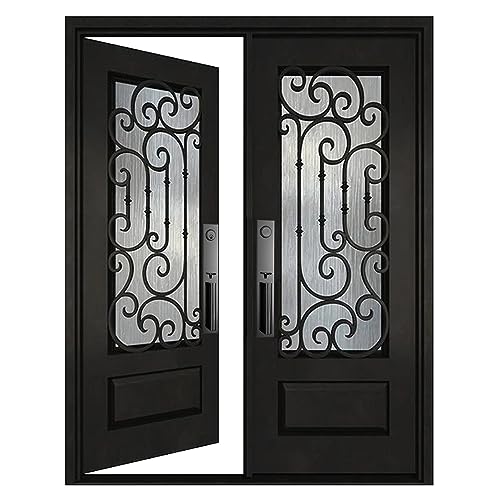 BGW Doors Matte Black Iron Double Front | Square matte black iron double door: Left-hand inswing Durable 14-gauge steel construction: Insulated frame and panel… Tempered E-glass panels: Double glazed, sealed, and weatherstripped… | Check price |
As an Amazon Associate we earn from qualifying purchases at no extra cost to you.
How insulation and weather seals work together
A steel skin does not make a door energy efficient by itself. The insulated core slows heat flow through the panel, while the frame, threshold, perimeter seals, and installation control losses around it. An impressive center-panel insulation claim is less useful if the bottom seal leaves a visible gap or the jamb is out of square.
Look for continuous compression weatherstripping around the head and sides, a replaceable bottom sweep or door shoe, and an adjustable threshold. Compression seals should contact evenly when the door closes—not require excessive force. For exposed entries, ask about the manufacturer’s recommended seal and threshold configuration for wind-driven rain and local weather conditions.
U-factor is the clearest thermal comparison when the same rating method and units are used: lower is better. ENERGY STAR requirements and applicable building codes can vary by climate zone and product category, so check current local requirements rather than assuming one number qualifies everywhere.
Solid panel or glass? Choose for the room, not the photo
A solid insulated door generally offers the simplest route to privacy and strong thermal performance. A glazed door brings daylight into an entry but adds another component whose rating depends on the glass and frame. If you want light, compare the U-factor for the complete door with the desired glass option included. Low-e insulated glass can help limit heat transfer, but it does not make every glazed configuration equivalent to a solid panel.
Also consider orientation. A west-facing entry may receive intense afternoon sun; an exposed porch may provide shade, while an unshaded glass lite can add glare and solar gain. Decorative glass can obscure views, but check the actual privacy level and whether the design makes glass replacement difficult.
Fit, swing, and installation: the details that protect performance
Measure the existing unit and rough opening before ordering. Record the slab width and height, jamb depth, hinge side, swing direction, and whether the threshold sits on a finished floor or subfloor. A common 36-by-80-inch slab does not mean the rough opening is 36 by 80 inches; the prehung frame needs additional clearance. Use the selected manufacturer’s opening chart, and have a qualified installer verify unusual or out-of-square openings.
- Confirm the jamb depth: It should suit the wall assembly and trim plan. A poor match can leave gaps or require extensive casing work.
- Check the sill and drainage: The threshold needs a stable, level base and a water-management detail appropriate to the entry. Sealant should not block designed drainage paths.
- Insulate the frame gap: The space between jamb and framing should be sealed with compatible low-expansion foam or another specified material. Excessive foam can bow the jamb and prevent latching.
- Test operation before finishing: The slab should swing freely, latch without lifting or slamming, and make even contact with the seals.
- Anchor into framing: Follow the installation instructions for fastener locations and shimming, especially behind hinges and the strike area.
For a rough-opening change, damaged sill, masonry opening, or door exposed to severe weather, installation is usually worth budgeting for separately. Ask whether the quote includes removal, flashing or sill preparation, insulation, trim, disposal, and adjustment after installation.
Security and ownership costs
Steel-faced doors are resistant to many everyday impacts, but “steel” alone is not a security rating. Check the full assembly: frame material, hinge attachment, strike reinforcement, lock compatibility, and any applicable testing or certification. Use a deadbolt and have its strike fasteners reach solid framing where the installation design permits. Glass near a lock may also affect how easily someone can reach the hardware, so consider glass placement and security glazing if that is a concern.
Over time, seals and bottom sweeps often need attention before the insulated core does. Inspect them seasonally for flattening, cracks, loose corners, or daylight at the threshold. Clean the painted surface with mild soap and water, and touch up scratches promptly according to the manufacturer’s instructions; exposed steel can rust if its protective finish is breached. Avoid abrasive cleaners and unapproved drilling or cutting, which can damage the coating or compromise the door.
Bottom line
For most buyers, the strongest balance is a prehung, foam-core steel door with a documented whole-unit U-factor, continuous compression seals, an adjustable threshold, and hardware anchored into sound framing. Choose a solid panel for maximum simplicity and privacy, or select a modest insulated-glass option when daylight is worth the added cost and thermal trade-off. Prioritize exact sizing and careful installation: those are what let the door’s insulation perform as intended.
More from Amazon
Programs that pair well with the guide above. Offers and eligibility are set by Amazon and may change.
Free shipping on eligible items, Prime Video and more. Eligible new members can start with a free trial.
Start a Prime free trialAudiobooks and podcasts to listen to on the go. Eligible new members can start with a free trial.
Try Audible freeAd-free music streaming. Eligible new subscribers can start with a free trial.
Try Music Unlimited freeA free business account with business pricing and bulk-buying tools for work, shop or home office.
Create a business accountAs an Amazon Associate we earn from qualifying purchases.