Key takeaways
- For most buyers, a model-specific Kydex IWB holster with adjustable cant, adjustable ride height, full trigger coverage, and a stable clip is the best first choice. Choose appendix IWB when its position fits your body and clothing; choose strong-side IWB for a familiar, versatile starting…
Best Concealed Carry Holsters: IWB, OWB & Appendix
The best concealed carry holsters are usually rigid Kydex for consistent retention and minimal bulk, leather for comfort and traditional styling, or hybrid designs when you want a softer body-facing surface with a rigid trigger-guard shell. Your ideal choice depends less on brand than on four measurable factors: trigger coverage, retention, ride height, and how the holster fits your body and carry position.
Quick picks by situation
| Situation | Best starting point | Why | Typical price range |
|---|---|---|---|
| First concealed-carry holster | Strong-side IWB Kydex | Simple draw direction, adjustable cant, rigid trigger coverage | $35–$100 |
| Maximum concealment under a fitted shirt | Appendix IWB Kydex | Places the grip near the centerline and often reduces printing | $45–$120 |
| Long hours of seated carry | Hybrid IWB or compact leather IWB | Distributes pressure across more surface area | $45–$140 |
| Heavy clothing or an untucked jacket | OWB pancake or belt-slide holster | Easy access and less waistband pressure | $40–$150 |
| Frequent training and repeated reholstering | Full Kydex with adjustable hardware | Resists moisture and keeps its shape after the pistol is drawn | $50–$150 |
| Lowest-cost setup | Basic molded Kydex IWB | Usually provides essential coverage without decorative extras | $25–$60 |
What to look for before comparing materials
Complete trigger-guard coverage
The holster should cover the trigger guard and prevent access to the trigger while the pistol is holstered. Avoid designs that leave part of the trigger exposed, collapse when empty, or rely on a loose fabric pouch to protect the trigger. The holster must fit the specific pistol model and any mounted optic, light, or aftermarket sight configuration.
Our top picks
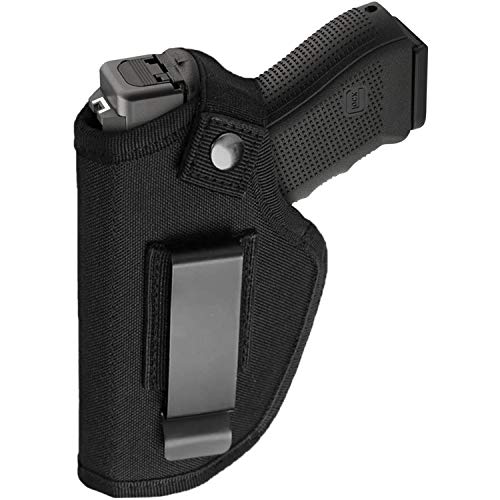


As an Amazon Associate we earn from qualifying purchases at no extra cost to you. Ratings are shown as listed on Amazon.
Retention you can verify
Passive retention normally comes from molded friction around the trigger guard or ejection-port area. A useful fit holds the unloaded pistol securely when the holster is turned upside down, but still allows a controlled draw without excessive force. Retention screws should have thread-locking protection intended for firearm hardware; check them regularly rather than assuming the factory setting will remain unchanged.
Ride height and cant
Ride height determines how much of the grip sits above the waistband. A deeper ride can conceal better but may make the grip harder to establish. Cant is the angle of the grip: a forward cant often helps strong-side IWB concealment, while a neutral angle is common for appendix carry. Look for adjustment slots that provide roughly 10–20 degrees of cant and at least 10–20 mm of vertical movement.
Belt attachment and stability
A holster can be well molded and still fail if its clip shifts during normal movement. For IWB carry, a sturdy metal clip or well-designed polymer clip should fit the actual belt or waistband thickness. For OWB carry, two attachment points or a close-fitting pancake shape generally reduce rocking. A purpose-built gun belt is not mandatory, but a soft, flexible belt makes concealment and consistent positioning more difficult.
Kydex, leather, or hybrid: the head-to-head
| Feature | Kydex | Leather | Hybrid |
|---|---|---|---|
| Typical thickness | 1.5–2.5 mm shell | 2.5–4 mm, often layered | 1.5–2.5 mm shell plus 1.5–3 mm backing |
| Typical weight for compact-pistol IWB | 50–100 g | 90–180 g | 100–200 g |
| Retention consistency | High when correctly molded | Changes as leather stretches and softens | High at the shell; backing can flex |
| Reholstering with pistol removed | Usually easy because shell remains open | May collapse, especially when worn | Usually easy if the shell is fully rigid |
| Moisture resistance | High, though hardware can corrode | Low to moderate without care | Moderate; backing needs drying |
| Common weakness | Hard edges, noise, possible cracking after abuse | Stretching, sweat damage, collapse | More bulk and more parts to inspect |
Kydex: best for predictable performance
Kydex is a molded thermoplastic that keeps its shape after the firearm is drawn. That makes it a strong choice for frequent practice, warm climates, and anyone who wants repeatable retention. Its disadvantages are edge pressure and noise: an unfinished edge can rub the skin, and a hard shell can expose printing if the design has too much material or the clip sits too high.
Leather: best when comfort and appearance lead
Leather can feel less abrasive against the body and often blends naturally with traditional clothing. It requires more maintenance, however. Sweat and body oils can soften the leather, change retention, and eventually cause the mouth of the holster to collapse. Never treat a softening leather holster as a harmless cosmetic issue; if it no longer securely covers and retains the firearm, replace it.
Hybrid: best compromise for extended wear
A hybrid holster combines a rigid molded shell with a broad leather or synthetic backing. The backing spreads pressure over a larger area, which can help with compact pistols carried for many hours. The trade-off is extra width and additional fasteners. Inspect the shell-to-backing connection, especially after repeated adjustments or exposure to sweat.
How carry position changes concealment
Appendix IWB
Appendix carry places the holster near the front of the waistband. It often conceals well for people with a relatively flat lower abdomen and can work under shorter garments because the grip stays close to the torso. A wedge or claw may rotate the grip inward, but these features add bulk and should be selected only if they solve a specific printing problem. Seated comfort varies widely with body shape, vehicle seats, and belt tension.
Strong-side IWB
Usually positioned around the 3 to 4 o’clock area, strong-side IWB is a practical starting point for many new carriers. A modest forward cant can align the grip with the waist and reduce printing. People with more room at the hips may find this position comfortable, while those with a pronounced waistline may experience pressure when sitting.
OWB
OWB generally offers the easiest access and least waistband pressure, but it needs more covering clothing. A compact OWB pancake holster can disappear beneath an untucked overshirt or jacket, especially when carried behind the hip. It is usually a poor match for tight shirts, short garments, or environments where the holster could be exposed.
Small-of-back and off-body options
Small-of-back carry can be uncomfortable and creates poor control of the firearm during a fall. Off-body bags introduce another risk: the firearm may be inaccessible, mixed with unsecured objects, or accessible to someone else. If used where lawful, a dedicated compartment with a fully covering holster is safer than placing a loose firearm in a general bag.
A practical fitting and adjustment process
-
Confirm compatibility. Match the exact pistol model, barrel length, optic, light, and safety configuration. A holster made for a similar-looking model is not necessarily safe.
-
Inspect unloaded. Verify the firearm is unloaded according to its manual, then check that the trigger is completely covered and that no control is being forced by the shell.
-
Set a middle position. Begin with neutral cant and medium ride height. This gives you a useful baseline before changing multiple variables at once.
-
Test under normal clothing. Use the belt, trousers, and shirt you actually wear. Check concealment while standing, sitting, bending, and reaching, without placing a loaded firearm in the holster during initial fitting.
-
Adjust one variable at a time. Lower the ride height if the grip prints; add modest forward cant if the grip angles outward; change position if the muzzle or shell creates painful pressure.
-
Recheck retention and fasteners. After adjustment, confirm the pistol seats fully and that every screw remains tight. Do not remove trigger coverage to gain comfort.
Ownership realities and common mistakes
Most holster problems appear at the contact points: clips loosen, screws back out, leather stretches, polymer edges become uncomfortable, and sweat accumulates around hardware. Wipe Kydex and polymer with a lightly damp cloth, dry them fully, and inspect for cracks or sharp edges. Let leather air-dry away from direct heat, and follow the maker’s leather-care guidance. Avoid soaking any holster or applying oils inside it, where residue can attract grit and affect retention.
Budget for a replacement belt clip, hardware, or spare holster over time. A $60 holster used 300 days per year for two years costs about 10 cents per wearing, but that calculation is meaningless if the fit is unsafe or the holster becomes uncomfortable enough to leave at home. Consistent use depends on secure coverage, stable positioning, and comfort that survives a full day.
Common mistakes include choosing a universal pouch, carrying a pistol with an incompatible light or optic, over-tightening retention until the draw becomes erratic, and using a flimsy belt with a heavy firearm. Before carrying, learn the laws where you are, follow the firearm and holster manuals, and seek qualified in-person instruction for safe handling, drawing, and reholstering.
Bottom line
For most buyers, a model-specific Kydex IWB holster with adjustable cant, adjustable ride height, full trigger coverage, and a stable clip is the best first choice. Choose appendix IWB when its position fits your body and clothing; choose strong-side IWB for a familiar, versatile starting point; choose OWB when covering garments permit it; and choose leather or hybrid construction when comfort and body contact matter more than minimum bulk. The right holster is the one that remains secure, conceals under your real wardrobe, and lets you handle the firearm safely every time.