Key takeaways
- Best overall for large residential yards: EGO Power+ 56V models with a 15- or 16-inch cutting swath.
- Best for maximum cutting width: Greenworks Pro 60V models with a 16- or 17-inch swath.
- Best for heavy weeds and shared batteries: DeWalt 60V FLEXVOLT or Milwaukee M18 FUEL.
- Best for smaller yards: A 40V trimmer with a 2.0Ah or 2.5Ah battery, provided the grass is maintained regularly.
- Best value when you already own batteries: A bare tool from the same battery platform, even if its specifications are not class-leading.
The best battery string trimmers that rival gas are the EGO Power+ 56V, Greenworks 60V, DeWalt 60V FLEXVOLT, and Milwaukee M18 FUEL models: they deliver roughly 25–60 minutes of practical cutting per charge, 15–17-inch swaths, and far less vibration and maintenance than a gas trimmer.
Voltage alone does not determine whether a cordless trimmer will finish your yard. The useful questions are how much grass the battery can cut, whether the trimmer remains balanced with its battery installed, and whether the cutting width matches the work. A high-voltage machine with a small battery may run for less time than a lower-voltage model with greater watt-hours.
Our top picks


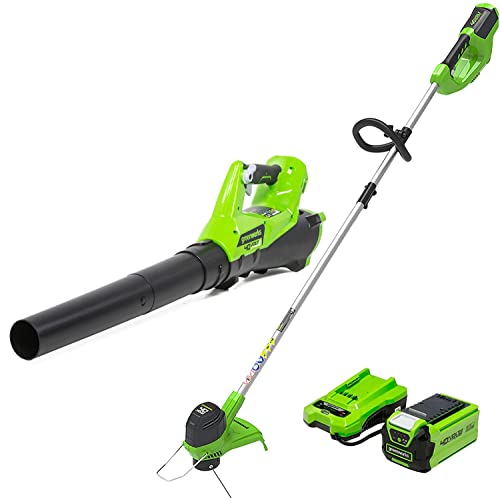

As an Amazon Associate we earn from qualifying purchases at no extra cost to you. Ratings are shown as listed on Amazon.
Best battery string trimmers by situation
- Best overall for large residential yards: EGO Power+ 56V models with a 15- or 16-inch cutting swath.
- Best for maximum cutting width: Greenworks Pro 60V models with a 16- or 17-inch swath.
- Best for heavy weeds and shared batteries: DeWalt 60V FLEXVOLT or Milwaukee M18 FUEL.
- Best for smaller yards: A 40V trimmer with a 2.0Ah or 2.5Ah battery, provided the grass is maintained regularly.
- Best value when you already own batteries: A bare tool from the same battery platform, even if its specifications are not class-leading.
Head-to-head comparison
The figures below represent common specifications for current tool-and-battery kits in these product families. Exact equipment, battery size, and included harnesses vary by package, so check the particular kit before purchasing.
| Product family | Battery system | Typical swath | Approx. bare-tool weight | Typical runtime with supplied battery | Best fit |
|---|---|---|---|---|---|
| EGO Power+ ST series | 56V, commonly 2.5Ah | 15–16 in. | 8.5–10.5 lb | 35–55 minutes | Large lawns and thick edging |
| Greenworks Pro 60V | 60V, commonly 2.5Ah | 16–17 in. | 8–11 lb | 30–50 minutes | Wide coverage and tall grass |
| DeWalt 60V FLEXVOLT | 60V, commonly 3.0Ah | 15 in. | 8–10 lb | 35–60 minutes | Heavy-duty work and tool sharing |
| Milwaukee M18 FUEL | 18V, commonly 8.0Ah or 12.0Ah | 14–16 in. | 9–12 lb | 25–45 minutes | Users already invested in M18 |
| Typical 40V brushless trimmer | 40V, commonly 2.0–2.5Ah | 13–15 in. | 7–10 lb | 20–40 minutes | Small and medium maintained yards |
Runtime depends on grass height, line diameter, cutting width, temperature, and how often the trigger is released. These are practical ranges rather than guaranteed times. Continuous full-power cutting in dense weeds can reduce them substantially.
Does higher voltage really mean more runtime?
Voltage is only half of the energy calculation. Battery capacity in watt-hours is found by multiplying nominal voltage by amp-hours. For example:
56V × 2.5Ah = approximately 140Wh
A 40V battery rated at 4.0Ah contains approximately 160Wh, so it can hold more energy than a 56V battery rated at 2.5Ah despite the lower voltage. The 56V system may deliver more peak power, while the 40V pack may run longer under the same workload.
As a useful planning estimate, a cordless trimmer may consume approximately 250–450 watts while cutting continuously, depending on load. A 140Wh battery therefore suggests about 19–34 minutes of uninterrupted heavy cutting after allowing for conversion losses and battery protection. Real yard work often lasts longer because you pause, walk between areas, and use lower power in thin grass.
How much yard can one charge cover?
Suppose a trimmer has a 15-inch swath and maintains an average working speed of 2.5 miles per hour. The theoretical coverage is:
1.25 feet × 220 feet per minute = about 275 square feet per minute
Allowing for overlap, obstacles, turning, and pauses, use approximately 180–220 square feet per minute as a realistic planning figure. A 35-minute working runtime could therefore cover roughly 6,300–7,700 square feet of open growth. Trimming around trees, fences, beds, and foundations may reduce that area considerably.
This is why a 15-inch trimmer is often enough for a typical suburban property even when a 17-inch model appears more productive on paper. The wider head covers more ground, but it also places more load on the motor and can drain the battery faster in thick growth.
Weight balance matters more than bare weight
A trimmer listed at 9 pounds can feel heavier than an 11-pound model if its battery sits far behind the handle or the motor makes the cutting head front-heavy. Look for an adjustable auxiliary handle, a rigid shaft, and a shoulder-strap attachment when available.
- Battery near the rear: usually improves balance but can make the rear of the tool bulky.
- Motor at the cutting head: can simplify the drive system but adds weight where your arms feel it most.
- Split shafts: are easier to transport but may introduce a joint that needs careful tightening.
- Carbon-fiber shafts: reduce weight on some premium models but cost more to replace.
- Metal gearboxes: are desirable for repeated heavy work, although the line head and bump knob usually wear first.
For occasional edging, a lighter 40V machine may be more comfortable. For long sessions, balance and a harness can matter more than a one-pound difference in the specification sheet.
Cutting swath, line size, and real cutting power
A 16- or 17-inch swath is useful for open areas, but a narrower setting is easier to control around shrubs and fences. Some models allow the guard or line length to limit the effective swath; do not remove the guard to gain extra width, because it protects the operator and helps control thrown debris.
Line diameter is another practical dividing line. Light-duty trimmers commonly use approximately 0.065- to 0.080-inch line. Brushless 40V–60V machines often support 0.095- or 0.105-inch line, which lasts longer in rough vegetation but requires more motor power. Thick line does not make a small trimmer heavy-duty; it can instead overload the motor and reduce runtime.
Decision matrix
| Your situation | Recommended specification | Why |
|---|---|---|
| Small yard, weekly maintenance | 25V–40V, 13–15 in., 2.0–2.5Ah | Lower purchase cost and easier handling are more valuable than maximum power. |
| Medium yard, mixed grass and edging | 40V–56V, brushless motor, 14–16 in. | Provides reserve power without the weight and cost of the largest systems. |
| Large yard or infrequent mowing | 56V–60V, 15–17 in., 2.5Ah or larger | Higher output helps with overgrown grass; a spare battery prevents interruptions. |
| Dense weeds and rough property edges | 60V class, 0.095-inch line support, metal drive components | Designed for sustained load and thicker line. |
| Existing cordless tool collection | Matching bare tool platform | Battery compatibility can save more than a small difference in motor performance. |
Ownership costs and maintenance
Battery trimmers cost more initially than basic gas models, but they eliminate fuel mixing, carburetor cleaning, spark-plug replacement, and winter fuel storage. Typical market pricing is approximately $150–$250 for a basic battery kit, $250–$450 for a stronger 40V–60V kit, and $450 or more for premium commercial-oriented packages. Bare tools are usually less expensive when you already own the correct battery.
Line is the main consumable. Depending on diameter and material, a replacement spool or bulk line commonly costs roughly $10–$30. Bump knobs, spool housings, guards, and cutting blades on compatible models can also wear from contact with concrete and stone.
After each use
- Remove the battery before clearing the head or inspecting the shaft.
- Brush away grass packed around the spool, guard, and cooling openings.
- Check for cracks in the guard and damage to the bump knob.
- Wipe the battery contacts dry; do not spray water into the battery or motor housing.
- Store the battery cool and dry, ideally partially charged rather than fully depleted.
The most common mistakes are using line that is too thick, repeatedly striking concrete, storing a battery in a hot shed, and expecting the advertised runtime while cutting dense wet weeds at maximum width. Keeping the head clean and matching line size to the manual generally improves both runtime and service life.
Final recommendation
Choose the EGO Power+ 56V or Greenworks Pro 60V class if your priority is broad coverage and strong performance on a larger residential property. Choose DeWalt 60V FLEXVOLT or Milwaukee M18 FUEL when battery-platform compatibility and heavy-duty work matter most. For a smaller, regularly maintained yard, a lighter 40V brushless trimmer is usually the smarter purchase. Compare watt-hours, not voltage alone, then verify the supplied battery, actual tool weight, line diameter, and replacement-head availability before deciding.