Key takeaways
- Five monopods for orpine photography on walls and rocky ledges, with honest trade-offs, safe working loads, and careful field tips for edge shooting.
Orpine grows where a tripod cannot go. It roots in the cracks of old stone walls, on rocky ledges, and along the dry edges of tracks where the ground drops away below your feet. The plant is tall for a stonecrop, with thick fleshy leaves and broad pink flower heads, and it rewards a photographer who works slowly, from the edge. A monopod fits that kind of session, giving you one point of contact with the ground and a steadier hand for a long lens. It is not a tripod, and it will never hold your camera still on its own.
As an Amazon Associate, we earn from qualifying purchases.
What Orpine Is and Where It Grows
Orpine, Hylotelephium telephium, belongs to the Crassulaceae family, the stonecrop family. It is a perennial of walls, rocky ledges, hedgebanks, and dry grassland edges, at its best in late summer, when its flat heads of pink flowers open above fleshy leaves. The plant can reach knee height, which is tall for its family, and its thick leaves store water through dry spells. Look for it on the sunny side of old walls and on limestone ledges.
The best way to photograph orpine is to work from the path. Stay on the walkway, keep your feet clear of the wall base, and shoot across the colony rather than into it. A long lens lets you fill the frame with a flower head while your body stays a metre or two back. Do not pick the plant, and do not lean on the wall. Old walls are fragile, and a single boot on a loose coping stone can do damage that lasts for years.
Orpine Is Not Biting-Stonecrop
Orpine is often confused with biting-stonecrop. Biting-stonecrop, Sedum acre, belongs to the same family, Crassulaceae, but it is a different genus, Sedum rather than Hylotelephium. Biting-stonecrop is a low mat-forming plant that hugs the ground, with tiny fleshy leaves and small yellow five-petalled flowers that open in early summer. Orpine is much taller, with broad fleshy leaves on upright stems and flat heads of pink flowers that open weeks later. The difference in height alone is usually enough: if the plant reaches knee height and carries pink flower heads, it is orpine; if it forms a yellow carpet a few centimetres high, it is biting-stonecrop.
The two plants also grow in different places. Biting-stonecrop favours bare ground, gravel, and the tops of walls, where it can spread as a mat. Orpine favours the cracks and ledges of walls and rocky banks. Photographing orpine means working at the edge of a wall or ledge, often with a drop below, while biting-stonecrop is usually shot from directly above on flat ground.
A Monopod at the Edge: An Honest Assessment
Let us be plain about what a monopod can and cannot do for orpine photography. A monopod steadies a long lens and takes its weight off your arms, which helps when you are waiting for wind to drop. It lets you pivot smoothly to follow a flower head, and it folds away quickly when you need to move along the wall. What it cannot do is hold your camera still by itself. A monopod has one leg, and that leg needs your hand on it at all times. If you let go, the camera falls. A monopod is not a tripod replacement.
The use case for orpine is honest but weak, and it is worth saying so clearly. Orpine grows on walls and ledges where a tripod would block the walkway, and a monopod lets you work in that narrow space without spreading three legs across the path. But the plant itself is not hard to photograph handheld with a short lens, and a monopod only earns its place with a long lens, in low light, or during a long wait. If you do not already own a monopod, do not buy one only for orpine. Borrow one, or shoot handheld, and spend your money on a close-focusing lens instead.
What to Look for in a Monopod for Orpine
Height matters first. Orpine flower heads sit anywhere from ankle height to knee height on a wall, so you need a monopod that can work low as well as tall. A monopod that collapses short lets you brace it against your boot for a low shot, while one that extends to eye level lets you shoot a tall stem without crouching.
Weight and load capacity come next. A carbon fibre monopod is lighter to carry on a long walk, but an aluminium monopod is often cheaper and just as strong for a modest camera and lens. Match the load capacity to your heaviest combination, and remember that the safe working load is the number to trust, not the headline figure on a shop listing.
Locks, feet, and heads are the details that decide whether a monopod is pleasant to use. Flip locks are fast and easy to operate with cold hands, while twist locks are quieter. A spiked foot grips soft ground at the base of a wall, while a rubber foot is safer on stone and paving. None of the monopods below include a proper head, so budget for a small ball head or a tilt head.
1. Sirui P-326 Carbon Fiber Monopod
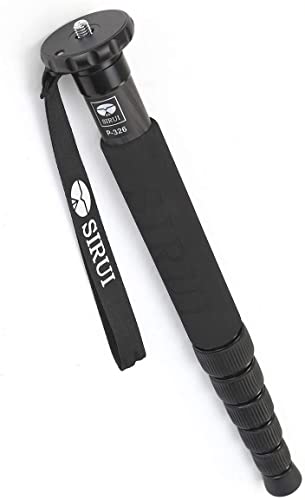
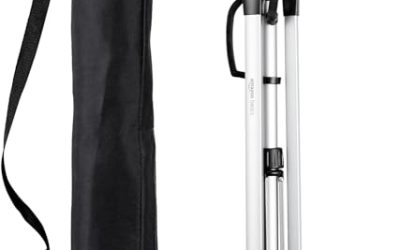
The Sirui P-326 is the lightest monopod in this guide, and the easiest to carry on a long walk to an orpine wall. It is built from carbon fibre in six sections, not eight, folds down to 15 inches, and weighs about 400 g. At full extension it reaches 60.6 inches, and the reversible mounting screw takes either a 1/4 inch or a 3/8 inch head, so most small ball heads fit without an adapter.
The trade-off is stability at full extension: six thin sections can flex a little with a heavy lens. It is at its best at three-quarter extension with a mirrorless body and a medium lens. It has no head included, and the twist locks can be slow with cold hands.
Specs
- Carbon fibre, 6 sections, 15 in folded, 60.6 in max height, about 400 g, 22 lb load recommendation, reversible 1/4 in and 3/8 in mounting screw, wrist strap included, no head included.
2. Manfrotto XPRO Carbon Monopod

The Manfrotto XPRO Carbon Monopod, model MPMXPROC4US, is the most rigid monopod in this guide, and the best choice if you shoot with a heavy lens. It is built from carbon fibre in four sections, so each section is thicker and stiffer than the thin sections of a six-section monopod. It extends to 64.76 inches, folds to 20.47 inches, weighs 1.3 lb, and its load capacity is 20 kg.
The trade-off is bulk and cost: four thick sections fold longer, and this is the most expensive monopod in this guide. It is carbon fibre, not the aluminium MVMXPRO500, so do not confuse the two models when you order. It has no head and no footed base, and it is more monopod than orpine photography strictly requires.
Specs
- Carbon fibre, 4 sections, model MPMXPROC4US, 20.47 in folded, 64.76 in max height, 1.3 lb, 20 kg load capacity, D-shaped tube profile, 1/4 in and 3/8 in mounting, no head included.
3. JOBY GorillaPod 3K PRO Stand

The JOBY GorillaPod 3K PRO Stand is the odd one out in this guide, because it is not a monopod in the usual sense. It is a flexible-legged stand with more than two dozen machined aluminium ball-and-socket joints, and it holds up to 3 kg of camera gear. It stands about 9.25 inches tall, weighs 9.6 ounces, and its legs can wrap around a branch, grip a fence rail, or splay flat on a wall top. For orpine, that flexibility is useful: you can set the stand on a flat coping stone and aim down at a flower head.
The trade-off is height: at 9.25 inches tall it cannot reach eye level, and it is useless for a tall orpine stem unless you can set it on a raised surface. It is limited to 3 kg, and it has no head included, so you need the BallHead 3K PRO or a similar small head. The joints are stiff when new, and the stand can tip if the legs are not set evenly.
Specs
- Anodized aluminium, flexible ball-and-socket legs, 9.25 in tall, 9.6 oz, 3 kg load capacity, model JB01569-BWW, 1/4 in mounting, no head included, legs grip and wrap.
4. Manfrotto 290 Carbon Monopod

The Manfrotto 290 Carbon Monopod, model MM290C4US, is the most balanced monopod in this guide, and the one we would pick for most orpine photographers. It is built from carbon fibre in four sections, extends to 59.4 inches, folds to 19.29 inches, and weighs 1.1 lb. Its safe working load is 5 kg according to the datasheet, which is the number to trust, not the 22 lb figure shown on some shop listings. That 5 kg is enough for a mirrorless body and a medium telephoto lens with room to spare.
The trade-off is that 5 kg is a modest limit, and a heavy professional body with a long prime lens will exceed it. It is shorter than the XPRO at full extension, and it has no head included. None of those limits matter much for orpine, where the camera is usually a mirrorless body with a modest lens.
Specs
- Carbon fibre, 4 sections, model MM290C4US, 19.29 in folded, 59.4 in max height, 1.1 lb, 5 kg safe working load from the datasheet, flip locks, rubber grip, wrist strap, 1/4 in and 3/8 in mounting, no head included.
5. NEEWER T222 Monopod
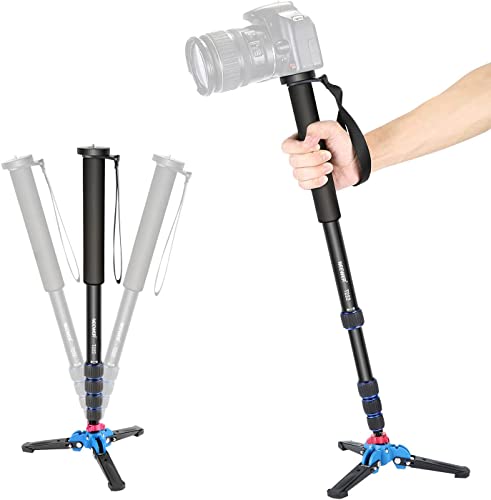
The NEEWER T222 is the most versatile monopod in this guide, because it comes with a detachable folding stand base that turns it into a small tripod for short exposures. The monopod itself is aluminium alloy in five sections, extends to 66 inches, not 62 inches, folds to 20.5 inches, and weighs 1.3 lb. Its maximum load is 5 kg, which suits a mirrorless body and a medium lens. The stand base has three folding feet, allows 360-degree panning, and tilts 15 degrees, so you can set the monopod down on a flat wall top and let go for a moment.
The trade-off is that the stand base adds weight and bulk, and aluminium is colder to hold on a cool morning than carbon fibre. The twist locks are slower than the flip locks on the Manfrotto 290. The stand base is only stable on a flat, level surface, so it is no help on uneven ground, and you should never trust it on a slope or in wind.
Specs
- Aluminium alloy, 5 sections, model T222, 20.5 in folded, 66 in max height, 1.3 lb, 5 kg maximum load, detachable folding stand base with 360-degree pan and 15-degree tilt, 1/4 in mounting screw, wrist strap and spike foot included, no head included.
Frequently Asked Questions
Is a monopod enough for orpine photography?
A monopod is enough for the kind of orpine photography most people do, which is a short session at the edge of a wall with a medium lens. It steadies the lens and takes its weight, which helps in low light and in wind. But a monopod cannot hold your camera still on its own, so it is not enough for very long exposures, and it is not a tripod replacement.
How do I tell orpine from biting-stonecrop?
Look at height and flower colour. Orpine is a tall plant with upright stems, broad fleshy leaves, and flat heads of pink flowers that open in late summer. Biting-stonecrop is a low mat with tiny fleshy leaves and small yellow five-petalled flowers that open in early summer. If the plant reaches your knee and carries pink flower heads, it is orpine. If it forms a yellow carpet a few centimetres high, it is biting-stonecrop.
Can I use the NEEWER T222 stand base on a wall top?
Yes, if the wall top is flat, level, and wide enough for the three folding feet, and if the wind is calm. The base allows 360-degree panning and a 15-degree tilt, so you can aim the camera while the monopod stands on its own for a moment. Never trust the base on a slope, on uneven stone, or in wind, and never walk away from a camera standing on a wall top. Keep a hand near the camera at all times.
Should I buy a monopod only for orpine?
No. Orpine is not hard to photograph handheld with a short lens, and a monopod only earns its place when you use a long lens, shoot in low light, or wait a long time for the right moment. If you do not already own a monopod, borrow one first, or shoot handheld, and spend your money on a lens that focuses close enough for flower work. A monopod is a useful tool for many kinds of photography, but orpine alone is not a good reason to buy one.
More from Amazon
Programs that pair well with the guide above. Offers and eligibility are set by Amazon and may change.
Free shipping on eligible items, Prime Video and more. Eligible new members can start with a free trial.
Start a Prime free trialAudiobooks and podcasts to listen to on the go. Eligible new members can start with a free trial.
Try Audible freeAd-free music streaming. Eligible new subscribers can start with a free trial.
Try Music Unlimited freeA free business account with business pricing and bulk-buying tools for work, shop or home office.
Create a business accountAs an Amazon Associate we earn from qualifying purchases.